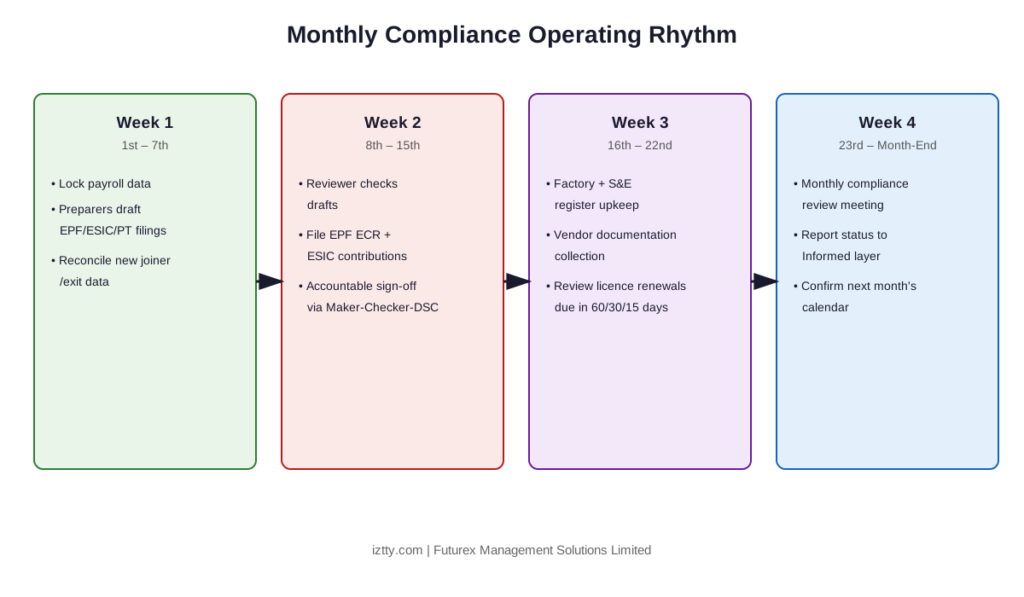
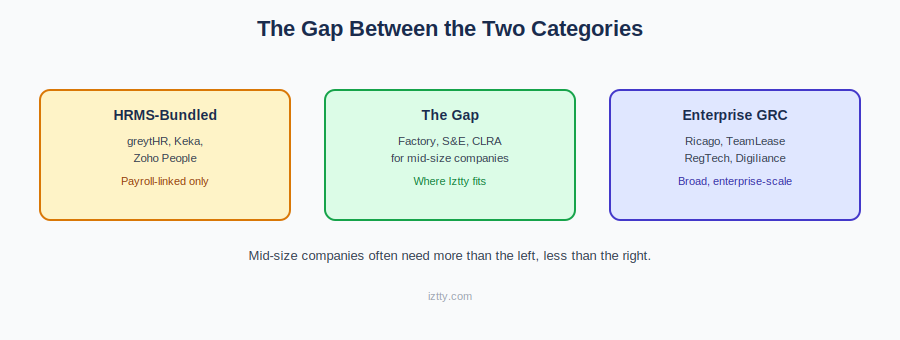
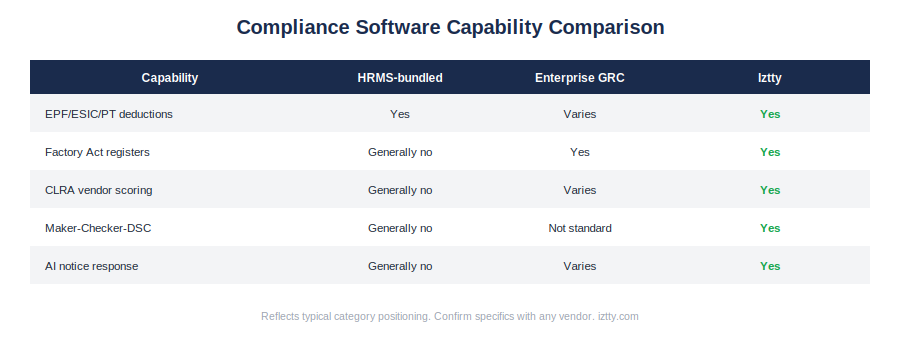
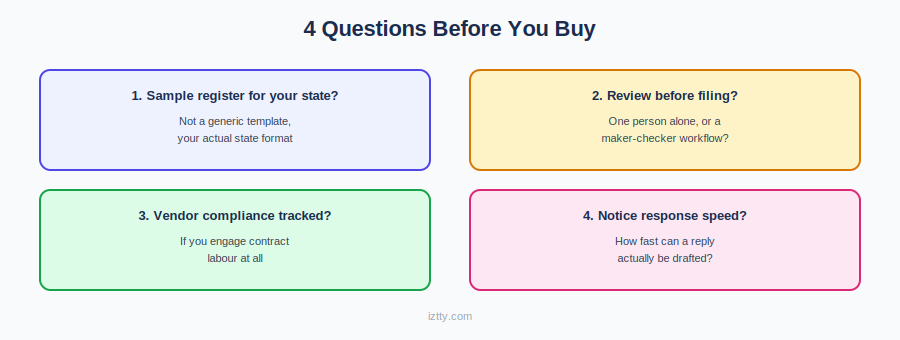
Compliance Software Pricing in India: Pricing Models, Hidden Costs and Total Cost of Ownership

You search for “compliance software pricing”, open six vendor sites, and find three things. A “request a quote” button. A per-employee rate for a payroll product that is not quite what you asked about. And a listicle that ranks tools without a single rupee figure. If that was your morning, you are not missing something obvious. The category simply does not publish prices the way a stationery shop does.

There is a reason, and it is useful to you. In compliance software, the price is not a number. It is a formula, and the formula multiplies things only you know: your states, your locations, your Acts, your contractors. Once you understand the formula, you can read any quote, predict how it will behave when you grow, and build a three-year total cost of ownership. This guide shows how. We have not invented price lists. We have shown the arithmetic.

Want a quote built on your own states, sites and contractors? Our compliance practice will itemise it with you. GET A FREE COMPLIANCE AUDIT

Why the Price Is a Formula, Not a Number

Compliance software pricing in India depends on how much compliance work the software has to carry. Two companies with the same headcount can need very different amounts of it. A 500-person employer with one plant in one state and a single contractor has a handful of registers and one Professional Tax regime. A 500-person employer with 30 branches across nine states and 120 contract workers has nine rule sets, a renewal calendar per branch and monthly proof from every contractor.

Vendors price against that load, in different ways, which is why quotes do not line up. If you want a quick view of the types of product behind those quotes, read our guide to compliance software types, costs and ROI. This article goes deeper on one thing only: how the money is structured.

A short note on what we checked. A quick search of Indian HRMS and payroll vendors shows that many publish per-employee plans. We did not find published prices for specialist labour compliance platforms in the same quick check, and it was not an exhaustive review. Verify current pricing pages yourself before relying on any comparison.

Eight Pricing Models and What Each One Multiplies
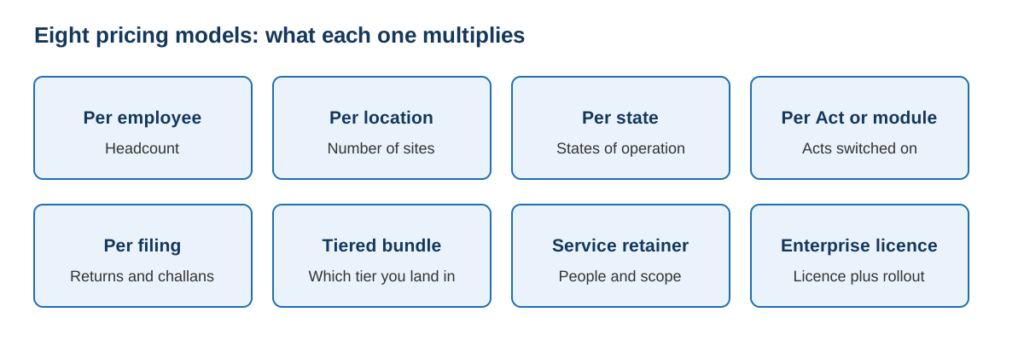
ModelWhat it multipliesLooks cheap whenGets expensive when
Per employee per monthHeadcountFew people, many sitesHeadcount grows or swings seasonally
Per location or establishmentNumber of sitesFew large sitesMany small stores or branches
Per stateStates of operationSingle-state employerYou expand across states
Per Act or moduleActs switched onYou only need EPF and ESICYou add Professional Tax, LWF, S&E, CLRA
Per filing or transactionReturns and challansFew filingsMany entities, frequent filings
Tiered bundleWhich tier you land inYou fit a tier neatlyYou sit just above a tier boundary
Service retainerPeople and scopeYou have no in-house teamScope creeps beyond the retainer
Enterprise licence plus implementationLicence, rollout and customisationYou are a large groupYou need only a fraction of the suite

Many real quotes blend two or three of these: a platform fee, plus a charge per location, plus state add-ons. Treat each blended element as its own multiplier and ask what it multiplies.

One more warning on the bottom row. Enterprise suites often bundle financial, tax and data privacy compliance with employment compliance. If your need is labour law alone, you may pay for breadth you will not use. Our guide to regulatory software solutions explains the different lanes.

How Each Model Reacts When You Grow
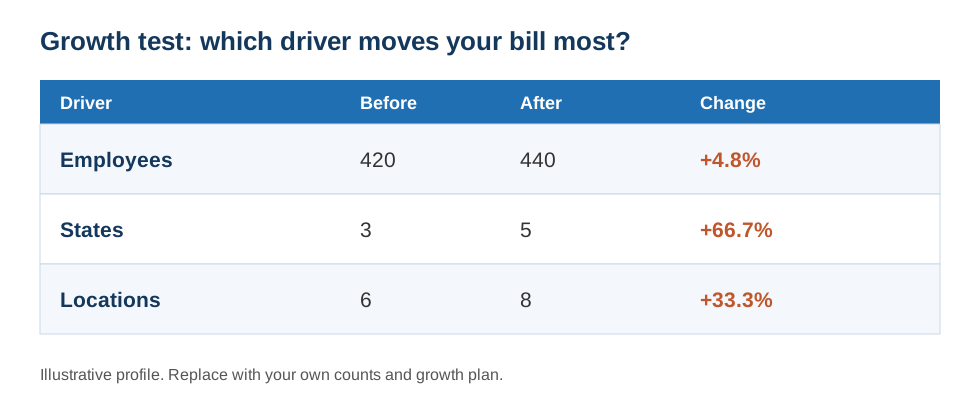
Here is a test that costs nothing. Take a standard profile: 420 employees, 3 states, 6 locations. Now imagine a year of growth: 20 more employees, 2 more states and 2 more locations. That gives 440 employees, 5 states and 8 locations. What happens to a bill that scales with each driver?

If the price scales withBeforeAfterChange in that part of the bill
Employees420440About 4.8% higher
States35About 66.7% higher
Locations68About 33.3% higher

Same company, same year, three very different outcomes. If your growth plan is hiring, a per-employee model grows gently. If your plan is new states, a per-state model punishes it. So the right question is not “which is cheapest today?” It is “which driver will grow fastest in our plan?” Then pick the model that scales with something else, or negotiate a cap.

Reading a Quote Line by Line

Take any quote and run each line through three questions: what does it multiply, what is included, and what happens at renewal?

  • Platform or licence fee: What does it cover, and is any usage limit hidden inside, such as users, locations or filings?
  • Implementation or onboarding: Is it one-time? Does it include data migration, or only setup?
  • State or location add-ons: How many are included in the base? What is the price of the next one?
  • Users and roles: Makers, Checkers and DSC holders are different people. Are they all priced as users?
  • Integrations: Is the connection to your payroll or accounting system included, or a separate project?
  • Digital Signature Certificates: Where signing is part of the workflow, DSCs are issued by licensed Certifying Authorities (see the Controller of Certifying Authorities), have a validity period and need renewal. Ask whether they are in the quote or yours to buy.
  • Services: Notice drafting, filing support and advisory hours: included, capped or chargeable by the hour?
  • Taxes: Does the figure include GST? Check the applicable rate and treatment on the CBIC GST site or with your tax adviser.
  • Renewal: What is the price after year one, and is there a cap on the uplift?

If the vendor cannot answer any of these in writing, the quote is not finished.

Building a Three-Year Total Cost of Ownership
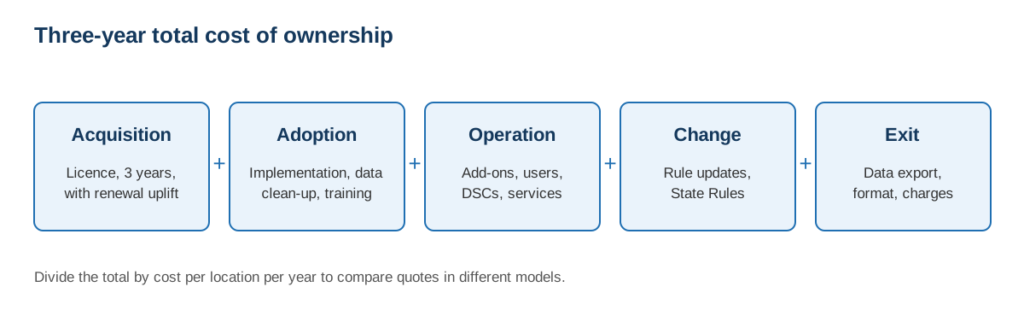
Total cost of ownership, or TCO, is everything you spend over a fixed period to own and run the tool. A workable formula for a three-year window is:

TCO = acquisition + adoption + operation + change + exit

  • Acquisition: licence or platform fees for three years, with the renewal uplift applied to years two and three.
  • Adoption: implementation, data clean-up (your team’s hours, priced at a loaded hourly cost), integration and training.
  • Operation: add-on states and locations as you grow, extra users, DSC purchase and renewal, and any recurring service fees.
  • Change: what it costs to keep the tool right as rules change. This matters more than usual now. The four Labour Codes took effect on 21 November 2025, final Central Rules followed on 8 May 2026, and State Rules are arriving unevenly. Ask whether rule updates are included or billed as change requests.
  • Exit: data export, format, and any charge for it.

Then do two things most people skip. First, compute TCO under your growth plan, not today’s footprint. Second, divide by something meaningful, such as cost per location per year or cost per 100 employees, so quotes in different models compare on one yardstick. For the benefit side of the ledger, including a worked example with its assumptions shown, see the ROI section of our cost guide linked above.

Contract Terms That Move the Price

  • Term length: Multi-year terms often lower the annual fee and make leaving costlier.
  • Minimum commitments: A floor on employees or locations that you pay even when you shrink.
  • True-up clauses: Charges adjusted upward when your counts exceed the contract at a review date.
  • Uplift caps: A ceiling on renewal increases, stated as a percentage.
  • Scope of rule updates: Whether new State Rules and Code changes are covered.
  • Service levels: Support response times, and what is credited if they are missed.
  • Data ownership and export: Your registers, proofs and logs, in a usable format, at exit.
  • Termination: Notice period and any early-exit fee.

Pricing Red Flags

  • “Unlimited” with no definition. Unlimited users, filings or locations usually has a fair-use limit somewhere. Ask where.
  • A price with no scope. If the quote does not list your states, Acts and contractors, it was written for someone else.
  • Silence on contractors. If you have contract workers and the quote never mentions collecting their proof, the work stays with you.
  • “Free” setup, expensive services. The cost moved; it did not vanish.
  • Per-filing pricing that rises with corrections. Ask what a rejected or resubmitted filing costs.
  • Pressure to sign for three years before a pilot. A confident vendor lets you test on one site first.
  • No itemised renewal. A low year one with a blank year two is a loan, not a price.

Holding a quote you are not sure about? Send it over and we will walk through it line by line, whether or not you end up buying. BOOK A DEMO

Four Company Profiles, Four Pricing Watch-Outs

ProfileDriver likely to grow fastestWatch-out
Single-state SME, 100 to 200 peopleHeadcountPer-employee tiers with a jump just above your size
Multi-state manufacturerStates and plantsState add-ons and factory register formats priced separately
Retail chain with many outletsLocationsPer-location pricing across dozens of small stores
Compliance consultancy with many clientsClient entitiesWhether multi-client accounts are priced per entity or as a bundle

These are tendencies, not rules. The only reliable test is the growth table in Section 3 using your own numbers.

What to Ask For Before You Sign

  1. A cap on renewal uplift, written as a percentage.
  2. A bundled price for the states you already plan to add within 12 months.
  3. A pilot on one site, with named milestones, before a multi-year commitment.
  4. Written confirmation that rule updates, including State Rules under the Labour Codes, are in scope.
  5. An itemised list of what is outside the quote.
  6. A data export clause in plain language.

Item five is the most useful. A vendor that tells you honestly what is outside the quote has done half your homework.

Where Iztty Fits

Iztty is an AI-powered statutory compliance platform built by Futurex Management Solutions Limited, a New Delhi firm that has handled Indian labour compliance for clients since 2014. We do not publish a price list, for the reasons in Section 1. We quote against your own profile and itemise the lines so you can compare them with any other quote.

Here is how the platform maps to the cost lines above, using published features only:

As anonymised illustrations, a representative 14-factory manufacturer moved its Compliance Score from 61% to 88% in 90 days, and a representative 40-client consultancy cut EPF and ESIC notice response from 5 days to 4 hours. They are not named case studies. Consultancies managing several clients use a separate Compliance Consultant account. See the platform page.

A Five-Day Quote Comparison

  • Day 1: Write your standard profile: locations, states, Acts, employees, contractors and users, plus your 12-month growth plan.
  • Day 2: Send the same profile to two or three vendors and ask for an itemised three-year total, with the Section 4 questions.
  • Day 3: Run the Section 3 growth test on each quote.
  • Day 4: Build each TCO using the Section 5 formula and divide by cost per location per year.
  • Day 5: Score the contract terms in Section 6 and shortlist.

To test what each tool actually does for the Acts you care about, pair this with our statutory compliance software checklist.

Conclusion

You will not find a single honest price for compliance software, because there is not one. You will find a formula, and the way to beat it is to know your own multipliers. Know what each line multiplies, test how the bill grows with your plan, and build a three-year total with the exit and rule-change costs included.

If you would like help turning a quote into a comparable total, we can do it with you.

CHECK MY COMPLIANCE  |  CALL AN EXPERT

FAQs

Q1: How much does compliance software cost in India?
There is no standard price. It depends on your locations, states, Acts, contractors, users, integrations and bundled services. Send every vendor the same profile and ask for an itemised three-year total.

Q2: What are the common pricing models for compliance software?
Per employee per month, per location, per state, per Act or module, per filing, tiered bundles, service retainers, and enterprise licences with implementation fees. Many quotes blend two or three.

Q3: Is per-employee or per-location pricing better?
Neither is better in general. Per-employee pricing grows with headcount, per-location pricing grows with sites. Pick the model that scales with the driver that will grow slowest in your plan.

Q4: What is total cost of ownership for compliance software?
It is everything you spend over a fixed period: licence fees, implementation, data clean-up, integrations, training, add-ons, DSCs, rule-change costs and exit costs. A three-year window works well.

Q5: What hidden costs should I look for in a quote?
State and location add-ons, integration work, DSC purchase and renewal, services billed by the hour, renewal uplifts, rule-update charges and data export fees.

Q6: How much does a compliance management system cost?
Use the same method. Compare the shape of the price against your growth plan and include every cost line over three years, not only the first-year fee.

Q7: Why do compliance software vendors not publish prices?
Because the price depends on your profile. A fixed list price would be wrong for most buyers. That is also a reason to insist on an itemised quote for your own profile.

Q8: Is an HRMS compliance module cheaper than a specialist platform?
It often is at the start, especially for one or two states. Check Professional Tax coverage, contract labour support and review workflows, because gaps there can create costs elsewhere.

Q9: Do the Labour Codes affect compliance software pricing?
They can. The four Codes took effect on 21 November 2025, final Central Rules were notified on 8 May 2026 and State Rules are arriving unevenly. Ask whether rule updates are included in the price or billed separately.

Q10: How can I negotiate compliance software pricing?
Ask for a cap on renewal uplift, a bundled price for planned state additions, a pilot before a multi-year commitment, written confirmation that rule updates are included and a clear data export clause.
Regulatory Compliance Software Solutions by Industry: What Manufacturing, IT/ITES, Retail and Healthcare Each Need

A plant manager in Manesar, an HR head in a Bengaluru tech park, a store operations lead in Lucknow and an administrator at a 150-bed hospital in Nagpur all open the same kind of email in the first week of the month: “Compliance status, please.” The four answers could not be more different. One is counting overtime hours against a register. One is checking whether a night-shift cab policy matches state rules. One is chasing renewals for forty small outlets. One is trying to prove that the housekeeping contractor paid its people.

That is the problem with buying regulatory compliance software solutions as if every employer were the same. The Acts are shared, but the pain is not. This guide walks through four sectors, manufacturing, IT/ITES, retail and healthcare, and shows what each one should demand from a platform before signing. If you want the general explanation first, read our guide to regulatory compliance software. This one starts where that ends.

Want to see how your sector’s obligations map to your own sites and states? Our compliance practice will walk you through it before you shortlist anything. GET A FREE COMPLIANCE AUDIT

Why One Sector’s Checklist Fails Another

Most buying guides give you one list of features and tell you to tick them. The trouble is that the same feature matters very differently depending on how you employ people.

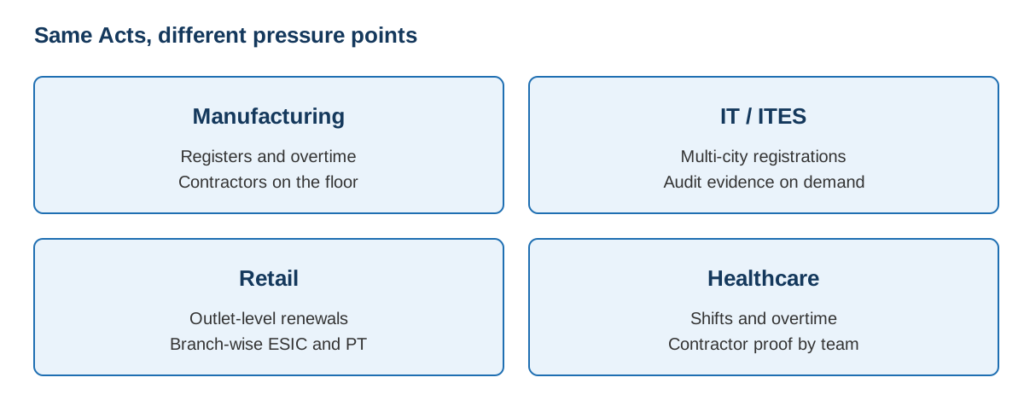
A factory lives and dies on registers kept at the plant, and on whether those registers agree with payroll. An IT services firm may have fewer registers but several offices, a client auditor and a night-shift policy. A retailer has a large number of small registrations, each with its own renewal date. A hospital has round-the-clock shifts, a large contractor share and a stack of licences, only some of which are labour-related.

So the question is not “which software has the most features?” It is “which features break first in my sector, and does this platform hold up there?” That shapes the rest of this guide.

The Labour Codes Layer Over All Four

Whatever your sector, one change sits on top of everything. The four Labour Codes took effect on 21 November 2025, the Central Government notified final Central Rules on 8 May 2026, and State Rules are arriving at different speeds. The Code on Occupational Safety, Health and Working Conditions now covers factories, contract labour and working conditions. The Code on Social Security covers provident fund and ESIC. State Shops & Establishment Acts continue alongside.

In practice, forms, portals and notices will mix legacy Act names with Code names for a while. Ask any vendor how its rules are dated and updated, and who reviews a change before it reaches your account. Check the Ministry’s labour.gov.in site for the current position. Our process guide to regulatory change management explains the loop. The rest of this article uses legacy Act references because that is what most registers, forms and notices still carry today. Confirm the applicable rule for your state before acting.

A quick word on who should read which part. If you are a CFO or founder, skim the “What to demand” line under each sector and the table in Section 7. If you are a compliance manager or plant HR head, the bullet lists are where the detail sits. When should you act? Usually when you add a second state, a first contractor, a second plant or a third person who touches filings. Why bother now? Because the Labour Codes are changing the paperwork underneath, and a manual process that coped last year may not cope with a mixed set of old and new forms.

Manufacturing: The Register and the Shop Floor

Think of a mid-sized auto-components maker with two plants, three shifts and about 150 contract workers across both sites. Where does compliance hurt?

  • Registers that must match reality: Muster rolls, overtime registers and leave registers under the Factories Act, 1948 and your state’s Factories Rules. Form numbers differ by state, so a tool needs your state’s format, not a national template. Our Factories Act registers checklist lists them.
  • Overtime and hours: Under the Act, overtime is paid at twice the ordinary rate (Section 59), and weekly and daily limits apply. Registers, attendance and payroll must agree, or the first inspection finds the gap. Ask whether the tool compares them.
  • Licence renewal: A factory licence and its renewal are tied to a date. A tiered alert, say 90, 60 and 30 days, is more useful than one reminder.
  • Contractors on the floor: Under the Contract Labour (Regulation and Abolition) Act, 1970, you carry responsibility if a contractor defaults on wages. That means monthly contractor EPF and ESIC proof per site. See our guide to CLRA registers and returns.
  • Plant-to-plant variation: Two plants in two states means two sets of Rules. One score per plant, not one blended number, shows where to look.

What to demand: state-specific factory registers, overtime reconciliation with payroll, licence alerts in tiers, contractor proof by plant and a per-plant score.

IT/ITES: Few Registers, Many Questions

Picture a 400-person software services company with offices in Pune, Noida and Chennai and a client who audits compliance every year. There is no factory floor, but the exposure is real.

  • Shops & Establishment registrations by city: Each office sits under its state’s Act, with its own registration, renewal period and register formats. Some states have special provisions for IT and ITES establishments on working hours or night work, so confirm per state. See our state-wise Shops & Establishment guide.
  • Professional Tax, PF and ESI in several states: The mix of Professional Tax slabs across Maharashtra, Karnataka and Tamil Nadu means payroll deductions differ by employee location.
  • Night shifts and women employees: State rules commonly attach conditions to night work. Under the new Rules, published advisory summaries point to written consent and transport. Check your state’s position.
  • Crèche and maternity obligations: The Maternity Benefit Act, 1961 requires a crèche in establishments with 50 or more employees. A tool that does not track it is not the end of the world, but you should know who does.
  • Client and investor audits: The audit asks, “Show us last quarter’s PF challan and the register.” Speed matters, so a searchable archive with the signed document is worth more than a dashboard.
  • Housekeeping and security contractors: Easy to overlook in an IT firm, and still covered by contract labour rules once headcount thresholds apply.

What to demand: multi-city Shops & Establishment handling, Professional Tax by employee location, an audit-ready archive and a clear answer on what adjacent obligations (for example, internal committee reporting) sit outside the tool.

Retail: Forty Outlets, Forty Small Deadlines

A fashion retailer has 40 stores across eight states and about 600 employees. No single store is complicated. The volume is the problem.

  • One registration per outlet: Each store needs its own Shops & Establishment registration, usually with a renewal date. At 40 outlets, that is a renewal almost every week.
  • Opening hours, weekly off and overtime: State rules differ, and festival seasons stretch hours. See our page on leave and working hours for how these interact.
  • Branch-wise ESIC and Professional Tax: Contributions are tracked per registered location and per state. A single misallocated branch can cause a short-payment notice.
  • Seasonal and part-time staff: Headcount swings change which thresholds apply and which registers need new rows.
  • Outsourced housekeeping and security: Contract workers at stores are still your concern if the contractor fails to pay. Check proof by contractor and by city.
  • Head office visibility: The regional manager needs to see which five outlets are behind, not 40 green ticks.

What to demand: a store-level registration tracker with tiered alerts, state-specific formats, branch-wise statutory tracking and a dashboard that ranks outlets by risk.

Running many outlets, plants or wards? See a multi-location view built from your own states. BOOK A DEMO

Healthcare: Shifts, Contractors and Mixed Licences

A 150-bed hospital has doctors, nurses, technicians, front desk staff and a large outsourced team for housekeeping, security, laundry and kitchen. Add a pharmacy and a diagnostic centre and the picture grows.

  • Round-the-clock shifts: Nurses on 12-hour shifts bump against daily and weekly limits in state rules. The tool should flag hours against the state’s limit, and overtime records must agree with payroll.
  • A very high contractor share: In many hospitals, a large part of the headcount sits with contractors. The same monthly proof of EPF, ESIC and wages applies. Our vendor compliance page shows the approach.
  • ESIC and EPF mix: Wage levels vary widely across roles, so coverage by employee must be right. Check how the tool handles an employee crossing the ESIC wage ceiling mid-period.
  • Licences that are not labour licences: Hospitals hold clinical, biomedical waste, fire and pharmacy approvals. Many are outside labour compliance software. Ask what the platform tracks and what stays with your administration team.
  • Pharma units: A pharmaceutical plant is a factory, so the manufacturing checklist applies.
  • Notices: Provident fund or ESIC local office notices land in a general inbox and wait. Speed of reply matters.

What to demand: shift and overtime reconciliation, contractor proof by department, clear boundaries on non-labour licences and a defined path for notices.

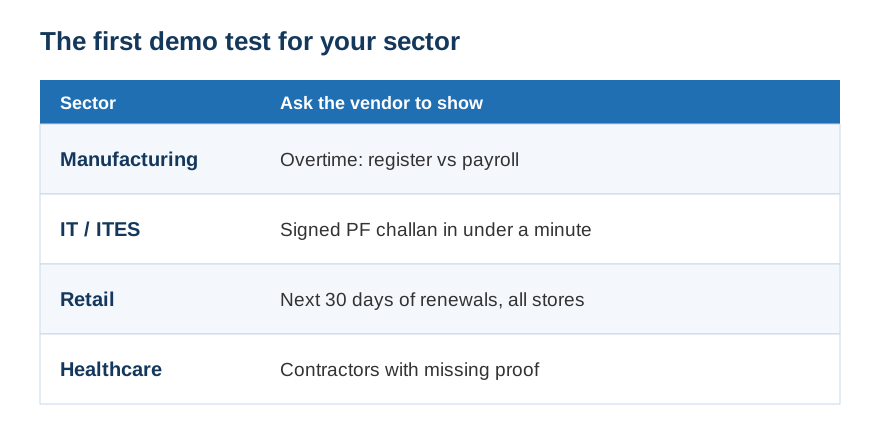
What Breaks First in Each Sector

SectorFirst thing to breakQuestion that exposes it
ManufacturingRegister and payroll disagree on overtimeShow me overtime hours reconciled across register and payroll
IT/ITESMulti-city registrations and client audit evidenceShow me a signed PF challan found in under a minute
RetailAn outlet’s licence expires unnoticedShow me the next 30 days of renewals across all stores
HealthcareA contractor stops remittingShow me contractors with missing proof this month

If a vendor’s demo does not touch the row for your sector, say so politely and ask for it.

Construction, staffing, logistics and mining follow the same logic with different pressure points. A construction firm has contractors that arrive and leave with each project. A staffing company deploys workers to client sites in several states and answers to principal employers. A logistics operator runs many warehouses with high attrition. A mine has its own regime that is moving into the Occupational Safety, Health and Working Conditions Code. Each deserves its own test row, and we will cover them separately rather than squeeze them in here.

Here is how this plays out in a real week. Say a retail operations lead gets a call from a state office about one outlet’s lapsed registration. In a spreadsheet, finding that store’s file takes ten minutes and a phone call. In a platform that tracks tiered alerts per outlet, the alert fired weeks ago and the renewal receipt sits next to the registration. The difference is not glamour. It is that the call becomes a two-minute reply instead of a scramble.

The same pattern holds for a plant. An inspector asks for the overtime register for the last quarter. If the register, attendance and payroll agree, the answer is a printout. If they do not, the next hour is spent explaining the difference. That gap is what the manufacturing test in the table is designed to find before an inspector does.

Five Questions to Ask Any Vendor in Your Sector

  1. Can you show our two least common states, not the biggest?
  2. Where does a second person review before anything is signed?
  3. What happens when a state notifies new rules, and who checks it?
  4. Which of our obligations does the tool not cover, in writing?
  5. How does it connect to our payroll system?

Question four is the most useful. A vendor that says “everything” is guessing.

Where Iztty Fits by Sector

Iztty is an AI-powered statutory compliance platform built by Futurex Management Solutions Limited, a New Delhi firm that has handled Indian labour compliance for clients since 2014. These are the pieces most relevant to the sectors above.

  • Manufacturing: Factories Act registers, licence renewal with tiered expiry alerts and a score by Act and state. A representative 14-factory manufacturer moved its Compliance Score from 61% to 88% in 90 days. That is an anonymised example, not a named case study.
  • IT/ITES and retail: state-specific Shops & Establishment registers, licence renewals and a multi-branch, multi-state dashboard, with payroll connections to Tally, Zoho Payroll and Keka HR.
  • Healthcare: vendor compliance collects contractor EPF, ESIC and wage registers and calculates a vendor score, supporting principal-employer liability records under CLRA.
  • Every sector: a Maker-Checker-DSC workflow with review, DSC signing and archive to the Document Vault, the Compliance Score Meter, and AI Notice Response, which averages 4 hours against 3 to 5 days manually.

See the platform page for the full picture. Consultancies serving several sectors can use the separate Compliance Consultant account.

How to Start in Your Sector

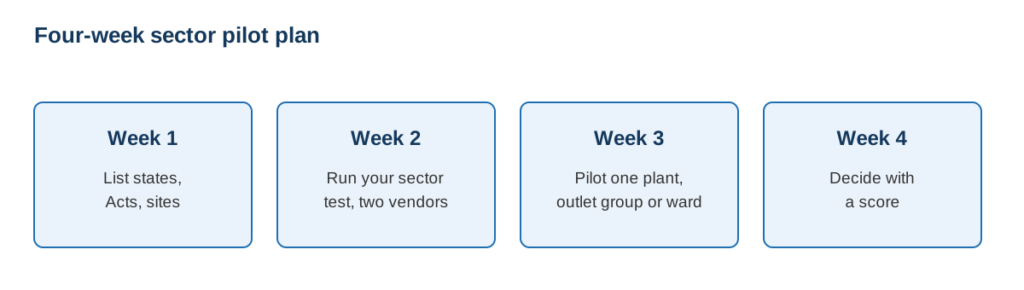
  • Week 1: list your states, Acts and sites. Mark the row from the Section 7 table that matches your sector.
  • Week 2: run that one test with two vendors, live.
  • Week 3: pilot one plant, one outlet group, one office or one department.
  • Week 4: decide with a score, not a feeling.

For a broader checklist across the main Acts, our statutory compliance software checklist goes Act by Act.

Conclusion

The right regulatory compliance software solution is the one that holds up where your sector is weakest. For a plant, that is registers and contractors. For an IT firm, evidence and multi-city registrations. For retail, volume. For a hospital, shifts and contractor proof. Test that first.

If you would like an expert to run the test against your own sites, we can do it with you.

CHECK MY COMPLIANCE  |  CALL AN EXPERT

FAQs

Q1: What are regulatory compliance software solutions?
They are platforms that map the labour and employment laws that apply to you, prepare filings and registers, route them for review and signing, track licences and deadlines and keep proof.

Q2: Does the right software differ by industry?
The core Acts overlap, but the pressure points differ. Factories need registers and overtime reconciliation, retail needs outlet-level tracking, IT needs multi-city handling and audit evidence, and hospitals need shift and contractor control.

Q3: What does a manufacturer need from compliance software?
State-specific Factories Act registers, overtime reconciliation with payroll, licence renewal alerts, contractor proof by plant and a score per plant.

Q4: Do IT and ITES companies need labour compliance software?
If you have more than one office or state, usually yes. Shops & Establishment registrations, Professional Tax, PF and ESI, and client audits create steady work even without a factory.

Q5: How should retailers track licences across many stores?
Use a tracker with one registration per outlet, tiered renewal alerts and a view that ranks stores by risk.

Q6: What about hospitals and contract staff?
Collect EPF, ESIC and wage proof from each contractor monthly and score them. The principal employer can be responsible if a contractor defaults on wages.

Q7: Do the Labour Codes change what I should buy?
The four Codes took effect on 21 November 2025, with final Central Rules notified on 8 May 2026 and State Rules arriving unevenly. Choose a platform that tracks legacy Act and Code references together and updates promptly.

Q8: Can an HRMS compliance module cover my sector?
For one state and simple payroll, often. For factories, many outlets or contractor-heavy sites, check state formats, contractor proof and review workflows.

Q9: How much does compliance software cost in India?
Pricing depends on locations, Acts, states, users and services bundled. Ask for a quote against your own profile.

Q10: What should I test in a demo for my sector?
Use the row for your sector in the table in Section 7, then ask which of your obligations the tool does not cover.

Statutory Compliance Software: What to Check for EPF, ESIC, PT, LWF, S&E and CLRA

Imagine a company with a plant near Pune, an office in Gurugram and a warehouse outside Hyderabad. Three states, three Professional Tax regimes, two Labour Welfare Fund schedules, a Shops & Establishment licence for the office, and about 80 contract workers at the plant. On the 15th, provident fund and ESIC contributions fall due. On the 31st of January, a contract labour return does. Which of those dates does your current tool know about?

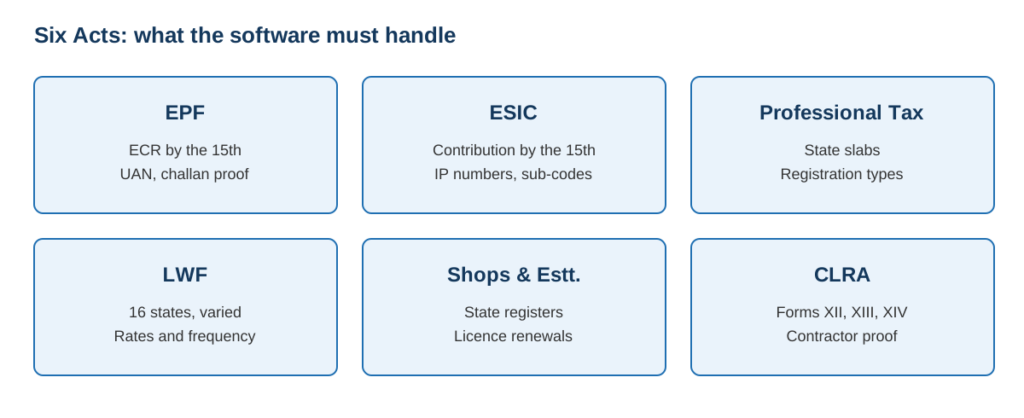
That question is the whole point of this guide. Most demos of statutory compliance software show a dashboard. Very few show what happens for a specific Act: which form, which due date, which state variation, who signs, where the proof goes. So instead of a generic feature list, this checklist goes Act by Act, for EPF, ESIC, Professional Tax, Labour Welfare Fund, Shops & Establishment and the Contract Labour (Regulation and Abolition) Act, 1970. Take it into your next demo and tick things off yourself.

Want this checklist run against your own states and sites? Our compliance practice will map your Acts and show you the gaps first. GET A FREE COMPLIANCE AUDIT

What Statutory Compliance Software Should Actually Do

Statutory compliance software helps an employer meet obligations under labour and employment laws: registrations, monthly contributions, returns, registers, licences and inspections. It is not the same as payroll software, although the two must talk to each other.

Think of it as five jobs. Know which obligations apply to which site. Remind the right person on time. Prepare the filing or register. Make sure a second person checks it before it goes out. Keep proof you can produce when an officer asks. If a tool does only the second job, it is a calendar. If it does the first and the third but nobody reviews anything, you have automated your mistakes.

Who needs it? Anyone with more than one state, more than one Act, a contractor-heavy workforce or a lean compliance team. When should you look? Usually when the spreadsheet starts needing a spreadsheet to manage it. For a wider view, our EPF and ESIC compliance guide and the overview of regulatory compliance software cover the background. This piece is the buying checklist.

One Thing to Settle First: Acts, Codes and Your Forms

The four Labour Codes took effect on 21 November 2025, and the Central Government notified final Central Rules on 8 May 2026. The Code on Social Security covers provident fund and ESIC matters. The Occupational Safety, Health and Working Conditions Code covers factories and contract labour. State Rules are arriving at different speeds, and State Shops & Establishment Acts continue alongside.

What does this mean for a software buyer? Forms, portal labels, notices and inspectors’ questions will use old Act names and new Code names side by side for a while. Ask every vendor two questions. Does the tool hold both the legacy Act reference and the Code reference for each obligation? And how quickly does it update when your state notifies its rules? Treat any answer that is vague on this as a warning sign.

EPF Checklist

The Employees’ Provident Funds and Miscellaneous Provisions Act, 1952 drives the busiest monthly deadline most employers have. The contribution and the Electronic Challan cum Return (ECR) are due by the 15th of the following month on the EPFO portal.

  • ECR preparation: Can it build the ECR from payroll data, flag members with missing or unseeded UANs, and show the difference between last month’s and this month’s headcount before you upload?
  • Wage-ceiling logic: Does it handle contribution on actual wages versus the statutory ceiling, and let you see which employees are treated which way?
  • Challan and payment proof: Does the challan and bank confirmation attach to the month’s record automatically?
  • Cost of lateness: Interest under Section 7Q is 12% per annum, and damages under Para 32A are a flat 1% per month from 15 June 2024. Does the tool show the exposure when a month slips? These figures should be confirmed against the current EPFO notification before you rely on them.
  • Exits and joiners: Does it track date of exit and new UAN generation without a separate sheet?
  • Contractor workers: Can it see whether your contractors have remitted for the people working at your site? That connects to the CLRA section below.

ESIC Checklist

Under the Employees’ State Insurance Act, 1948, contributions are also due by the 15th of the following month through the ESIC portal. The scheme works in two contribution periods a year, which matters for how benefit eligibility is calculated.

  • Eligibility rules: Does it apply the wage ceiling correctly and handle the mid-period crossing, where an employee’s wages move above the ceiling during a contribution period?
  • IP number tracking: New joiners, exits and transfers between branches with different ESIC sub-codes.
  • Monthly contribution file: Preparation, validation, and a record of what was uploaded.
  • Branch and sub-code logic: Does it keep contributions separate for each registered location?
  • Notice handling: Local office notices about short payment or inspection reach someone with a deadline, not a general inbox.

Confirm the current ceiling and rates on the ESIC site at the time of your evaluation, because these are revised by notification.

Professional Tax Checklist

Professional Tax is the one where tools most often look finished and are not. It is a state levy, so slabs, registration types, due dates and return formats differ from one state to the next. Our Professional Tax guide and the PT page go into state detail.

  • State slabs by employee: Does it deduct by the slab of the state where each employee works, not where head office sits?
  • Two registrations in some states: Where a state separates employer registration from employee enrolment, does the tool track both certificates?
  • Different frequencies: Monthly in some states, quarterly or annual in others. One calendar should show them all.
  • Slab change handling: When a state revises slabs, is there a dated change record and an updated rule, not a manual reset?
  • Women, seasonal and category exemptions: Where a state grants them, can the tool apply them per employee?

Ask the vendor to show you your own two least common states. If they only demo Maharashtra and Karnataka, you have learned something.

Labour Welfare Fund Checklist

LWF applies in a limited set of states and is easy to forget precisely because it is not everywhere. Rates, frequency and who pays differ by state, and some states require a registration and a return. Details are in our LWF compliance guide and the LWF page.

  • Applicability by site: Does the system know which of your locations fall in an LWF state, and stay silent for those that do not?
  • Employee and employer share: Separate amounts, state-wise, updated when notified.
  • Frequency: Monthly, half-yearly or annual, with the right date for each state.
  • Remittance record: A dated proof of payment per state, stored with the return.
  • Unclaimed amounts: Some states have rules on unpaid or unclaimed contributions. Ask whether the tool captures them.

Shops & Establishment Checklist

There is no single Shops & Establishment Act. Each state has its own, with its own registration, renewal period, register formats and working-hour rules. This is where multi-state employers get tripped up, and where a generic tool’s “India-wide template” is least useful. See the state-wise Shops & Establishment guide for background.

  • State-validated register formats: Employee, leave, wage and overtime registers in the format your state expects, not a common template.
  • Licence and registration renewal: Tiered alerts ahead of expiry, with the certificate stored.
  • Working hours and overtime: Daily and weekly limits, with overtime records that agree with payroll. See the leave and working hours page for detail.
  • Multi-location view: Retail chains and branch offices need to see every location’s status in one place.
  • Intimation of changes: Change of address, manager or employee count where the state requires a notice.

CLRA Checklist

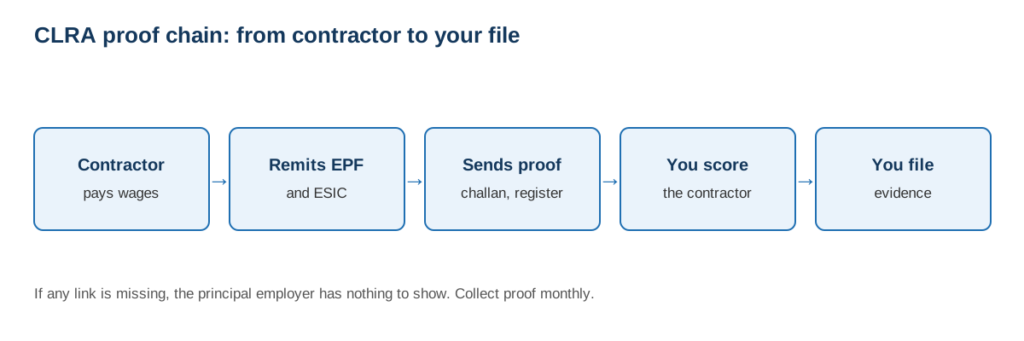
The Contract Labour (Regulation and Abolition) Act, 1970 (see the bare Act on India Code) makes the principal employer responsible if a contractor fails to pay wages. That is why this one belongs on a CFO’s radar, and why it deserves the most demanding checklist. Our CLRA page, vendor compliance page and the guide to CLRA registers and returns add context.

  • Registers: Form XII (Register of Contractors), Form XIII (Register of Workmen) and Form XIV (Employment Card), kept by site and by contractor.
  • Returns: The contractor’s half-yearly return in Form XXIV and the principal employer’s annual return in Form XXV (due 31 January). Verify current due dates against the Central or State Rules that apply to you.
  • Contractor proof, collected not assumed: EPF challan, ESIC challan and wage register from each contractor, month by month, with a status when something is missing.
  • A vendor score: A number per contractor, calculated from what was submitted, so you know which three to chase this week.
  • Licence tracking: Contractor licence validity linked to the work order.
  • Liability file: One place showing what you checked and when, for use if a contractor defaults.

Forms VI-A and VI-B are notices connected with the commencement and completion of contract work. They are not periodic returns, so a tool that puts VI-B on a half-yearly calendar deserves a follow-up question.

Not sure how many of your contractors have actually remitted this month? See a live vendor compliance score for your own sites. BOOK A DEMO

Features That Cut Across Every Act

Once the Act checklists are done, five cross-cutting features decide whether the tool is a system or a set of screens.

  • Maker-checker with digital signing: Preparation, review with mandatory remarks on rejection, Digital Signature Certificate signing, and automatic archive. If the same person prepares and signs, you have no control.
  • Audit trail and document vault: Who did what, when, with the file attached. Ask to see an export, not a screenshot.
  • Compliance score: A live score by Act and by state, with a clear rule for what moves it.
  • Regulatory change tracking: New circulars and amendments matched to your profile, with a person reviewing before anything changes in your account. We cover the process in our guide to regulatory change management.
  • Notice response: Reading a scanned notice, pulling out the allegation and deadline and drafting a reply with an evidence checklist.
  • Integrations: Connection with your payroll or accounting system, so data is not typed twice.
  • Role-based access: Makers, Checkers and DSC holders as distinct roles, with department-wise visibility.

Where an HRMS Module Usually Stops

Many HRMS products include a compliance module, and for a single-state company with straightforward payroll that may be enough. Here is where the gap tends to open. Treat the right-hand column as questions to ask, not claims about any particular product.

AreaTypical HRMS moduleWhat to ask about a specialist platform
EPF and ESICCalculates and generates files from payrollDoes it also check, sign and archive with proof of review?
Professional TaxSlabs for the main statesHow many states, and how are changes dated?
CLRA and contractorsOften limited or absentAre contractor proofs collected, scored and filed?
Factories and S&E registersBasic attendance-linked registersAre formats state-validated?
NoticesOut of scopeIs there a drafting workflow with evidence?
Rule changesRelease notesIs there monitoring with named review?

If your payroll lives in an HRMS you like, you do not have to replace it. The question is whether the compliance layer sits on top and reads from it.

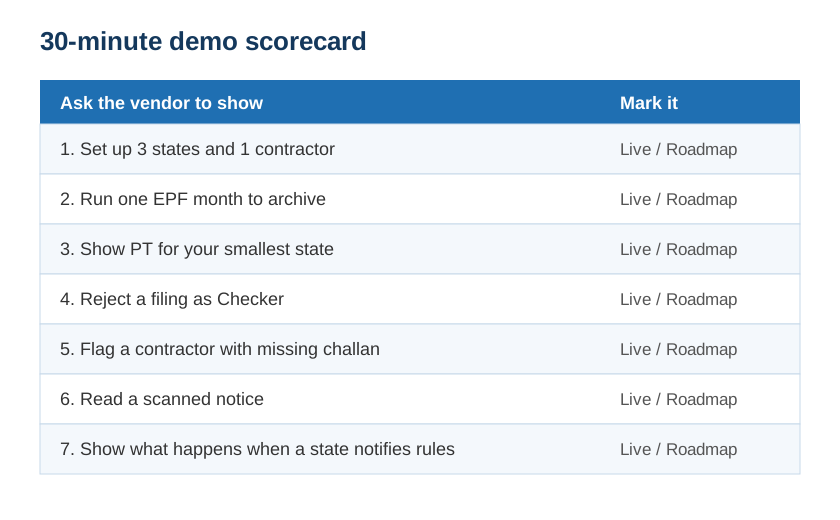
A 30-Minute Demo Script

  1. Ask them to set up a company with three states and one contractor. Time how long that takes.
  2. Run one EPF month from payroll upload to proof archive.
  3. Show Professional Tax for your two least common states.
  4. Reject a filing as the Checker and show the remark trail.
  5. Show the contractor with a missing challan and what the system does about it.
  6. Open a scanned notice and ask what the tool extracts.
  7. Ask what happens the day a state notifies new rules.

Anything that cannot be shown live should be marked “roadmap” on your scorecard.

Where Iztty Fits

Iztty is an AI-powered statutory compliance platform built by Futurex Management Solutions Limited, a New Delhi firm that has handled Indian labour compliance for clients since 2014. Against the checklist above, it covers labour, factory, Shops & Establishment, payroll, vendor and CLRA compliance across 28+ states. A few specifics:

  • Review before filing: The Maker-Checker-DSC workflow runs four stages, from upload and validation to review, DSC signing and auto-archive to the Document Vault.
  • Payroll connection: Integrations with Tally, Zoho Payroll and Keka HR. See the integrations page.
  • Visible score: The Compliance Score Meter shows a live 0 to 100% score by Act and state with Low, Medium and High banding.
  • Notices: AI Notice Response averages 4 hours against 3 to 5 days manually.
  • Changes: Regulatory Change Intelligence turns gazette notifications and circulars into tasks for your profile, with human review before enforcement.

As an illustration, a representative 14-factory manufacturer on the platform moved its score from 61% to 88% in 90 days, and a representative 40-client consultancy cut EPF and ESIC notice responses from 5 days to 4 hours. Both are anonymised examples, not named case studies. Consultancies managing several clients can use the separate Compliance Consultant account. See the full platform and AI features.

Conclusion

A feature list that says “covers EPF, ESIC, PT, LWF, S&E and CLRA” tells you very little. Ask what happens for each Act, with your forms, in your states, and who checks before it goes out. Bring the checklist to every demo and score what you see, not what you hear.

If you would rather have an expert run it against your sites first, we can do that.

CHECK MY COMPLIANCE  |  CALL AN EXPERT

FAQs

Q1: What is statutory compliance software?
It is software that helps employers meet labour and employment law obligations such as EPF, ESIC, Professional Tax, LWF, Shops & Establishment and CLRA. It tracks what applies, prepares filings and registers, routes them for review and stores proof.

Q2: What is the difference between HRMS and compliance software?
An HRMS runs people processes such as payroll, attendance and leave. Compliance software handles the legal obligations that follow, including state variations, review, signing, proof and notices. Many HRMS products include a compliance module with narrower coverage.

Q3: Which Acts should statutory compliance software cover?
At minimum, EPF, ESIC, Professional Tax, LWF, Shops & Establishment and CLRA, plus Factories Act registers if you run a factory. Coverage should hold for every state where you have employees.

Q4: Do the Labour Codes change what software I need?
The four Codes took effect on 21 November 2025, with final Central Rules notified on 8 May 2026 and State Rules arriving unevenly. Choose a tool that tracks legacy Act and Code references together and updates quickly when your state notifies rules.

Q5: What is a maker-checker workflow and why does it matter?
One person prepares a filing and another reviews it before it is signed and submitted. It reduces errors and gives you a record of who approved what.

Q6: Can software file EPF and ESIC returns directly?
That depends on the product. Ask whether it files directly on the portals or prepares the file for upload and signing, and ask to see it done.

Q7: How does software help with CLRA compliance?
It keeps registers such as Forms XII, XIII and XIV, collects contractor challans and wage registers, scores each contractor and records your checks, which helps if a contractor defaults.

Q8: How much does statutory compliance software cost in India?
Pricing depends on the number of locations, Acts, states, users and whether services are bundled. Request a quote against your own profile and compare what is included.

Q9: Is AI useful in statutory compliance?
Yes for reading notices, matching circulars to your sites and drafting replies. A qualified person should still review before anything goes to an authority.

Q10: How long does implementation take?
It depends on the number of sites, the state of your data and your payroll integration. Ask for a plan with named milestones and a pilot on one site first.

Regulatory Software Solutions: RegTech Explained for Indian Businesses

Count the logins your compliance person carries. The EPFO portal for the ECR. The ESIC portal for contributions. A state labour department site for licence renewal. Maybe a Shram Suvidha account. Then an Excel file that ties them together, and an inbox full of circulars. Somewhere in that pile sits your actual compliance. This is the gap that regulatory software solutions, the Indian end of what the world calls RegTech, are meant to close.

Most RegTech writing is about banks and anti-money-laundering. This guide is about you: an Indian employer with sites, contractors and a Labour Code transition to survive. It explains what RegTech really is, what technology sits under it, where AI helps and where it should not be trusted, and how to pick a regulatory compliance solution that fits a business your size.

Want to see how your own compliance would look inside a platform? Share your states and contractor count and we will walk you through it. GET A FREE COMPLIANCE AUDIT

What RegTech Actually Means

RegTech is short for regulatory technology: software that helps organisations meet legal and regulatory obligations faster, more accurately and with better proof. The UK’s Financial Conduct Authority helped popularise the term after a 2015 Call for Input, describing RegTech as new technologies developed to help overcome regulatory challenges in financial services.

That origin matters because it explains why so much of what you read is about banks. But the idea travelled. Anywhere there is a rulebook, a deadline and a penalty, there is a RegTech product trying to automate it. In India, one of the heaviest rulebooks sits not in banking but in employment: provident fund, ESIC, factory law, contract labour, state Shops & Establishment Acts and now the four Labour Codes.

So a plain-English definition for this guide: regulatory software solutions are tools that map the rules that apply to you, run the workflow to meet them, keep the proof and tell you when something changes.

Six Building Blocks Under the Hood

Different vendors use different jargon. Strip it away and nearly every serious product is assembled from six parts. Knowing them helps you ask better questions.

  • A regulatory knowledge base. The structured list of Acts, forms, frequencies and state variations. If this is thin or stale, nothing else matters. In labour compliance it has to cope with, say, a Form 25 Muster Roll in one state and a different format in another.
  • A rules engine. Logic that decides what applies to your company based on location, headcount and activity, and calculates due dates.
  • Workflow. Who prepares, who checks, who signs. The maker-checker-DSC workflow is this layer.
  • Document intelligence. Optical character recognition and language models that read notices, circulars and registers.
  • Integrations. Connectors to payroll and HR systems so data is not re-keyed. See Iztty’s integrations and the note on API integration.
  • Analytics and scoring. A live view of where you stand by Act and state, such as the Compliance Score Meter.

A product that is strong on only one of these (a pretty dashboard, say) is a feature, not a solution.

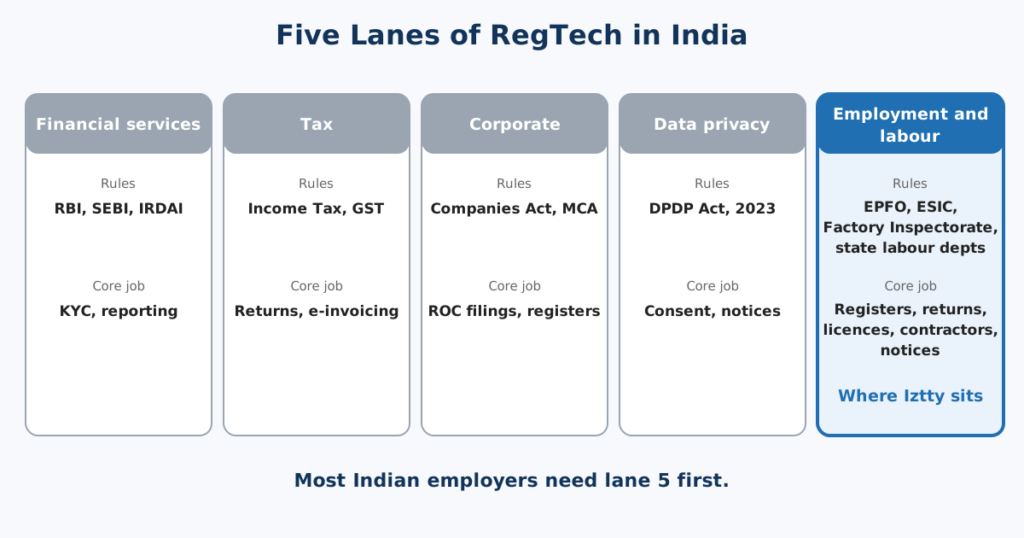
Five Lanes of RegTech in India

Here is something that rarely gets said. RegTech is not one market, it is several, and you almost certainly need only one or two lanes. Buying outside your lane is how companies end up with expensive tools that do not fit.

LaneTypical regulators and rulesTypical buyersCore job
Financial servicesRBI, SEBI, IRDAI; KYC and anti-money-laundering rulesBanks, NBFCs, insurers, fintechsCustomer checks, reporting, transaction monitoring
Tax and indirect taxIncome Tax Department, GST frameworkFinance and tax teamsReturns, reconciliations, e-invoicing
Corporate and secretarialCompanies Act, MCA filingsCompany Secretaries, legal teamsBoard records, ROC filings, registers
Data privacyDigital Personal Data Protection Act, 2023Legal, IT and privacy teamsConsent, notices, data requests
Employment and labour statutoryEPFO, ESIC, Factory Inspectorate, state labour departments, Labour CodesHR, plant, compliance and finance teamsRegisters, returns, licences, contractors, notices

If you are a manufacturer, retailer, logistics operator or staffing company, the fifth lane is where your day-to-day risk sits. The others may matter, but they are usually handled by finance and legal tools you already own. If you want the full category comparison within that lane, see our compliance management software guide and the companion piece on regulatory compliance software.

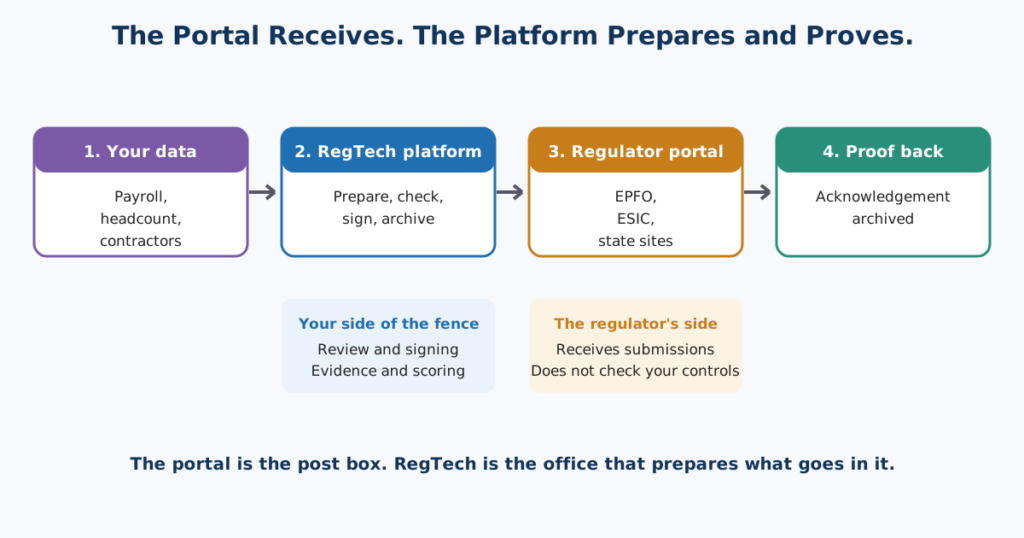
Portals Are the Regulator’s Tech, Not Yours

This is a distinction worth getting straight. When you log into the EPFO portal to upload an ECR, you are using the regulator’s technology. It receives your submission. It does not check whether you filed on time every month for four sites, whether the person who prepared the file is different from the person who approved it, or whether a contractor’s remittance proof is missing.

RegTech sits on your side of the fence. It helps you prepare, check, track and prove, and then hands off to the portal for submission, or integrates with it where that is supported. Think of the portal as the post box and RegTech as the office that prepares what goes in it.

What AI Does in RegTech, and What It Should Not

Every vendor now says “AI”. Here is a practical split.

What AI is genuinely good at:

  • Reading a scanned notice and pulling out the allegation, the section cited and the reply deadline.
  • Matching a new circular or amendment to the companies and sites it affects.
  • Drafting a first version of a reply or a task list from a template and your data.
  • Spotting patterns, like a contractor whose proof is slipping month on month.

What AI should not do on its own:

  • Decide how an ambiguous provision applies to your business.
  • Send a reply to a regulator without a person reading it.
  • Change your compliance obligations because a document said so, without review.

The four Labour Codes took effect on 21 November 2025, with detailed Central and State rules still being notified. That is exactly the kind of moving ground where a monitoring tool helps and a blindly automated one hurts. Iztty’s Regulatory Change Intelligence creates tasks matched to your profile but needs human review before anything is enforced, and its AI Notice Response drafts a reply that a person then reviews. That is the right shape: AI does the reading, people make the call.

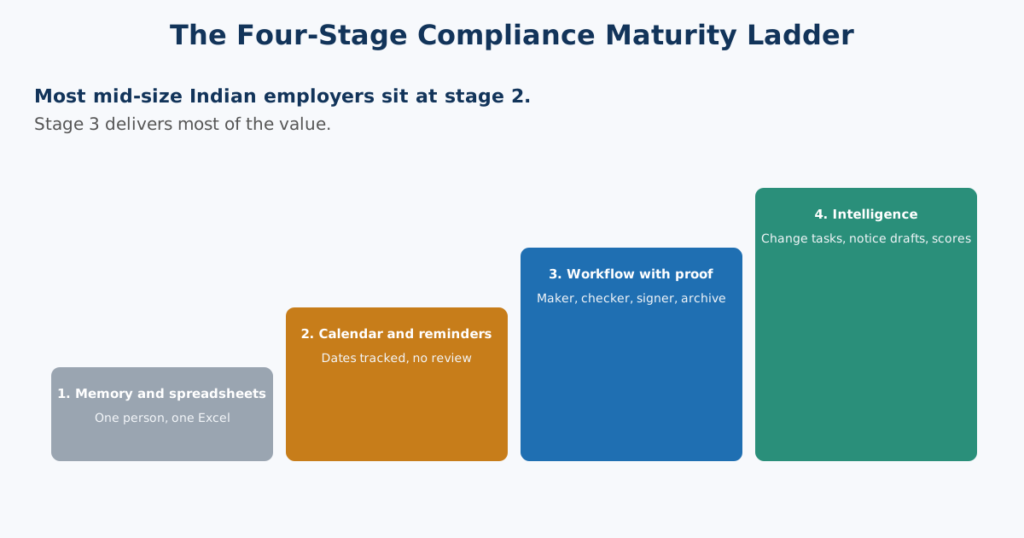
The Four-Stage Maturity Ladder

Most businesses do not need the top rung on day one. Find where you are.

StageWhat it looks likeWhat breaksWhat to add
1. Memory and spreadsheetsOne person, one Excel, a few email remindersLeave, attrition, a missed renewalA shared calendar and written owners
2. Calendar and remindersDates tracked, but preparing and checking are informalWrong formats, no review, no proofWorkflow with a checker and an archive
3. Workflow with proofMaker, checker and signer; evidence storedRule changes arrive late; notices take daysChange monitoring and notice handling
4. IntelligenceChanges create tasks, notices get drafted replies, scores show exposureLittle, if people keep the review disciplineRefinement and multi-entity views

In our experience, many mid-size Indian employers sit at stage 2. They have a calendar and good intentions, but nobody reviews the work and nothing is stored in a way they can find under pressure. Moving to stage 3 delivers most of the value.

Buy, Build or Outsource

Three ways to get a regulatory compliance solution. They are not mutually exclusive.

RouteWho it suitsUpsideTrade-off
Buy a platformMulti-state employers with a compliance ownerFaster to start, maintained formats, built-in review and proofYou still need an owner and clean payroll data
Build in-houseLarge enterprises with a technology team and unusual needsFits internal systems exactlyYou must track every rule change and state format yourself, forever
Outsource to a consultantCompanies without in-house capacityExpert hands from day oneLess visibility and less control unless paired with a system

The honest answer for most companies is a mix: a platform for the daily workflow, with a consultant for judgement calls and inspections. That is the reason Iztty comes from a consulting firm. The people who built the registers by hand for clients are the ones who encoded them.

Data and Security Questions to Ask Any Vendor

Compliance tools handle employee wages, identifiers and contractor records. Before you sign, ask:

  • Where is the data hosted, and who at the vendor can see it?
  • Is access role-based, so a Maker, a Checker and a DSC holder see only what they need?
  • Is there a full audit trail of who did what and when?
  • How is a Digital Signature Certificate handled and stored?
  • Can I export my data and records if I leave?
  • How does the vendor approach obligations under the Digital Personal Data Protection Act, 2023?

A vendor that answers these in writing is worth more than one with a longer feature list.

Six Red Flags in a RegTech Pitch

  • “Fully automated, no human needed.” Compliance has judgement in it. Be wary of anything that promises otherwise.
  • “Covers all of India” with no list. Ask which states and registers, by name.
  • AI as a headline with no example. Ask them to show a real notice being read.
  • No explanation of who maintains formats and rule updates.
  • A dashboard but no evidence behind the green ticks.
  • A one-person signoff. If the same user can prepare, approve and sign, the control is gone.

Where Iztty Fits

Iztty is an AI-powered statutory compliance platform built by Futurex Management Solutions Limited, a New Delhi consulting firm that has handled Indian labour compliance for clients since 2014. In RegTech terms it is an employment-lane platform with a consulting backbone. It covers labour, factory, Shops & Establishment, payroll and CLRA compliance plus vendor compliance across 28+ states.

  • Workflow: a four-stage Maker-Checker-DSC process (upload and validate, review and approve or reject with mandatory remarks, DSC signing, auto-archive to a Document Vault), with role-based access and a multi-branch structure.
  • Intelligence: Regulatory Change Intelligence for gazette notifications, EPFO and ESIC circulars and state amendments, with human review before enforcement, plus AI Notice Response that averages 4 hours against 3 to 5 days manually.
  • Visibility: a live Compliance Score Meter (0 to 100%) by Act and state with Low, Medium and High banding, and dashboards for multi-state views.
  • Contractors: vendor compliance with contractor audits, proof collection and auto-calculated vendor scores.
  • Connectors: payroll integrations with Tally, Zoho Payroll and Keka HR.

Compared with an HRMS module, where compliance is one menu among many, or an enterprise GRC suite built for a bank’s risk team, Iztty is purpose-built for labour and statutory work. The platform overview and AI features pages show the modules. For consultancies running several clients, a separate Compliance Consultant account type exists, and one anonymised illustration published by Iztty shows a 40-client consultancy cutting EPF and ESIC notice response from 5 days to 4 hours. It is a representative outcome, not an attributed case study.

See the platform on your own sites and states. A short demo with your locations loaded is more useful than any brochure. BOOK A DEMO

Conclusion: Pick the Lane, Then the Tool

RegTech sounds like a big, abstract idea. For an Indian employer it comes down to something plain: fewer logins and spreadsheets holding your compliance together, a second pair of eyes on every filing, proof you can find when an inspector asks, and an early warning when the rules shift. Choose the lane that matches your real risk, look for review and evidence before you look at AI, and test any platform on your own data.

Not sure where you sit on the ladder? We will tell you straight.

CHECK MY COMPLIANCE  |  CALL AN EXPERT

FAQs

Q1: What is RegTech?
RegTech, or regulatory technology, is software that helps organisations meet regulatory obligations more efficiently. The term grew out of financial services, and the UK’s Financial Conduct Authority described it as technologies that help overcome regulatory challenges in that sector.

Q2: Is RegTech only for banks and financial companies?
No. It began there, but the same approach now serves tax, corporate secretarial, data privacy and employment compliance. In India, labour and statutory compliance is one of the largest non-financial areas.

Q3: What are regulatory software solutions for Indian employers?
They are platforms that map applicable labour and statutory laws, run the preparation, review and signing workflow, store proof, track regulatory changes and help respond to notices. They cover EPF, ESIC, Factories Act, Shops & Establishment, CLRA, Professional Tax and Labour Welfare Fund.

Q4: How is RegTech different from GRC software?
GRC suites cover governance, risk and compliance broadly, often for enterprise risk teams. RegTech tends to focus on meeting specific regulatory obligations. Labour-focused platforms go further by carrying state-specific registers and statutory formats.

Q5: Can AI be trusted for compliance work?
For reading notices, matching circulars and drafting first versions, yes, with review. For interpreting ambiguous law or sending a reply to a regulator, no. Look for products that keep a human review step.

Q6: Does RegTech replace compliance consultants?
No. It handles the repeatable work and proof. Judgement on interpretation, inspections and complex notices still benefits from experienced professionals, which is why many companies combine a platform with a consultant.

Q7: Should we build our own compliance system?
Only if you have a technology team and unusual needs. You would need to track every rule change and state format yourself, indefinitely. Most employers are better served by buying and configuring a maintained platform.

Q8: Is employee data safe in a RegTech platform?
It depends on the vendor. Ask where data is hosted, who can see it, whether access is role-based, whether there is an audit trail, how Digital Signature Certificates are handled and how you can export your data.

Q9: How much does a regulatory compliance solution cost in India?
Pricing depends on locations, Acts, users and contractors, and on whether services are bundled. Request a quote on your own profile and compare what is included rather than headline figures.

Q10: Do the Labour Codes change what we should look for?
Yes. The four Labour Codes took effect on 21 November 2025, with detailed rules still being notified. Choose a platform that monitors changes, matches them to your profile and lets a person review each before it applies.

Images (3): regtech-five-lanes-india.png (after Section 3), regtech-portal-vs-platform.png (after Section 4), regtech-maturity-ladder.png (after Section 6).

Regulatory Compliance Software: What It Does and Who Needs It in India

Say you run a plant in Manesar, a warehouse in Bhiwandi and a retail chain across four states. Your EPF return is due on the 15th. Your factory licence expires in March. A contractor at the warehouse has not sent remittance proof since August. And a state you operate in just changed its register format. Who is keeping track of all that? If the honest answer is “one very tired person and a spreadsheet”, you are exactly who regulatory compliance software is built for.

This guide explains what regulatory compliance software actually does in an Indian employer’s day, who genuinely needs it, and who can wait. It also clears up a naming confusion that trips up half the people searching for it.

Not sure whether you need software yet? Send us your locations and contractor count and we will tell you plainly. GET A FREE COMPLIANCE AUDIT

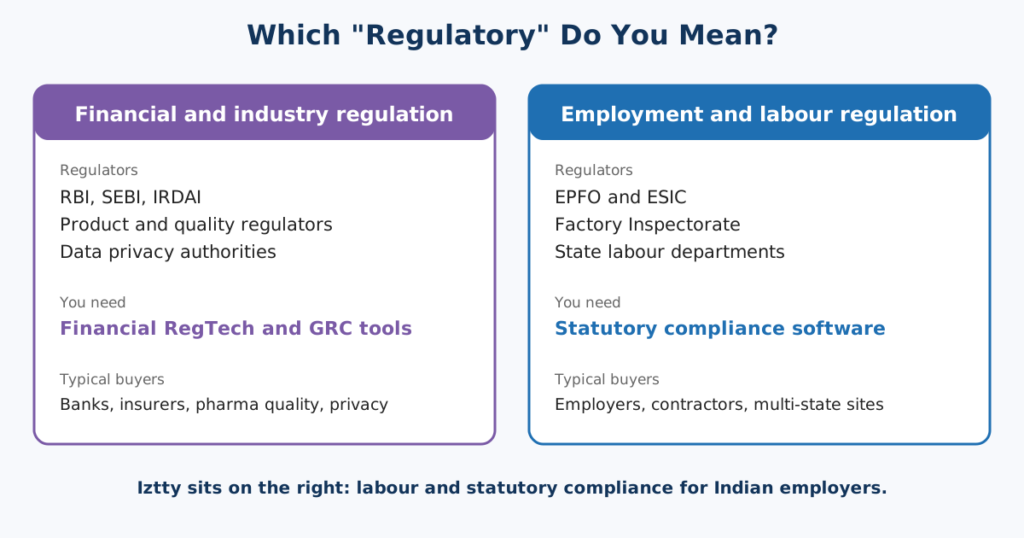
What Regulatory Compliance Software Is (and Which “Regulatory” You Mean)

Regulatory compliance software is a system that tracks the laws, licences and filings your business must comply with, assigns each to an owner, checks the work and keeps proof that it was done. For an Indian employer, those obligations come from the EPF and ESI schemes, the Factories Act, state Shops & Establishment Acts, the Contract Labour (Regulation and Abolition) Act, Professional Tax and Labour Welfare Fund laws, and now the four Labour Codes.

Here is the confusing bit. Search for “regulatory compliance software” and you will see tools for banks, insurers, pharma quality systems and data privacy. That is a different world. Those products manage financial regulation, product safety or privacy law. This article is about the employment and labour side: statutory compliance software for companies that employ people, use contractors and run sites across states.

Quick way to tell the two apart: if the regulator is RBI, SEBI or IRDAI, you want a financial RegTech tool. If the regulator is EPFO, ESIC, a Factory Inspectorate or a state labour department, keep reading.

The Seven Jobs It Does

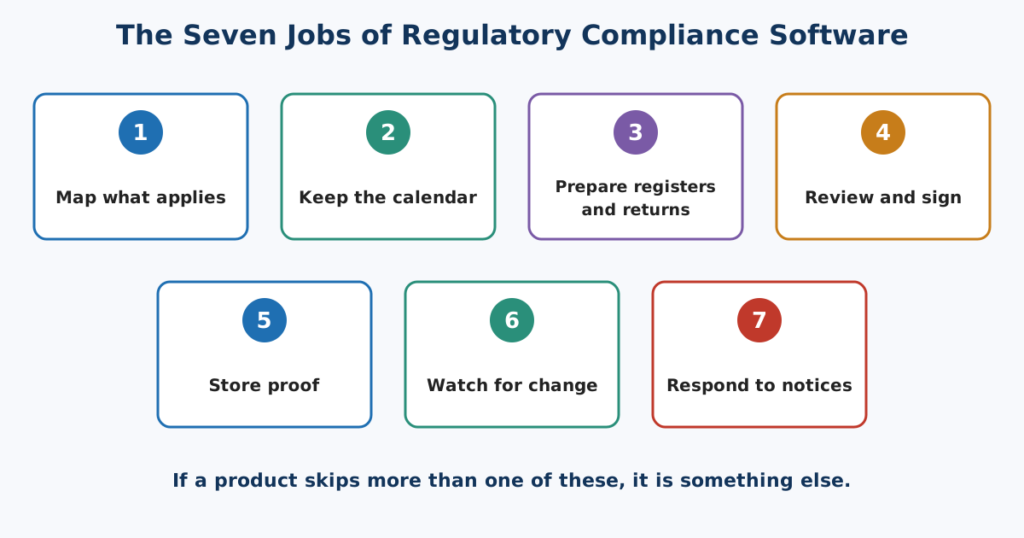
Strip away the marketing and good regulatory compliance software does seven things. If a product skips more than one, it is something else.

1. Maps what applies to you

Which Acts, which forms, which states, which sites. Applicability depends on your location, headcount, activity and whether you use contractors. The software builds that list from your company profile, so nobody has to rebuild it from memory each year.

2. Keeps the calendar

EPF ECR and ESIC contributions on the 15th. The CLRA principal employer annual return (Form XXV) by 31 January. Licence renewals. State Professional Tax and Labour Welfare Fund dates that differ by state. A compliance calendar that knows your sites is the base layer.

3. Prepares the registers and returns

Muster roll, overtime register, wage registers, employment cards, in the format your state requires. This is where most manual effort sits, and where wrong formats cause findings. Our Factories Act registers checklist shows how many there are.

4. Reviews and signs before anything goes out

One person prepares, another checks, a DSC holder signs. That is the Maker-Checker-DSC pattern, and it is the control most manual processes lack. The maker-checker-DSC guide walks through it.

5. Stores proof

Approved registers, challan proof and acknowledgements, archived and searchable. When an inspector asks for last year’s register from a plant in another state, you find it in a minute, not a day.

6. Watches for changes

A new circular, a state amendment, a Code rule. The four Labour Codes took effect on 21 November 2025, with detailed rules still arriving. Regulatory change intelligence turns each change into tasks matched to your profile.

7. Helps you answer notices

When EPFO, ESIC or a labour department writes to you, the clock starts. Software that reads the notice, extracts the allegation and deadline and drafts a reply with an evidence list saves the first and slowest stretch. See AI notice response.

What It Does Not Do

A fair guide should say this out loud.

  • It does not replace judgement. Whether a contractor arrangement is genuine, or how to read an ambiguous Code provision, still needs a person with experience.
  • It does not remove accountability. The occupier, employer or principal employer stays responsible. Software gives you control and proof, not a transfer of liability.
  • It is not legal advice. Good platforms keep a human review step before any rule change is enforced in your account.
  • It will not fix bad data. If headcount, wages or contractor lists are wrong in payroll, the output will be wrong too. Garbage in, tidy-looking garbage out.

Also check one practical thing early: does the product file directly on government portals, or does it prepare, review and sign documents that you then submit? Both are legitimate. Know which one you are buying.

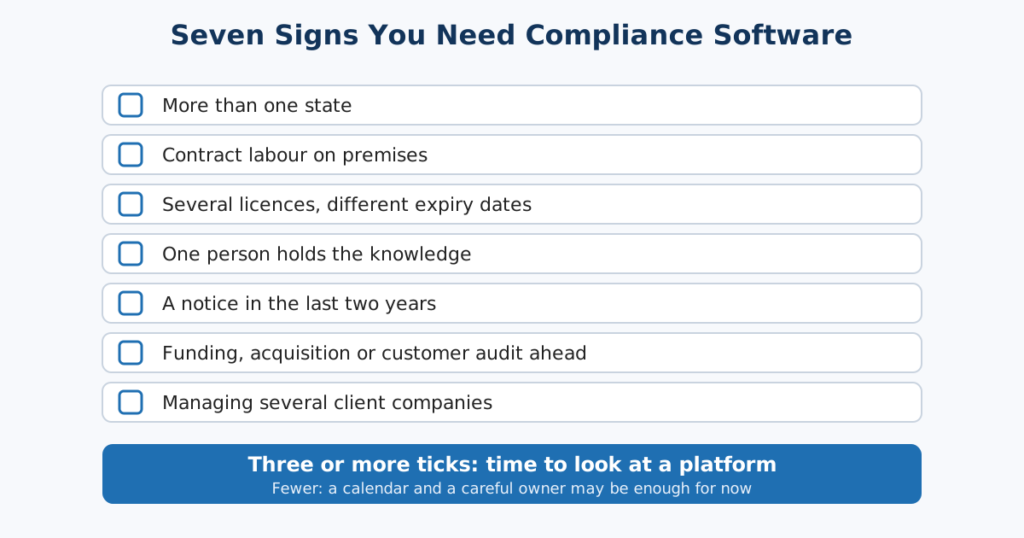
Who Needs It: Seven Signs

There is no single employee count where software becomes necessary, and applicability thresholds under each Act or Code differ by state, so check current thresholds on the official sources: EPFO and ESIC publish theirs. What matters is how many things you are juggling. If three or more of these sound familiar, it is time.

  • You operate in more than one state. Each state brings its own register formats, renewal cycles and Professional Tax and Labour Welfare Fund rules.
  • You use contract labour. Under the Contract Labour (Regulation and Abolition) Act, 1970, a principal employer can carry liability for specified contractor failures. Chasing proof by email does not scale.
  • You have several licences with different expiry dates. Factory licence, S&E registrations, contractor licences. One missed renewal can stop a site.
  • One person holds all the knowledge. If they resign, do you still know what is due?
  • You have received a notice in the last two years. It usually means a gap exists elsewhere too.
  • You are preparing for funding, an acquisition or a big customer audit. Diligence teams ask for evidence, not assurances.
  • You are a consultant or firm handling several client companies. Separate spreadsheets per client are a risk in themselves.

Who Needs It by Industry

The need looks different depending on what you do. This table shows the main driver in each sector and what the software has to handle.

SectorWhat drives the loadWhat the software must handle
Manufacturing and factoriesFactories Act registers and licences, overtime, contractor labour on the shop floorForm 25 Muster Roll and Form 17 Overtime Register, licence renewal alerts, per-plant scoring
Retail and shopsMany small locations under state S&E Acts, each with its own registrationState-specific formats, renewal tracking per outlet, a single view across all of them
IT and technology servicesFewer registers but multiple offices and client audits asking for proofS&E, Professional Tax, PF and ESI across cities, plus an audit-ready archive
Construction and infrastructureLarge, changing contractor workforces at project sitesContractor onboarding, CLRA registers, remittance proof, vendor scoring
Staffing and contractorsWorkers deployed at client sites in several statesPer-client and per-state compliance, quick evidence for principal employers
Healthcare and pharmaMixed workforce, shift work, licence-driven operationsRegisters, licences, and contractor compliance for support services
Logistics and warehousingMany sites, high contractor share, high attritionMulti-site tracking, contractor proof, fast register generation

6. Who Can Wait

We would rather tell you than sell you something early. You can probably hold off if you run one state, have a small team, no contractors, one licence and a person who owns compliance and documents what they do. A good spreadsheet and a calendar will do. Revisit when you add a second state, a first contractor or a second person who touches filings.

And if you are comparing categories first, our compliance management software guide sets out HRMS modules, GRC suites and specialist platforms side by side.

What Each Role Gets on Day One

RoleWhat changes in the first month
CEO, MD or founderA single view of where the business stands, without asking five people
CFOVisibility of penalty exposure and a score by site and Act
CHRO or Plant HR HeadRegisters and renewals tracked per site, fewer last-minute scrambles
Compliance Manager or CSA review and approval trail, evidence on hand, change tasks created for them
Admin and Legal ManagerNotices logged and routed, with a draft reply and evidence list
Compliance consultant or firmMultiple clients under one roof, with separate scoring per company

Five Checks Before You Shortlist

Once you know you need it, a first-pass screen saves weeks. For the deeper feature tests on alerts, scoring and escalation, use our guide to compliance risk management software. For a first screen, ask:

  1. Does it cover my Acts and states? Not “all of India” in a brochure, but the actual states and registers you use.
  2. Who keeps the formats current? If a state changes a register, who updates it and how fast?
  3. Is there a real review step? Preparing, checking and signing by different people.
  4. Can it handle contractors? Not just your own employees.
  5. Does it plug into my payroll? Re-keying data is where errors begin. Look at the integrations list.

Where Iztty Fits

Iztty is an AI-powered statutory compliance platform built by Futurex Management Solutions Limited, a New Delhi compliance consulting firm working with Indian employers since 2014. It covers labour, factory, Shops & Establishment, payroll and CLRA compliance, plus vendor compliance, across 28+ states. Here is how it lines up with the seven jobs.

  • Map and calendar: a company profile drives applicable obligations, with tiered expiry alerts for licences and a compliance calendar.
  • Prepare and review: state-validated register formats and the four-stage Maker-Checker-DSC workflow: upload and validate, review and approve or reject with mandatory remarks, DSC signing, auto-archive to a Document Vault.
  • Watch and respond: Regulatory Change Intelligence for gazette notifications, EPFO and ESIC circulars and state amendments, with human review before enforcement, and the AI Notice Response assistant averaging 4 hours against 3 to 5 days manually.
  • Contractors: the vendor compliance module collects EPF, ESIC and wage register proof and calculates vendor scores, and CLRA compliance covers Forms XII, XIII, XIV and the returns.
  • Visibility: the Compliance Score Meter gives a live 0 to 100% score by Act and state, with Low, Medium and High banding, and dashboards cover multi-branch, multi-state views. Role-based access separates makers, checkers and DSC holders.

Unlike an HRMS module that treats compliance as one more menu, or a heavy enterprise GRC suite built for banks, Iztty is built for labour and statutory work, and backed by consultants who have done this by hand for over a decade. For firms managing several client companies, a separate Compliance Consultant account type exists. One anonymised illustration published by Iztty shows a 14-factory manufacturer’s compliance score moving from 61% to 88% in 90 days. It is a representative outcome, not an attributed case study.

See it on your own states and sites. We will load a sample of your locations and show you the calendar, review flow and score. BOOK A DEMO

What a Two-Week Pilot Looks Like

  • Days 1 to 3: share your list of locations, registrations and contractors. The profile gets built and applicable obligations mapped.
  • Days 4 to 7: name owners and checkers. Load one month of payroll-linked data for one state.
  • Days 8 to 10: run one full register or return through the review and signing flow.
  • Days 11 to 14: review the first score, the open items and the gaps. Decide what to roll out next.

The point of a pilot is not to prove the software works. It is to see whether your team will actually use it. Choose one state and one filing cycle, and judge from there.

Conclusion: Start With the Question, Not the Tool

The right question is not “which regulatory compliance software is best?”. It is “what is likely to go wrong in my business, and who would catch it?”. If the honest answer depends on one person’s memory, software is worth a look. If you are not sure, start with a quick audit and let the gaps decide.

CHECK MY COMPLIANCE  |  CALL AN EXPERT

FAQs

Q1: What is regulatory compliance software?
It is software that maps the laws and licences that apply to your business, schedules filings, prepares and reviews registers and returns, stores proof and monitors changes. In an Indian employment context it covers EPF, ESIC, Factories Act, Shops & Establishment, CLRA, Professional Tax and Labour Welfare Fund.

Q2: What is the difference between regulatory and statutory compliance software?
“Regulatory” is the wider term and often points to financial or industry regulators. “Statutory” refers to obligations created by Acts, such as EPF, ESI and the Factories Act. For labour compliance in India, statutory compliance software is the closer match.

Q3: Who needs regulatory compliance software?
Employers with more than one state, contractors, several licences, or a compliance function that depends on one person. Consultants managing several client companies and businesses preparing for funding or audits also benefit.

Q4: Is an HRMS compliance module enough?
For a single-state company with simple payroll, often yes. As soon as contractors, multiple licences or several states are involved, a dedicated platform adds review controls, evidence, ranking and change monitoring that payroll tools are not designed to provide.

Q5: How much does compliance management software cost in India?
It depends on locations, Acts, users and contractors, and on whether services are bundled. Request a quote on your own profile and compare what each plan includes.

Q6: Do the Labour Codes change what I need?
Yes. The four Labour Codes took effect on 21 November 2025, with detailed rules still being notified. Choose software that monitors changes and lets a person review each before it applies to your account.

Q7: Can it handle contract labour compliance?
Look for contractor onboarding, collection of EPF, ESIC and wage register proof, vendor scoring and CLRA registers and returns. Under the CLRA, a principal employer can carry liability for specified contractor failures.

Q8: Will it file returns on the government portals for me?
Products differ. Some prepare, review and sign documents that you then submit, while others integrate with portals. Ask each vendor exactly which steps happen inside the tool.

Q9: How long does implementation take?
A focused pilot on one state and one filing cycle can run in about two weeks. A full multi-state rollout takes longer, depending on data quality and number of sites.

Q10: Is it suitable for small businesses and startups?
It can be, once you operate in more than one state, use contractors or hold several licences. A single-location business with simple needs can manage with a calendar and checklist until then.

Compliance Risk Register: How to Score, Map and Monitor Statutory Risk in India

A compliance risk register is a living list of every statutory obligation your company carries, with a score for how likely each is to fail, how badly it would hurt, who owns it, what control protects it and which indicator warns you early. It is not a compliance calendar, which tells you what is due. It is the document that tells you which due date, licence or contractor is most likely to hurt you first.

Most Indian companies that say they have a risk register actually have a spreadsheet with a column called “risk level” filled in by whoever built it, once. This guide is about making the register itself work: the fields that matter, scoring scales you can defend to an inspector or an auditor, heat maps that show a CFO where to look, and key risk indicators (KRIs) that fire before a notice does. If you want the wider framework around the register, read our compliance management solutions guide and the companion piece on compliance risk management; this article stays with the register.

What a Compliance Risk Register Is, and What It Is Not

The register sits between three documents that people confuse with it.

  • Compliance calendar. Lists what is due and when, such as the EPF ECR and ESIC contributions on the 15th, or the CLRA principal employer annual return (Form XXV) by 31 January. It says nothing about which item is most dangerous.
  • Audit report. A point-in-time finding. Useful, but stale the week after it is issued. Our compliance risk audit guide covers how to run one; the register is where its findings go to be tracked.
  • Compliance checklist. Yes or no per item. It cannot tell a missed internal deadline from a lapsed factory licence.

A register is the only one of the four that ranks. That ranking decides where your Compliance Manager spends Tuesday morning and what your CFO reads on the first of the month.

The 14 Fields Every Row Needs

One row per obligation per location. A row with fewer than these fields cannot be scored defensibly or audited later.

FieldWhat to record
ObligationPlain description, e.g. “EPF ECR and challan for Site 2”
Act and Code tagLegacy Act and the Labour Code that now subsumes it
Form or filingThe actual form, return or register name
Frequency and due dateMonthly 15th, half-yearly, annual, or event-triggered
AuthorityEPFO, ESIC, state labour department, Factory Inspectorate
LocationSite or branch, as registered
Risk ownerOne named person, not a department
Likelihood and impactInherent scores, each 1 to 5
ControlWhat actually stops the failure
Control evidenceThe artefact proving the control ran, with date
Residual scoreScores after credit for evidenced controls
Linked KRIThe indicator that warns you early
Last reviewed and next reviewTwo dates, both mandatory
Notice historyAny past notice or inspection remark on this row

Two fields do most of the work and are the ones spreadsheets usually lack. Control evidence (field 10) stops people from scoring a risk low because “we have a process”. Notice history (field 14) is the strongest predictor of the next likelihood score you will assign: a row that drew a notice last year is not a 2.

Scoring Scales Anchored in Indian Statutory Consequences

A 1 to 5 scale only works if each number means one thing to everyone who scores. The anchors below are written for Indian statutory compliance; adjust them to your company, but write your version down.

ScoreLikelihood anchorImpact anchor
1Automated control, tested, evidence in last 90 daysInternal correction only
2Manual control, two people, evidence on fileInterest or a small late fee
3Control depends on one person, or on a single data sourceInterest and damages, and a notice to answer
4Control exists on paper, one miss in the last 12 monthsProsecution exposure for the occupier, employer or officers
5No control, or repeated failuresLicence suspension, stoppage of operations or a due diligence deal-breaker

Three rules make the scale hold up in practice.

Floor the impact. If the Act carries prosecution exposure for the occupier or employer for that obligation, impact never scores below 4, whatever the money involved. Late EPF remittance attracts interest under Section 7Q at 12% per annum and damages under Section 14B and Para 32A of the EPF Scheme, which since 15 June 2024 is a flat 1% per month of default. The rupee amount can look small on one month of one site. The pattern across sites is what draws an inspector.

Score the exposure, not the effort. Renewing a factory licence is easy work and a catastrophic failure. A tedious monthly register can fail with a minor consequence. Teams that score by effort push every licence to Low.

Never let the owner score alone. Owners under-score, honestly and consistently. Have a second person challenge every row scored 2 or below on any obligation with prosecution exposure.

Inherent and Residual Score: How a Control Earns Credit

Inherent score is the risk before controls. Residual score is what remains after the controls you can prove. The gap between them tells you whether your controls are doing anything.

Take the EPF monthly ECR for a site with 600 employees. Inherent: likelihood 4 (it has been filed late twice in the last year), impact 4 (repeat default draws damages and an inspection), score 16, High. After the company introduces a payroll lock two days before the 15th and a maker-checker review of the ECR file, the residual likelihood falls to 2 and the residual score to 8, Medium.

A practitioner rule that keeps this honest: a control reduces likelihood by a maximum of two points, and only if the evidence field shows it ran in the last 90 days. A control that cannot show an artefact (a signed checker approval, a dated acknowledgement from the portal) earns no credit. If the residual score barely differs from the inherent score across your whole register, your controls are decoration. If it drops on every row, your scoring is generous.

Three Heat Maps Management Will Actually Use

The 5 by 5 grid with dots on it is the heat map everybody draws and few people act on. Three variants do more.

Risk heat map (the standard grid). Plot residual likelihood against impact. Use it for the top 10 rows only. With 100 or more rows, the grid becomes a cluster of overlapping dots that tells nobody anything.

Site-by-act heat map. Rows are your locations, columns are your Acts or obligation groups, and each cell takes the highest residual score of any row in it. This one answers the CFO question “which plant is the problem?” in under ten seconds. Use the maximum, never the average. An average of one Red and nine Greens reads as Green and hides the one cell that will hurt.

Site (illustrative)EPF / ESICFactories ActCLRAS&E / PT / LWF
Plant 1, State AMedium (9)Low (4)High (15)Low (6)
Plant 2, State ALow (6)Medium (10)Medium (12)Low (4)
Warehouse, State BMedium (8)Low (3)High (16)Medium (9)
Head office, State CLow (4)Low (2)Low (2)Medium (8)

Read the table the way a CFO would: the CLRA column is where the money and the personal exposure sit. Two sites with contractor labour account for both High cells, and the next step is not “improve compliance” but “audit those two contractor files this week”. The vendor and contractor compliance guide explains why the principal employer carries that exposure under the Contract Labour (Regulation and Abolition) Act, 1970.

Trend heat map. The same site-by-act grid for three consecutive months. A cell that drifts from Medium to High across the three months deserves a conversation before it crosses the threshold. Static pictures hide drift.

A Key Risk Indicator Library With Thresholds

A KRI is a number you can read from your own data that moves before the failure does. A good one is leading (it falls or rises before a deadline is missed), measurable from system data without a manual count, and tied to an action. Use amber and red thresholds so owners get a nudge before they get an alarm.

RiskKRIAmberRedAction at red
EPF and ESIC filingDays between ECR file approval and the 15thUnder 3 daysUnder 1 dayPayroll lead escalates; checker backup assigned
Challan paymentChallans paid but proof not archivedAny over 3 daysAny over 7 daysArchive before next cycle opens
Licence renewalDays to nearest licence expiry, per siteUnder 60Under 30Renewal file with Plant HR Head
CLRA contractorsContractors with EPF or ESIC proof overdueOver 15 daysOver 30 daysWritten notice; payment hold review
CLRA returnsContractor data received 30 days before the 31 January Form XXVUnder 90%Under 70%Principal employer chases directly
RegistersRegisters pending checker approvalOver 3 working daysOver 5 working daysBackup checker takes over
NoticesOpen notices older than the reply windowAny at 50% of windowAny at 80% of windowEscalation Owner and counsel
Regulatory changeNotified changes with no owner assignedAny over 5 daysAny over 10 daysCompliance Manager assigns today
Headcount thresholdsSites within 10% of an applicability thresholdAnyAny within 5%Pre-register before crossing
Score qualityRows not re-scored in the last 12 monthsOver 10% of rowsOver 25%Full register re-score

The thresholds above are starting points drawn from how these obligations usually fail; set yours from your own filing history. Cap the library at 10 to 12 indicators. Past that, owners stop reading them. Every KRI must link to a register row (field 12), or it is trivia.

Keeping the Register Alive Through the Labour Codes Transition

The four Labour Codes took effect on 21 November 2025, and detailed Central and State rules are still being notified. For a register this has one practical consequence: the legal basis of many rows is moving even while the filing itself has not changed.

Tag every row with both the legacy Act and the Code that now subsumes it. The EPF Act and the ESI Act map to the Code on Social Security, 2020; the Factories Act and the CLRA map to the Occupational Safety, Health and Working Conditions Code, 2020. When a rule is notified, filter by the Code tag and you have the list of rows to re-score in a minute rather than a week. Keep the legacy reference in place until your Compliance Manager confirms the new rule is operative for that filing.

Beyond the Codes, four habits keep a register honest.

  • Re-score on triggers, not just on a calendar. A new site, a first contractor, a notice, a headcount crossing a threshold or a notified rule all warrant an immediate re-score of the affected rows.
  • Control score changes. A score is a statement to an auditor. Whoever lowers a High score should need a second person’s approval and a remark.
  • Keep history. Store the previous score with the date it changed and why. Without it, the trend heat map is impossible.
  • Close the loop on notices. Every notice adds an entry to field 14 and triggers a re-score of that row. Regulatory change tracking feeds the same loop from the other direction.

Spreadsheet or Software: Where the Register Breaks

A spreadsheet is a fair first register. Many strong ones start there, and building the first version by hand teaches you your own obligations. It breaks at predictable points.

NeedSpreadsheetCompliance software
Single owner, one stateWorks wellNot required
Several editorsOverwritten cells, no record of who changed a scoreRole-based access, change history
Control evidenceLinks to files that move or vanishEvidence attached to the row, archived
Alerts before a deadlineManual remindersTiered alerts tied to due dates
Consistent scoringDepends on the personLocked scale and required remarks
Rule changes across statesSomeone must read every gazetteMonitoring matched to your company profile
Board reportingRebuilt each monthLive dashboard
Audit trailWeak or absentBuilt in

The honest decision rule: stay on the spreadsheet while one person maintains it and the company files in one or two states. Move when a second editor appears, when you add a state, or when you can no longer answer “who changed this score and why?” in one minute. That is also the point where HRMS-bundled compliance modules and standalone statutory platforms start to differ. An HRMS compliance module generally records that a filing happened. A dedicated platform ranks and tracks the risk around it. Our compliance management software guide compares the categories in full.

Eight Questions to Ask Before You Buy Register Software

If you are comparing compliance management software, statutory compliance software or a broader compliance management system, ask every vendor the same eight questions and ask for a live demonstration, not a slide.

  1. Can I define my own 1 to 5 scoring anchors, and does the tool lock them?
  2. Does it show inherent and residual scores separately, and does a control need evidence to earn credit?
  3. Does it produce a site-by-act view that uses the maximum score, not an average?
  4. Which Acts and states are covered natively, and who maintains register formats when a state amends them?
  5. Who can change a score, and is a second approver required?
  6. Is there a full audit trail, and can I export it for an inspection or a due diligence request?
  7. How does a notified rule change reach my register, and is a human review step built in before anything is enforced?
  8. Can the tool handle contractor and vendor data, not only my own employees?

A tool that cannot answer questions 2, 5 and 6 produces a prettier spreadsheet, not a register.

How Iztty Runs the Register

Iztty is an AI-powered statutory compliance platform built by Futurex Management Solutions Limited, whose consultants have spent more than a decade building registers for Indian employers by hand. The platform covers the fields and controls in this guide as follows.

  • The Compliance Score Meter gives a live 0 to 100% score with act-wise and state-wise breakdown and Low, Medium and High banding, which is the site-by-act view without the manual rebuild.
  • The Maker-Checker-DSC workflow routes each register or return through upload and validation, review with mandatory remarks on rejection, digital signing and auto-archive to a document vault. That produces the control evidence your residual scores depend on.
  • Regulatory Change Intelligence monitors gazette notifications, EPFO and ESIC circulars and state amendments, and creates tasks matched to your company profile. A human reviews each before anything is enforced.
  • The AI Notice Response assistant reads PF, ESIC, labour, S&E and Factories Act notices and drafts a formal reply with an evidence checklist, averaging 4 hours against 3 to 5 days manually.

For compliance consultants and statutory compliance firms: a separate Compliance Consultant account type lets one firm run registers for several client companies. In one anonymised illustration published by Iztty, a 40-client compliance consultancy cut EPF and ESIC notice response from 5 days to 4 hours. It is a representative outcome, not an attributed case study.

If you want to see your own register scored the way this guide describes, book a free compliance audit with Iztty. We start from your current registers and licences and return a scored baseline across your Acts and states.

A 10-Day Plan to Stand Up Your First Register

  1. Days 1 and 2: Pull every licence, registration and contractor list into one inventory. Confirm which locations are registered for what.
  2. Day 3: Write one row per obligation per location using the 14 fields. Leave scores blank.
  3. Day 4: Write and agree your scoring anchors. Get the CFO or CHRO to sign the impact floor for prosecution-exposure rows.
  4. Days 5 and 6: Score inherent likelihood and impact, with a second person challenging every low score on a prosecution-exposure row.
  5. Day 7: List controls and attach evidence. Score residual risk only where evidence exists.
  6. Day 8: Pick 10 KRIs, set amber and red thresholds, and link each to a row.
  7. Day 9: Build the site-by-act heat map and the top-10 grid.
  8. Day 10: Walk the top five rows with their owners and agree dates. If this is where a platform helps, request a demo and bring your draft register.

FAQs

What is a compliance risk register?
A compliance risk register is a structured list of every statutory obligation, with one row per obligation per location, recording the owner, likelihood and impact scores, controls, evidence and indicators. It ranks obligations by exposure instead of by due date.

How is a compliance risk register different from a compliance calendar?
A calendar lists what is due and when. A register scores how likely each item is to fail and how bad the consequence would be, so it tells you which item deserves attention first.

How many risks should a compliance risk register contain?
One row per obligation per location. A multi-site employer commonly reaches a hundred rows or more. The register needs ranking and filters rather than a smaller list, and the heat map should show only the top ten.

What is the difference between inherent and residual risk?
Inherent risk is the score before controls. Residual risk is the score after controls you can evidence. A control without evidence of operation in the last 90 days should earn no reduction.

How do I score a compliance risk when I have no history?
Use the anchors, not memory. Score likelihood from the strength of the control (automated, two-person, one-person, none) and impact from the consequence ladder. Treat any obligation with prosecution exposure as impact 4 or higher until proven otherwise.

What is a heat map in compliance risk management?
A heat map is a colour-coded matrix of risk scores. The standard version plots likelihood against impact. A site-by-act version, using the highest score in each cell, shows which location and which Act need attention.

Can I keep my compliance risk register in Excel?
Yes, while one person maintains it and you operate in one or two states. Move to software when multiple editors, more states or the need for a reliable audit trail make spreadsheets unsafe.

What is the difference between an HRMS compliance module and compliance software?
An HRMS compliance module records and files statutory returns as part of payroll. Dedicated statutory compliance software adds ranking, ownership, evidence, contractor tracking and regulatory change monitoring around the filings.

How much does compliance management software cost in India?
Pricing depends on the number of locations, Acts, users and contractors covered, and on whether services are bundled. Ask each vendor for a quote on your own profile, and compare what is included, rather than comparing list prices alone.

Do the Labour Codes change how I maintain my risk register?
Yes. The four Labour Codes took effect on 21 November 2025, with detailed rules still being notified. Tag each row with its legacy Act and its Code, and re-score affected rows when a rule is notified.

Images (3): compliance-risk-register-fields-anatomy.png (after Section 2), compliance-site-by-act-heat-map.png (after Section 5), compliance-kri-amber-red-thresholds.png (after Section 6).

Compliance Risk Management: A Framework for Indian Companies

Compliance risk management is the discipline of deciding which statutory obligations could hurt your company most, how likely each is to fail, and what controls stand between a failure and a penalty, prosecution or business stoppage. It is different from compliance management, which is the day-to-day work of filing returns and maintaining registers. A company can file everything it remembers to file and still carry serious risk, because nobody ranked what could go wrong or checked whether the controls actually hold.

Most Indian companies manage this by instinct: whichever deadline is closest or whichever notice arrived last gets attention. This guide replaces instinct with a six-step framework built for Indian statutory compliance, covering EPF, ESIC, the Factories Act, Shops & Establishment Acts, CLRA, Professional Tax and Labour Welfare Fund. If you are looking for a one-time check of your current gaps, our Compliance Risk Audit guide covers that. This piece covers what comes after: the standing system that keeps risk visible and falling.

What Compliance Risk Management Covers, and What It Does Not

Compliance risk is the chance that your company fails to meet a legal obligation and suffers a consequence: interest and damages, prosecution of the occupier or officers, licence suspension, a stalled funding round or a failed due diligence. Risk management is the loop that finds those chances, ranks them, assigns them an owner, controls them and watches them over time.

It does not replace filing work. It decides where filing effort and review attention go first. A company with 40 contractors and 3 factory licences does not have the same top risks as a 12-person office in one state, and a framework makes that difference explicit instead of leaving it to whoever is loudest in the monthly meeting.

The Five Categories of Statutory Compliance Risk

Grouping risks stops the register from becoming an unreadable list of 200 items. Five categories cover nearly every statutory exposure an Indian employer faces:

  • Filing and payment risk. Late or wrong EPF ECR (due the 15th of each month), ESIC contributions, Professional Tax returns and Labour Welfare Fund deposits. Late EPF remittance attracts interest under Section 7Q and damages under Section 14B of the EPF & Miscellaneous Provisions Act, 1952.
  • Registration and licence risk. A factory licence, Shops & Establishment registration, CLRA registration or contractor licence that lapses or was never obtained for a new location.
  • Record and register risk. Missing, outdated or wrongly formatted statutory registers, such as the Form 25 Muster Roll and Form 17 Overtime Register used for factory compliance, or the CLRA registers and employment cards in Forms XII to XIV.
  • Third-party risk. A contractor who stops remitting EPF or ESIC. Under the Contract Labour (Regulation and Abolition) Act, 1970, the principal employer carries liability for specified contractor failures.
  • Regulatory change risk. A new notification, circular or state amendment that makes a currently correct process wrong. This category matters more now: the four Labour Codes took effect on 21 November 2025, with detailed Central and State rules still being finalised.

Step 1: Identify Every Obligation in a Register

The foundation is a risk register: one row per obligation, per location. For each row record the act, the form or filing, the frequency, the due date, the authority, the location and the current owner. A manufacturer with two states and three sites will usually land between 80 and 150 rows. That count is normal, and it is the reason a spreadsheet kept in one person’s head stops working.

Build it from three sources: your registrations and licences (what you are legally covered by), your payroll and headcount data (which thresholds you have crossed, such as ESI coverage), and your contractor list (every vendor engaged on site). Anything that triggers on an event, like a new branch or the first contract labour engagement, needs its own row with a trigger note rather than a calendar date.

Step 2: Assess Likelihood and Impact

Score each register row on two scales from 1 to 5 and multiply. Likelihood asks how probable a failure is given your current process, people and data. Impact asks how bad it is if it fails: the money, the personal exposure of the occupier or officers, whether operations can continue, and whether it would surface in due diligence. The bands below are an illustrative starting point; calibrate them to your own size and appetite.

Illustrative riskLikelihood (1-5)Impact (1-5)ScoreBand
Contractor stops remitting EPF/ESIC for deployed workers3515High
Labour Codes rules change and processes are not updated3412Medium
Factory licence renewal lapses at one site2510Medium
EPF ECR filed after the 15th339Medium
Register format outdated after a state amendment339Medium
S&E registration missing for a newly opened branch248Medium

Use bands of 1 to 6 for Low, 7 to 12 for Medium and 13 to 25 for High. The table is deliberate about one thing: the highest-scoring item is not the most frequent filing. It is the third-party exposure that nobody in the company controls directly. That ordering is exactly what a calendar-driven approach misses.

Write the scale definitions down so two people score the same risk the same way. A workable version for likelihood: 1 means the control is automated and tested, 3 means a control exists but depends on one person, 5 means there is no control or the failure has already happened in the last year. For impact: 1 means an internal correction with no external consequence, 3 means interest or damages and a notice, 5 means prosecution exposure, a licence suspension, a halt to operations or a visible problem in due diligence.

Score before controls (inherent risk) and again after (residual risk). The gap between the two is the proof that your controls do something. If the residual score is the same as the inherent score, the control is decoration.

Step 3: Assign a Named Risk Owner

Every High and Medium risk needs one named owner who answers for it. Not a department, not a committee. If ownership is blurry, the risk is simply unmanaged. We cover how to assign Responsible, Accountable, Consulted and Informed roles task by task in Compliance Management: Roles, RACI and a Monthly Operating Rhythm. The risk register and the RACI matrix should reference each other: every register row has an Accountable name that matches the RACI.

Step 4: Put Controls Between the Risk and the Penalty

A control is anything that reduces likelihood or limits impact. Sort them into three kinds so you can see what you are missing:

  • Preventive controls stop the failure: a maker-checker review where one person prepares a return and a second approves it before a Digital Signature Certificate is applied; payroll data locked three to four working days before the EPF due date.
  • Detective controls catch a failure early: tiered alerts at 7, 3 and 1 days before a due date; a monthly check that every active contractor has submitted EPF and ESIC proof.
  • Corrective controls limit damage after a failure: a documented notice response procedure with an evidence checklist, so a reply is drafted in hours rather than days.

Most companies are heavy on corrective effort (firefighting a notice) and light on preventive and detective controls. For third-party risk specifically, the control that matters is monthly verification, with a record that you checked. The mechanics are in Vendor & Contractor Compliance: Managing Principal Employer Liability.

Step 5: Monitor With Risk Indicators

A control that is never measured decays silently. Key risk indicators (KRIs) are a short set of numbers that move before a failure does. Useful ones for Indian statutory compliance:

  • Percentage of filings submitted at least two days before the due date
  • Days remaining on the nearest licence or registration renewal, per location
  • Number of active contractors with proof overdue by more than 30 days
  • Open statutory notices and days since each was received
  • Registers pending checker approval for more than 5 working days

Set a threshold for each and decide in advance what happens when it is crossed. A KRI without a trigger action is just a chart. Iztty’s Compliance Score Meter rolls indicators like these into a single 0 to 100 score with act-wise and state-wise breakdown and Low, Medium and High banding.

8. Step 6: Report Upward in One Page

Leadership does not need 150 rows. It needs one page each month: the overall score and its trend, the top five risks by residual score, any KRI over threshold, open notices, and decisions needed. A CFO reads this for penalty exposure, a CEO for whether anything threatens operations or a transaction, and a Company Secretary for audit trail defensibility.

Keep the same layout every month so a change is visible at a glance. Also decide your risk appetite explicitly: for instance, zero tolerance for lapsed licences and contractor proof gaps, with a small tolerance for one-day internal deadline slips.

Four mistakes make frameworks fail in practice. The register is built once and never re-scored, so it describes last year’s company. Scores are set by the person who owns the risk, who has every reason to mark it low. Indicators are tracked but no action is tied to a threshold. And the framework lives in a spreadsheet owned by one person, which recreates the single point of failure it was meant to remove. Have the second line challenge scores each quarter and keep the register in a system with an edit history.

Three Lines of Defence for a Mid-Size Company

The three-lines model sounds like a bank concept, but it maps cleanly onto an Indian employer:

  • First line: the people who do the work and own the controls, such as payroll executives, plant HR and factory admin, vendor coordinators.
  • Second line: the Compliance Manager or Company Secretary who sets the framework, reviews the register, challenges scores and watches the indicators.
  • Third line: independent assurance, such as an internal auditor or an external compliance review that tests whether the first two lines work as described.

In a smaller company one person may hold both first and second line roles. That is the point at which independent review matters most, because nobody is checking the checker. Our guidance on in-house, outsourced and hybrid compliance staffing covers who can fill the third line when you cannot afford a dedicated function.

A Worked Example: A Multi-Factory Manufacturer

Iztty’s published, anonymised outcome for a 14-factory manufacturer is useful as an illustration of the loop working. The company’s compliance score moved from 61% to 88% in 90 days. The pattern behind a move like that is rarely mysterious: the register exposed which factories carried the most licence and register risk, owners were named, maker-checker review replaced single-person filing, and indicators showed which sites were slipping before a deadline passed.

This is an anonymised representative outcome, not an attributed case study, and results depend on starting position.

The lesson for your own framework is the sequence. Rank first, assign second, control third, measure fourth. Companies that start by buying a tool before ranking their risks tend to automate their existing blind spots.

Where a Platform Fits in the Framework

A framework needs data it cannot get from memory. Iztty maps to each step: the obligation register is built from your acts, states and locations; the Compliance Score Meter gives the scored, banded view; the maker-checker-DSC workflow is the preventive control with an audit trail; vendor compliance audits and auto-calculated vendor scores cover third-party risk; and Regulatory Change Intelligence monitors gazette notifications and EPFO and ESIC circulars, turning them into action tasks matched to your company profile, with human review before enforcement.

The AI Notice Response Assistant is the corrective control: it reads a notice, extracts allegations and deadlines and drafts a reply with an evidence checklist, averaging 4 hours against 3 to 5 days manually. For a side-by-side look at tool categories, see Compliance Management Solutions.

Getting Started This Month

  1. List every act, form and licence by location into a register (aim for a first draft in a week, not a perfect one).
  2. Score each row for likelihood and impact, before controls.
  3. Name an owner for every High and Medium row and match it to your RACI.
  4. Pick five indicators with thresholds and a trigger action each.
  5. Build the one-page monthly report and review it at the same meeting every month.
  6. Re-score after any change: a new state, a new contractor, a licence renewal, or a Labour Codes rule notification.

If you would rather start from a pre-built register mapped to your states and acts, book a free compliance audit with Iztty. It produces a scored baseline you can use as the first version of this framework.

FAQs

What is compliance risk management?
It is the ongoing process of identifying legal obligations, scoring the likelihood and impact of failing each one, assigning owners, applying controls and monitoring indicators, so effort goes to the biggest exposures first.

How is compliance risk management different from compliance management?
Compliance management is doing the work: filings, registers, renewals. Compliance risk management decides which of that work carries the most exposure and checks whether the controls around it actually hold.

What are the main compliance risks for an Indian employer?
Late or wrong filings under EPF, ESIC, Professional Tax and Labour Welfare Fund; lapsed licences and registrations; missing or outdated registers; contractor non-compliance that falls back on the principal employer under the CLRA; and regulatory change such as the Labour Codes.

How do I score a compliance risk?
Rate likelihood from 1 to 5 and impact from 1 to 5, then multiply. Score before controls and after to show what your controls achieve. Calibrate the bands to your own size and tolerance.

What is a compliance risk register?
A structured list with one row per obligation per location, recording the act, filing, due date, authority, owner, scores and controls. It is the single source for ranking and reporting.

How often should a compliance risk assessment be refreshed?
Review the top risks and indicators monthly, re-score the full register at least annually, and re-score immediately after a trigger such as a new location, a first contractor engagement or a notified rule change.

Who should own compliance risk in a company?
Each risk needs one named owner. Overall framework ownership usually sits with the Compliance Manager or Company Secretary, with the CFO or CHRO accountable for leadership reporting.

What are key risk indicators for statutory compliance?
Examples include the share of filings made two days early, days to the nearest licence expiry, contractors with proof overdue, open notices and registers awaiting approval. Each needs a threshold and a defined response.

Do the Labour Codes change compliance risk?
Yes. All four Labour Codes took effect on 21 November 2025, with detailed Central and State rules still being finalised, so regulatory change risk is elevated and should be tracked as its own register category.

Can software run a compliance risk framework?
Software supplies the register, scoring, alerts, review workflow and audit trail, which are hard to sustain manually across states. The decisions about risk appetite, ownership and what to do about a High risk remain human.

Compliance Management Tools: Trackers vs Calendars vs Platforms

“Compliance management tools” is a search phrase that returns three genuinely different kinds of products, and most comparisons never separate them. A Google Calendar reminder for the EPF due date is a compliance management tool. A shared spreadsheet tracking Shops & Establishment renewals across branches is a compliance management tool. So is a dedicated platform that generates state-specific Factories Act registers automatically. Comparing these by price or features misses the actual question, which tool does the specific job you need done, because a calendar reminder and a register-generation engine aren’t competing products, they’re solving different problems entirely.

This guide breaks Indian statutory compliance down into six concrete jobs and shows which category of tool, simple tracker, calendar/reminder system, or dedicated platform, actually gets each one done, so you’re matching the tool to the job rather than buying based on category hype. If you want a head-to-head comparison of specific software vendors instead, see our Compliance Management Software: A Buyer’s Guide. This piece works at the tool-category level, one step before you’re comparing named products.

The Three Tool Categories, Defined Honestly

Trackers (spreadsheets, shared sheets, basic databases) store information: due dates, renewal status, documents collected. They don’t do anything on their own, they’re only as current as the last person who updated them, and they have no built-in way to flag that an update is overdue.

Calendars and reminder systems (Google Calendar, Outlook reminders, task management apps like Asana or Trello configured for compliance) add a notification layer on top of dates. They’re good at telling you something is due. They do nothing to help you actually prepare the filing, generate the correct register format, or verify a vendor’s documentation.

Dedicated compliance platforms combine data storage, automated alerts, document generation in the correct statutory format, and often a review/sign-off workflow. They cost more and take longer to set up than the first two categories, which is exactly why many companies default to trackers and calendars long after they’ve outgrown them.

Job 1: Tracking Filing Deadlines

A shared spreadsheet with due dates works for this job at small scale, provided someone checks it regularly, which is the actual failure point: a spreadsheet doesn’t notify anyone, it just sits there. A calendar app with recurring reminders closes that gap for a single person, but breaks down the moment the task needs to transfer to someone else, when the owner is on leave, or when a reminder gets dismissed without the EPF ECR filing actually being completed.

A dedicated platform wins this job once you have more than a handful of recurring filings, because it escalates to a second person automatically if the first doesn’t act, which neither a spreadsheet nor a personal calendar does on its own.

Job 2: Generating State-Specific Registers and Returns

This is where trackers and calendars both fail completely, neither one generates a document. A Factories Act Form 25 Muster Roll or Form 17 Overtime Register has to be produced in a specific, state-validated format, and a spreadsheet template someone built in-house drifts out of date the moment a state amends its format, often without anyone noticing until an inspector flags it. This job genuinely requires a platform with state-specific register templates built in and maintained, which is a structural requirement, not a nice-to-have.

Job 3: Managing Multi-State Rule Differences

A company operating in Maharashtra, Karnataka, and Tamil Nadu is managing three different Shops & Establishment renewal cycles, three different Professional Tax slabs, and potentially three different Labour Welfare Fund contribution rates. A spreadsheet can list all of this, but keeping it current across three states’ independent amendment schedules is a maintenance burden most internal teams underestimate until something slips. A platform with state-specific rule data built in and actively maintained is the only category that scales past two or three states without a dedicated full-time tracker.

Job 4: Vendor and Contractor Documentation

Collecting monthly EPF/ESIC proof from every active contractor, required under the Contract Labour (Regulation and Abolition) Act, 1970 to document that a company has been actively verifying contractor compliance, is a recurring collection-and-verification task. A spreadsheet can log what’s been collected, but it won’t flag a contractor who’s gone quiet for two months unless someone actively checks it weekly. A platform with automated contractor documentation tracking and a compliance score surfaces this gap without anyone having to remember to look. We cover the liability mechanism this job protects against in Vendor & Contractor Compliance: Managing Principal Employer (PE) Liability.

Job 5: Responding to a Regulatory Notice

None of the three tool categories can draft a legal response for you, this job always needs human judgment. But the tool matters for the preparation speed: with a spreadsheet, pulling together the relevant filing history and supporting documentation for a notice period typically takes 3 to 5 days of manual reconstruction. A platform that already has that history organized and retrievable, and that can extract the specific allegation from a scanned notice, can compress that preparation window to a few hours, leaving more of the actual response deadline for legal review rather than document hunting.

Job 6: Maintaining an Audit-Ready Trail

Due diligence requests and EPFO/ESIC reviews commonly ask for 12 to 24 months of organized filing history. A spreadsheet-and-folder system can technically hold this, but assembling it on request, confirming which version of which register was actually the one filed, is slow and error-prone without a system that timestamps and archives each filing automatically. A maker-checker-DSC workflow, where a document is prepared, reviewed, digitally signed, and archived as one linked process, is specifically what makes this job fast rather than a multi-day scramble.

Which Tool Wins for Each Job: The Comparison

  • Tracking deadlines: Platform (at scale); Calendar (single person, low volume); Tracker (weakest, no active notification)
  • Generating state-specific registers: Platform only; Tracker and Calendar cannot do this job at all
  • Multi-state rule management: Platform (built-in, maintained rule data); Tracker (possible but high maintenance burden); Calendar (not suited to this job)
  • Vendor/contractor documentation: Platform (automated gap-flagging); Tracker (functional but passive); Calendar (not suited to this job)
  • Notice response preparation: Platform (fastest document retrieval); Tracker (slow manual reconstruction); Calendar (not suited to this job)
  • Audit-ready trail: Platform (automated, timestamped); Tracker (manual assembly, error-prone); Calendar (not suited to this job)

The pattern is consistent: trackers and calendars remain genuinely useful for the single job of personal reminders at very small scale, but every job involving document generation, multi-state consistency, or a defensible audit trail needs a dedicated platform, there’s no tracker-based workaround that holds up once a company crosses a handful of states, filings, or contractors.

Where Iztty Fits

Iztty is built around exactly this job breakdown rather than being a single generic “compliance software” feature set. Deadline tracking and escalation, state-specific register generation for Factories Act and Shops & Establishment obligations, multi-state rule data, CLRA vendor documentation tracking, and a maker-checker-DSC workflow for audit-ready sign-off are each a distinct module, built because each is a distinct job, not bundled as one undifferentiated feature. The AI Notice Response Assistant specifically targets Job 5, cutting notice preparation from the typical 3 to 5 days down to roughly 4 hours of review time by extracting the allegation and drafting a response directly from existing filing history.

A Practical Decision Framework

Match your situation to the right tool rather than defaulting to whatever you already have:

  • Single state, under roughly 50 employees, no contract labour: a well-maintained tracker with calendar reminders can genuinely work, provided someone owns checking it weekly.
  • Any state-specific register requirement (Factories Act, S&E): you need a platform, there is no tracker-based substitute for generating a compliant document.
  • Two or more states: a platform’s maintained rule data starts paying for itself once manual upkeep across states becomes a part-time job for someone.
  • Any contract labour engagement: a platform’s automated vendor documentation tracking closes a liability gap a spreadsheet structurally can’t catch proactively.
  • Have received a notice, or are preparing for funding-round due diligence: an organized, platform-based filing history is the difference between hours and days of preparation.

If you want this mapped to your specific states, acts, and current tool setup, book a free compliance audit with Iztty, which includes a review of what your current tools are and aren’t covering.

FAQs

Is a spreadsheet enough for compliance management?
For deadline tracking alone, at very small single-state scale, it can work if someone actively checks it. It cannot generate state-specific registers or flag vendor documentation gaps on its own, regardless of company size.

What’s the difference between a compliance calendar and compliance management software?
A calendar tells you something is due. Compliance management software additionally generates the required documents in the correct format, tracks multi-state rules, and often includes a review and sign-off workflow, a calendar does none of this.

Can Google Calendar or Outlook reminders replace dedicated compliance software?
Only for the single job of personal deadline reminders. They have no mechanism for document generation, multi-person escalation, or audit trail archiving, which are the jobs that actually cause compliance failures at scale.

When should a company move from a tracker to a dedicated platform?
Typically when any of these appear: a second state of operation, the first contract labour engagement, a Factories Act register requirement, or the first time assembling filing history for due diligence or a notice takes more than a day.

Do compliance management tools generate statutory registers automatically?
Dedicated platforms do, in state-specific formats for acts like the Factories Act 1948 and state Shops & Establishment Acts. Trackers and calendar tools cannot generate statutory documents.

How much does a dedicated compliance management platform cost compared to a spreadsheet?
A spreadsheet has no direct cost but carries hidden labour cost in manual upkeep and the risk cost of gaps going unnoticed. Platform pricing typically scales with employee count and states covered; request a quote mapped to your specific scale for an accurate comparison.

Does a compliance management tool help with CLRA contractor compliance?
A tracker can log what’s been collected from contractors, but only a platform with automated gap-flagging reliably surfaces a contractor who’s stopped submitting EPF/ESIC proof before it becomes a liability exposure.

What is a Maker-Checker-DSC workflow and why does it matter for tool selection?
It’s a review process where one person prepares a document, a second reviews and approves it, and the approved version is digitally signed before archiving. It matters for tool selection because it’s the mechanism that makes an audit trail defensible, something no spreadsheet or calendar tool provides.

Can I use a mix of tools, a spreadsheet for some things and a platform for others?
Yes, this is common during a transition, but it reintroduces the core risk a platform solves: inconsistent visibility, since a gap in the spreadsheet-tracked portion won’t surface in the platform’s dashboard. Most companies consolidate once the mixed-tool gap causes a visible problem.

How do I know which job is actually causing my current compliance pain?
Ask where the most recent near-miss happened: a missed deadline points to the tracking job, a wrong register format points to the generation job, a vendor liability surprise points to the documentation job. The job that’s failing tells you which tool category you’re actually missing.

Compliance Management Roles and Responsibilities: RACI Guide

Ask five people at a 200-employee company who is responsible for the EPF ECR filing, and you will often get five different answers. HR says payroll handles it. Payroll says it’s a finance sign-off. Finance says HR owns the data. The admin manager thought the new compliance software handled it automatically. Nobody is lying, and nobody is being lazy, the role was simply never written down anywhere a person could check it.

This is the single most common cause of missed filings, not ignorance of the law, not lack of tools, but an undefined RACI (Responsible, Accountable, Consulted, Informed) for who does what, who signs off, and who gets told when something goes wrong. This guide sets out the actual roles involved in Indian statutory compliance, how to build a working RACI matrix for them, and the monthly operating rhythm that keeps the whole thing running without depending on one person’s memory.

Why Compliance Management Fails Where Ownership Is Undefined

Most compliance breakdowns are not knowledge failures. The compliance manager usually knows the EPF ECR is due on the 15th. What fails is the handoff: payroll finalizes data late, nobody flags that as a compliance-affecting delay rather than a payroll delay, and the filing slips because no single person was accountable for catching it in time.

A RACI matrix exists to close exactly this gap. It assigns, for every recurring compliance task, who does the work (Responsible), who is answerable if it fails (Accountable), who must be consulted before it’s finalized, and who simply needs to be informed once it’s done. Without this written down, “the team handles it” quietly becomes “nobody specifically owns it,” and that’s the condition under which filings slip.

What a Compliance RACI Matrix Actually Maps

A compliance RACI matrix is not an org chart. It’s a task-by-task assignment table, built around your actual recurring statutory obligations, not job titles. The same person can be Responsible for one task and merely Consulted on another. The matrix answers four questions for every task on your compliance calendar:

  • Responsible: who actually prepares the filing, register, or return
  • Accountable: who signs off and is answerable if it’s wrong or late (there should be exactly one Accountable person per task, never more)
  • Consulted: who needs to review or provide input before it’s finalized (often a second department, like finance confirming a wage figure)
  • Informed: who needs to know it happened, without being involved in producing it (often leadership, for visibility)

The Five Core Roles in Indian Statutory Compliance

Across most Indian companies, regardless of size, the same five functional roles recur in statutory compliance, even when the same individual wears more than one hat:

1. The Preparer (usually HR or Payroll Executive). Pulls the underlying data, drafts the filing or register, and is the first point of error-catching.

2. The Reviewer (usually a Compliance Manager or Senior HR). Checks the preparer’s work against the applicable act’s requirements before it moves forward. This is the Consulted role in most RACI structures.

3. The Accountable Sign-Off (usually a Compliance Manager, Company Secretary, or CHRO depending on company size). The person whose name is effectively on the filing. In a maker-checker-DSC workflow, this is the person holding the Digital Signature Certificate.

4. The Escalation Owner (usually CFO or COO). Gets involved only when something goes wrong, a missed deadline, a notice, a flagged discrepancy, not for routine filings. This role exists specifically so escalation doesn’t default to “whoever happens to notice.”

5. The Informed Executive (usually CEO/Managing Director). Doesn’t touch the task but needs visibility into overall compliance health, typically through a dashboard or periodic summary rather than individual filings.

Building Your RACI Matrix, Act by Act

A single company-wide RACI is too generic to be useful. Build it per statutory obligation. A representative example for a mid-size manufacturer:

EPF ECR (monthly, due 15th): Responsible: Payroll Executive. Accountable: Compliance Manager. Consulted: Finance (wage data confirmation). Informed: CHRO.

ESIC contribution (monthly): Responsible: Payroll Executive. Accountable: Compliance Manager. Consulted: HR (employee coverage changes). Informed: CHRO.

Factories Act registers, e.g. Form 25 Muster Roll (ongoing, state-specific format): Responsible: Factory HR/Admin. Accountable: Plant HR Head or Factory Manager. Consulted: Compliance Manager (format correctness). Informed: COO.

CLRA half-yearly return, Form VI-B and Form XXIV (due 31 July and 31 January): Responsible: Vendor Compliance Executive. Accountable: Compliance Manager. Consulted: Procurement (vendor contract terms) and Legal. Informed: CFO (liability exposure).

Shops & Establishment licence renewal (annual or multi-year, state-specific): Responsible: Admin Manager. Accountable: Company Secretary or Legal Manager. Consulted: Finance (renewal fee budgeting). Informed: CEO/MD.

Notice the pattern: Responsible shifts by function (payroll vs. factory admin vs. vendor team), but Accountable consistently sits with whoever holds sign-off authority for that category, usually the Compliance Manager, with escalation-worthy items (CLRA liability, licence renewals) also informing the CFO or CEO directly.

The Monthly Compliance Operating Rhythm

A RACI matrix tells you who. An operating rhythm tells you when, and it’s what actually prevents the matrix from becoming a document nobody looks at after the first month. A working monthly rhythm looks like this:

Week 1 (1st to 7th): Prior month’s payroll data locked. Preparers begin drafting EPF/ESIC/PT filings. Any new joiner or exit data reconciled against UAN and ESIC registration status.

Week 2 (8th to 15th): Reviewer checks drafts. EPF ECR and ESIC contributions filed by the 15th (EPF) and 15th/21st (ESIC, depending on the specific contribution cycle). Accountable sign-off applied via maker-checker-DSC before submission.

Week 3 (16th to 22nd): Register upkeep window, factory registers, S&E registers, vendor documentation collection for the current month. This is also when licence renewal dates 60/30/15 days out get reviewed and flagged if any are approaching.

Week 4 (23rd to month-end): Monthly compliance review meeting, Accountable owners report status to the Informed layer (CHRO, COO, CFO), any flagged gaps get an owner and a target date, and the following month’s calendar is confirmed before it starts.

This rhythm doesn’t need to be elaborate. It needs to be the same four windows, every month, so that a filing slipping isn’t discovered reactively but shows up as a gap in a review that was always going to happen regardless.

Where Maker-Checker-DSC Sign-Off Fits the Rhythm

The RACI’s Responsible and Accountable roles map directly onto a maker-checker-DSC workflow: the Preparer is the maker, the Accountable sign-off holder is the checker, and the Digital Signature Certificate step is what formally closes the task, converting an internal draft into a filed, legally binding document with a clear audit trail of who approved what and when. This is the operational mechanism that makes a RACI matrix enforceable rather than aspirational, since the system itself won’t let a filing go out without the Accountable person’s review, regardless of deadline pressure. See how Iztty’s Maker-Checker-DSC workflow engine applies this structure directly to the filing process.

What Breaks When Roles Are Left Undefined

Three patterns repeat across companies that haven’t formalized this:

The “everyone assumed someone else had it” filing gap. A task with no clearly Accountable person gets treated by three different people as someone else’s job, and the actual filing happens late or not at all, discovered only when a notice arrives.

The single point of failure. One person, usually the original compliance hire, becomes the de facto owner of everything by default, and when they leave or take extended leave, institutional knowledge about which state has which quirk leaves with them.

The escalation that never reaches leadership. Without a defined Informed layer, a compliance gap can sit at the HR or payroll level for months without the CFO or CEO ever knowing it existed, which is precisely the kind of gap that surfaces during funding-round due diligence rather than internally.

How This Changes at Multi-State and Multi-Vendor Scale

A single-location RACI matrix doesn’t scale by simply copying it across branches. Each state introduces its own Shops & Establishment, Professional Tax, and Labour Welfare Fund requirements, which means the Responsible role for register upkeep needs to sit with someone who actually understands that state’s specific rules, not a central HR team applying one state’s process everywhere. Multi-state companies typically add a state-level Compliance Coordinator role, Responsible for that state’s filings, reporting up to a central Compliance Manager who holds overall Accountability.

Vendor and contract labour adds a parallel structure entirely: the Vendor Compliance Executive role (Responsible for collecting and verifying contractor EPF/ESIC documentation monthly) typically doesn’t exist at all in companies before their first contractor engagement, which is exactly why principal employer liability under the Contract Labour (Regulation and Abolition) Act, 1970 so often goes unmanaged until it’s already a problem. We cover this specific liability mechanism in full in Vendor & Contractor Compliance: Managing Principal Employer (PE) Liability.

RACI for Compliance Consultants Managing Multiple Clients

For a statutory compliance consulting firm managing several client companies, the RACI structure adds a layer: the consultant’s own team is Responsible for preparing filings across multiple client accounts, but Accountable sign-off still legally belongs to each client’s own authorized signatory. This is a distinct operational challenge, keeping dozens of clients’ filing calendars, role assignments, and sign-off chains separate and auditable within a single team, which is why Iztty offers a dedicated Compliance Consultant account type built for firms managing multiple client companies from one dashboard, with per-client RACI and DSC-holder separation rather than a single shared workflow.

A Practical Starting Checklist

To build your own RACI and operating rhythm starting this month:

  • List every recurring statutory obligation your company actually has, not a generic template, specific to your states and acts
  • For each one, name the Responsible, Accountable, Consulted, and Informed person by role, not just department
  • Confirm exactly one Accountable person per task, never shared accountability
  • Set the four-window monthly rhythm (data lock, filing, register upkeep, review) and put the review meeting on a recurring calendar invite
  • Identify your single points of failure, any task where only one person knows how to do it, and begin documenting or cross-training against that risk

If you’d rather see this mapped against your specific states, acts, and team structure rather than building it from scratch, book a free compliance audit with Iztty, which includes a RACI and calendar review as part of the baseline assessment.

FAQs

What is a RACI matrix in compliance management?
It’s a task-by-task table assigning who is Responsible (does the work), Accountable (signs off and answers for it), Consulted (reviews before finalization), and Informed (notified after) for each recurring statutory obligation.

Who should be Accountable for EPF and ESIC filings?
Typically the Compliance Manager or equivalent senior HR role, since they hold sign-off authority. There should be exactly one Accountable person per filing, never a shared or ambiguous accountability.

How is a RACI matrix different from an org chart?
An org chart shows reporting lines. A RACI matrix shows task-level accountability, and the same person can carry different RACI roles across different compliance tasks depending on their expertise, regardless of their position in the org chart.

Do small companies need a formal RACI matrix?
Even a 20-person single-state company benefits from writing down who owns each filing, since the “everyone assumes someone else has it” gap happens at small scale too, often because there’s no dedicated compliance hire at all.

How does a monthly operating rhythm prevent missed filings?
By building in a recurring review window (typically the last week of the month) where every task’s status gets checked against the RACI, a gap surfaces during a scheduled review rather than being discovered only when a deadline is already missed.

What happens when the Accountable person for a task leaves the company?
This is exactly the single-point-of-failure risk a documented RACI is meant to prevent. If the role and its requirements are written down rather than held only in one person’s memory, a successor can take over the Accountable role without a compliance gap opening up during the transition.

Where does Maker-Checker-DSC fit into a RACI structure?
It operationalizes it. The maker role maps to Responsible, the checker role maps to Accountable, and the Digital Signature Certificate step formally closes the task, creating an audit trail that shows the RACI was actually followed, not just documented on paper.

Does the RACI change for multi-state operations?
Yes, most multi-state companies add a state-level Compliance Coordinator role, Responsible for that specific state’s filings, since Shops & Establishment, Professional Tax, and Labour Welfare Fund rules differ by state and a single centralized Responsible owner can’t realistically track all of them accurately.

How does vendor and contract labour compliance fit the RACI model?
It typically needs its own dedicated role, a Vendor Compliance Executive, Responsible for monthly collection and verification of contractor EPF/ESIC documentation, since principal employer liability under the CLRA exists independent of whether this role has been formally assigned.

Can a compliance platform replace the need for a RACI matrix?
No, a platform enforces and automates the RACI, flagging gaps, routing sign-offs, maintaining audit trails, but the underlying decision of who is Responsible and who is Accountable for each task is a human organizational decision the company still has to make first.

How often should a RACI matrix be reviewed and updated?
At minimum annually, and immediately after any structural change: a new state of operation, a new contractor engagement, a role change, or crossing a statutory coverage threshold such as ESI Act applicability.

Compliance Management Software: A Buyer’s Guide for Indian Businesses

What Is Compliance Management Software, and What Should It Actually Do?

Compliance management software automates the registers, returns, and filings a business is legally required to maintain under India’s labour, factory, and tax laws, EPF under the EPF & MP Act, 1952, ESIC under the ESI Act, 1948, Factories Act 1948 registers, Shops & Establishment licences, and CLRA vendor documentation.

Done properly, it should do four specific things: generate the correct state-specific register or return format automatically, track every filing and licence deadline with advance alerts, route each document through a review step before it becomes a legal filing, and give a single, real-time view of risk exposure across every act and state a business operates in.

Most “compliance software” in the Indian market does some of this, not all of it. Knowing which part a given tool actually covers, versus which part it merely claims to cover, is the single most useful filter when evaluating options.

This distinction matters more than it sounds, because the search results for “compliance management software” are dominated by two different kinds of content: product pages from platforms built for one slice of the problem, and listicles comparing tools that are themselves mostly payroll or HRMS products with a compliance label attached. Neither tells you, directly, whether a specific tool covers factory registers, CLRA vendor liability, or a reviewed sign-off workflow, the three areas where coverage gaps actually cost companies during an inspection.

Want a direct read on what you actually need? Book a Free Compliance Audit.


Who Needs Dedicated Compliance Management Software vs. an HRMS Module?

A single-state company with no factory operations and no contract labour can often get by on the compliance module bundled into its HRMS, since the core need is accurate EPF, ESIC, and Professional Tax deductions on payroll. The calculation changes once any of three things happen: the company is covered under the Factories Act and needs state-specific registers (Form 25, Form 5, Form 17), it operates in more than one state with different S&E and Professional Tax rules, or it engages contract labour and carries principal employer liability under CLRA.

At that point, dedicated compliance management software stops being a nice-to-have and starts being the only realistic way to avoid gaps.


The Two Categories of Compliance Software in India, and the Gap Between Them

Almost every option in this market falls into one of two camps. The first is HRMS-bundled compliance, platforms like greytHR, Keka, Zoho People, and similar tools reviewed in roundups comparing HROne, Darwinbox, RazorpayX Payroll, Zimyo, PeopleStrong, ADP India, and Ramco HR, where compliance is one module alongside payroll, attendance, and leave.

The second is enterprise GRC and labour-law specialist platforms, firms like Ricago, which positions itself around tracking 1,500+ Acts and 35,000+ compliance obligations from one dashboard, or TeamLease RegTech’s RegTrack, a digital compliance management system the company describes as used across 3,300+ entities, or Digiliance’s cloud-based labour law compliance platform.

What almost none of this content addresses directly is the gap between the two camps: a mid-size manufacturer or multi-branch retailer that needs real factory, S&E, and CLRA coverage, but doesn’t need, or can’t justify the cost and complexity of, a full enterprise GRC deployment built for organizations tracking obligations across many sectors. This is the specific space a platform like Iztty is built to occupy.

It’s also worth naming the confusion this creates for buyers directly: round-ups that mix outsourced HR compliance services with software products, or that bundle labour compliance as one line item among payroll, attendance, and leave features, make it genuinely hard to tell whether a given tool was built to solve statutory compliance as its primary problem, or added compliance as a feature to an existing payroll product. The fastest way to tell the difference is to ask what happens for the specific obligations outside payroll, factory registers, licence renewals, vendor audits, since that’s where the two categories diverge sharply.


What Should You Look For in a Compliance Management System?

  • Act coverage that matches your actual exposure, not just EPF/ESIC/PT, but Factories Act, S&E, and CLRA if any of those apply to you
  • State-specific register generation that updates when a state amends its format, rather than a static template
  • A genuine review-and-sign-off workflow before any statutory document is filed, not a single-person upload-and-submit process
  • Vendor and contract labour tracking, if you engage contractors, since this is where principal employer liability concentrates
  • Integration with your existing payroll or HRMS tool, rather than requiring a full system replacement
  • A live, weighted risk score, not just a document repository you have to manually review to assess exposure

For the detail behind two of these specifically, see our guides on CLRA registers and returns and managing principal employer liability.


How Does Iztty Compare to Other Compliance Management Software in India?

CapabilityHRMS-bundled (greytHR, Keka, etc.)Enterprise GRC (Ricago, TeamLease RegTech, Digiliance)Iztty
EPF/ESIC/PT payroll deductionsYesVariesYes
Factory Act state-specific registersGenerally noYes, as part of broad act coverageYes
CLRA vendor compliance scoringGenerally noVaries by platformYes
Maker-Checker-DSC digital signingGenerally noNot standard across the categoryYes
AI-assisted notice responseGenerally noVariesYes (approx. 4 hrs vs. 3-5 days manual)
Built by a compliance consultancy, not software-onlyNoVariesYes (10+ years, Futurex Management Solutions)

This comparison reflects each category’s typical positioning rather than every individual product’s exact feature set, since offerings do vary within each camp; confirm specifics directly with any vendor you’re evaluating, including us.

See the full platform in a live walkthrough: Explore Iztty’s platform.


What Does Compliance Management Software Actually Cost in India?

Pricing in this category typically scales with three variables: employee count, number of states and branches, and which modules are needed (payroll-only compliance costs less than a full stack including Factory, S&E, and CLRA vendor compliance). Enterprise GRC platforms built for organizations tracking obligations across many sectors tend to price at the higher end, reflecting their broader scope.

HRMS-bundled compliance is often included or low-cost as an add-on, but covers a narrower slice of actual obligations. A dedicated platform scoped specifically for Indian statutory, labour, and vendor compliance, without enterprise-wide GRC overhead, typically sits in between.

The only way to get an accurate number for your specific situation is a direct conversation scoped to your employee count, states, and which modules you actually need.

Get a scoped quote for your company: Book a Free Compliance Audit.


How Do You Evaluate a Compliance Management Tool Before Buying?

Run a short test before committing to any vendor, Iztty included: ask them to generate a sample register for your specific state and act (not a generic template), ask whether a filing can be submitted by one person alone or requires review, ask how vendor and CLRA compliance is tracked if you engage contract labour, and ask what happens when a labour notice arrives, specifically, how fast a response can realistically be drafted. The answers to these four questions tend to separate genuine statutory compliance coverage from a payroll tool with a compliance label attached.


What Makes Iztty’s Approach Different?

Three things, specifically. The Maker-Checker-DSC workflow means no single person can generate and legally sign a statutory document alone, every filing has a dated, auditable review trail. The AI Notice Response Assistant reads an EPF, ESIC, Labour, S&E, or Factories Act notice, extracts the specific allegation and deadline, and drafts a formal reply with an evidence checklist, cutting response time from the typical 3 to 5 days down to roughly 4 hours.

And the platform itself was built by Futurex Management Solutions Limited, a compliance consultancy that ran manual labour, factory, and payroll engagements for roughly a decade before automating the process, not a software team building compliance features from regulatory text alone. For the detail behind this history, see our full platform overview.

See these three differentiators in a live demo: Explore AI Features.


How Do You Get Started?

The typical starting point is a Free Compliance Audit, a state-and-act-wise review of your current exposure, followed by a walkthrough of whichever modules apply to your specific operations. This also happens to be the fastest way to directly compare Iztty against whatever else you’re evaluating, since you’ll be looking at your own data, not a generic demo dataset.

Ready to compare directly against your own compliance picture? Book a Free Compliance Audit with Iztty.


FAQs

1. What is compliance management software?
Software that automates the tracking, generation, and filing of statutory registers, returns, and contributions required under labour, factory, and tax laws, replacing manual tracking across spreadsheets and reminders.

2. What is the difference between HRMS and compliance management software?
An HRMS manages payroll, attendance, and leave with compliance as one feature focused on payroll deductions; dedicated compliance management software additionally covers factory registers, licence renewals, vendor audits, and digital sign-off workflows that most HRMS platforms don’t handle natively.

3. What does compliance management software cost in India?
Pricing depends on employee count, number of states and branches, and which modules are required; request a quote scoped to your specific situation rather than relying on a generic published price.

4. Is compliance management software only for large enterprises?
No, mid-size manufacturers and multi-branch businesses with 50 to 100+ employees commonly need it once they cross a state, factory, or vendor-compliance threshold, well below enterprise scale.

5. What are the best compliance management software options in India?
Options generally fall into HRMS-bundled platforms (payroll-focused) and enterprise GRC specialists (broad act coverage, enterprise scale), with a smaller set of platforms, including Iztty, built specifically for mid-size Indian statutory, labour, and vendor compliance without enterprise GRC overhead.

6. Does compliance management software cover the Labour Codes 2026 transition?
The four Labour Codes are formally in effect since 21 November 2025, though detailed Central and State rules are still being finalized per the Ministry of Labour & Employment. A good compliance platform should track both current Act obligations and update as new rules are notified, rather than assuming either the old or new framework exclusively.

7. Can compliance management software integrate with my existing payroll system?
Platforms like Iztty are built to integrate with existing tools such as Tally, Zoho Payroll, and Keka HR, so compliance runs alongside your current payroll data rather than requiring a replacement.

8. What is a compliance score or compliance health score?
A live, weighted measure of your statutory compliance risk, built from inputs like filing timeliness, documentation completeness, and licence validity, broken down act-wise and state-wise with risk banding.

9. Does compliance management software handle vendor and contract labour compliance?
This varies significantly by platform; dedicated vendor and contract labour compliance software (as opposed to a generic HRMS compliance module) typically runs digital contractor audits and tracks principal-employer liability documentation under CLRA.

10. How do I choose between compliance management systems?
Map your actual obligations (which acts and states apply to you) against what each system actually covers, test it with a real sample register or filing for your specific state, and confirm pricing scoped to your company size before committing.


For the full statutory compliance picture, see our pillar guide on Statutory Compliance Management in India, and our guides on Shop & Establishment Act registration, CLRA registers and returns, managing principal employer liability, payroll statutory compliance, and running a compliance risk audit. Browse more on our compliance blogs.

Image Placement (3 images, provided separately)

  1. compliance-software-two-categories-gap.png – Alt: “The two categories of compliance software in India, HRMS-bundled and enterprise GRC, and the gap between them” – insert after Section 3.
  2. compliance-software-comparison-table.png – Alt: “Comparison of HRMS, enterprise GRC, and Iztty across key compliance management capabilities” – insert after Section 5.
  3. compliance-software-evaluation-checklist.png – Alt: “Four questions to ask before buying compliance management software” – insert after Section 7.