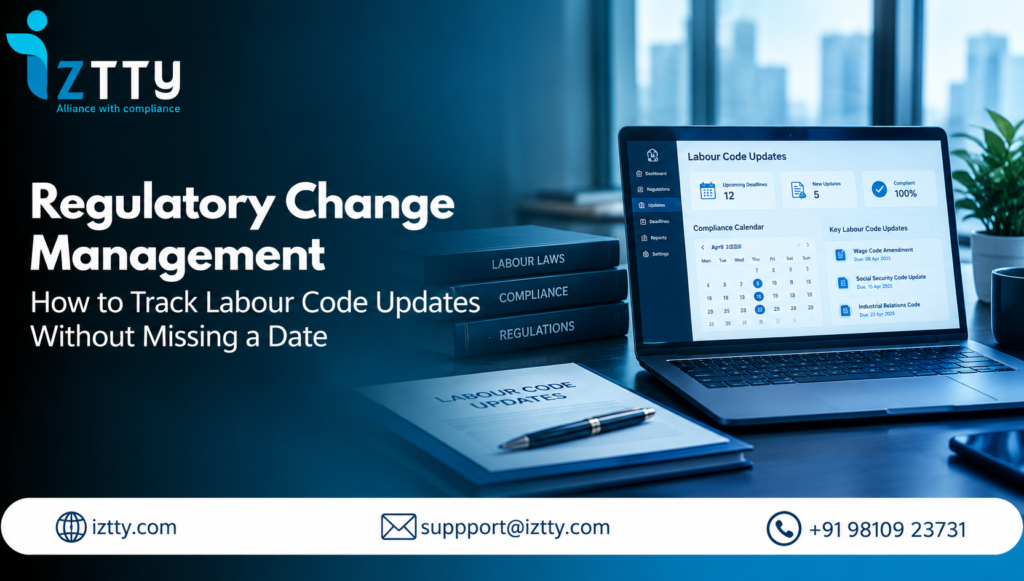
On 8 May 2026, the Central Government notified the final rules under all four Labour Codes. If you run a factory in Pune or a retail chain across four states, you may have heard about it three days later from a forwarded message. Or two weeks later from your payroll vendor. Or not until a notice arrived. That gap, between a rule changing and the person who owns the process knowing about it, is what regulatory change management exists to close.
This guide is about the process, not the news. It lays out a seven-step loop for catching a change, working out whether it touches you, assigning it, fixing the process and keeping proof. It uses the Labour Codes as the running example because they are the biggest change Indian employers have faced in decades, and they are still moving state by state.
Not sure which Labour Code changes already apply to your sites? Share your states and we will map them for you. GET A FREE COMPLIANCE AUDIT
What Regulatory Change Management Is
Regulatory change management is the routine of spotting new or amended laws, rules and circulars, deciding whether they apply to your business, assigning the work to change your processes, and keeping evidence that you did it. It is a loop, not a one-off project.
It is not the same as a compliance calendar. A calendar tells you what is due. Change management tells you that the thing on the calendar just changed: the form, the due date, the threshold or the register format. Without it, a calendar can be perfectly maintained and still wrong.
The Labour Code Timeline So Far
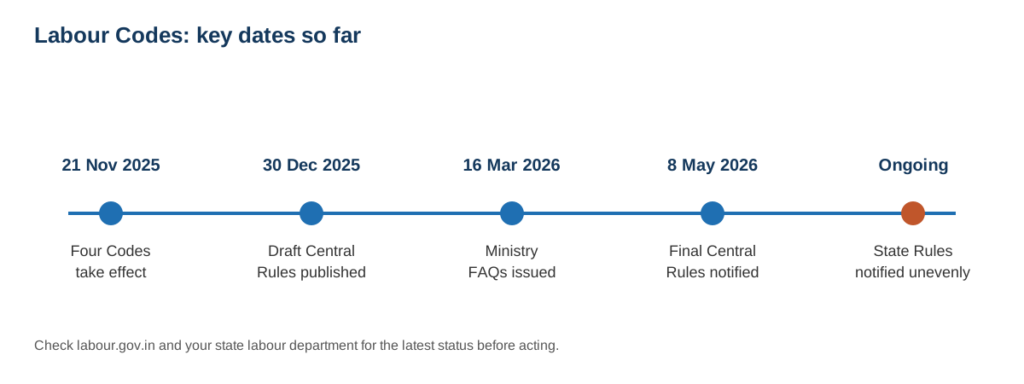
Here are the dates that matter. Treat the table as a snapshot and check the Ministry’s site before you act, because this is still moving.
| Date | What happened | Why it matters to you |
|---|---|---|
| 21 November 2025 | All four Labour Codes (Wages, Industrial Relations, Social Security, Occupational Safety, Health and Working Conditions) took effect, per the Government’s announcement, replacing 29 earlier central labour laws | The law changed on this date, even where rules were not ready |
| 30 December 2025 | Draft Central Rules published for comment | Early signal of what was coming |
| 16 March 2026 | Ministry of Labour and Employment issued additional FAQs | Clarifications on how to read the provisions |
| 8 May 2026 | Final Central Rules notified for all four Codes, along with Model Standing Orders | Operational detail for establishments where the Centre is the appropriate government |
| Ongoing | State Rules notified at different speeds | For most private factories and establishments, the State is the appropriate government, so your State Rules decide the day-to-day detail |
One point trips up a lot of teams. The Central Rules apply where the Central Government is the appropriate government, typically railways, mines, ports, banking, insurance and central public sector undertakings. For many private employers, State Rules govern the detail. Check the status in each state where you operate on the Ministry of Labour and Employment site and your state labour department’s portal.
Also remember that state Shops & Establishment Acts have remained in force alongside the Codes, so those registers and renewals still need their own tracking.
Where Changes Come From
You cannot track what you do not watch. These are the sources worth a regular look.
| Source | What it tells you | Suggested rhythm |
|---|---|---|
| The Gazette of India and State Gazettes | Notified rules and amendments, the legal text itself | Weekly |
| Ministry of Labour and Employment and PIB releases | Announcements, FAQs, clarifications | Weekly |
| EPFO and ESIC circulars (see EPFO) | Procedure changes on contributions, returns and portals | Weekly |
| State labour department notices | State Rules, wage revisions, licence and register changes | Weekly, per state |
| Inspectors and notices you receive | What authorities are actually enforcing | As received |
| Your advisers and consultants | Interpretation, not just text | Monthly |
Newsletters and forwarded messages can alert you, but treat them as pointers. Always go back to the notified text before changing a process.
The Seven-Step Change Loop
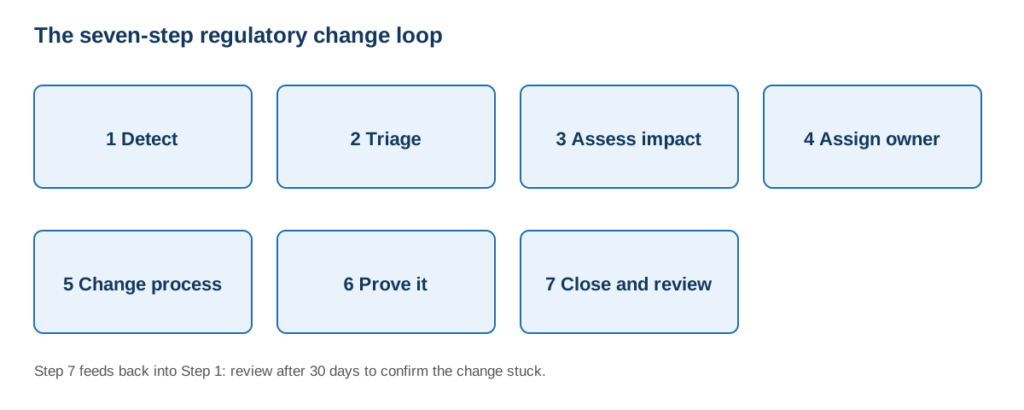
Step 1: Detect
Someone is named to watch the sources above and log anything new. Not “the team”. One person, with a backup. A single missed week is how a notified amendment becomes a surprise.
Step 2: Triage
Within two working days, answer three questions. Does this apply to our Acts, states and headcount? Is it already in force or only proposed? Does it change a due date, a form, a threshold or an obligation? Mark each change as Act now, Plan, or Watch.
Step 3: Assess the impact
List the sites, registers, filings, contracts and people affected. A rule on contract labour touches your CLRA registers, vendor agreements and payment terms. A wage definition change touches payroll, gratuity and provident fund calculations.
Step 4: Assign an owner and a date
Every change that needs action gets one named owner and a due date. If it affects more than one function, name a lead and list the contributors.
Step 5: Change the process
Update the register format, the checklist, the template or the payroll rule. Where a document goes out under a signature, put it through review. A second person checks before it is signed.
Step 6: Prove it
Store the notified text, your impact note, the updated document and the approval. When an inspector asks “when did you start doing it this way?”, you should be able to answer in a minute.
Step 7: Close and review
Mark the change closed. After a month, check whether the new process is actually being followed. Many changes are implemented on paper and quietly reverted by habit.
A simple triage rule that saves arguments
Teams often stall at Step 2 because nobody wants to be the one who says “this does not apply to us”. A simple rule helps. If a change touches an Act you are registered under, in a state where you have headcount or a licence, treat it as applicable until someone senior writes down why it is not. The note takes two minutes. Without it, you cannot show later that the decision was made on purpose.
Keep the Watch status honest as well. A proposed amendment is not a law, and acting on a draft can be as costly as ignoring a final rule. Draft rules, proposed amendments and committee reports go to Watch with a review date, not into your registers.
A Worked Example: Ten Working Days After a State Notifies Rules
This is an illustration, not a client story. A company has two plants and a warehouse in one state, with about 40 contract workers at each site. The state notifies its rules under the Code on Occupational Safety, Health and Working Conditions.
| Day | Action | Owner |
|---|---|---|
| 1 | Notification spotted in the State Gazette and logged | Compliance Manager |
| 2 | Triage: applies to both plants and the warehouse, already in force; marked Act now | Compliance Manager |
| 3 to 4 | Impact note: registers, contractor licensing and wage slip format affected | Compliance Manager with Plant HR Heads |
| 5 | Owners and dates assigned; Legal reviews contractor agreements | Admin and Legal Manager |
| 6 to 8 | Register formats and templates updated; Checker reviews | Plant HR Heads and Checker |
| 9 | Contractors told about new documents and timelines | Vendor compliance owner |
| 10 | Evidence filed; CFO gets a one-line status; change closed with a 30-day follow-up | Compliance Manager |
None of this is difficult. It simply needs somebody to see the notification on Day 1.
The Change Log: What to Record
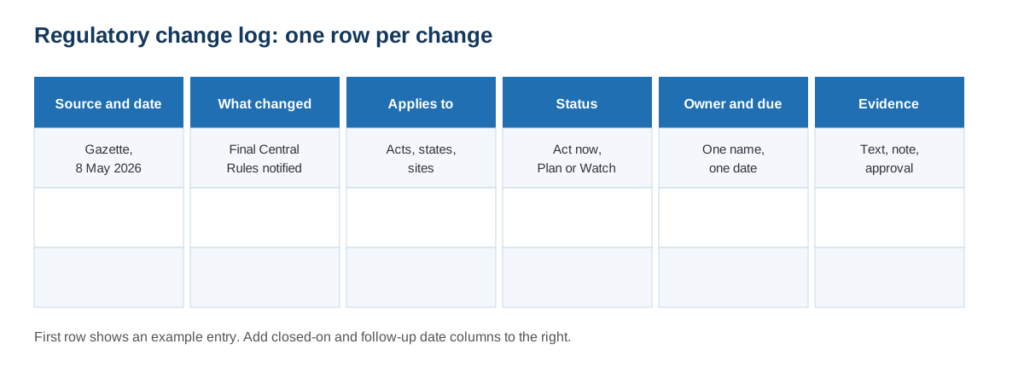
A change log is the spine of the process. One row per change, with these fields:
- Source and date: where it was published and when you saw it.
- What changed: a plain-English line plus a link to the notified text.
- Applies to: Acts, states and sites.
- Status: Act now, Plan or Watch.
- Owner and due date.
- Actions taken: what was updated.
- Evidence: documents and approval.
- Closed on, and follow-up date.
If your register of obligations carries a Code tag next to each Act, a change in a Code instantly shows you which rows to revisit. Our guide to the compliance risk register shows how.
Where Labour Code Changes Usually Hit Operations
Published advisory summaries of the Central Rules point to several areas that employers should review. Use this table as a prompt, and confirm each item against the notified text for your state before acting.
| Area | What to review |
|---|---|
| Employee documentation | Appointment letters, wage slips and registers in the prescribed content and format |
| Working hours and overtime | Weekly limits and overtime rate rules, and how payroll applies them |
| Contract labour | Principal employer duties when a contractor defaults, contractor licensing across states, wage payment timelines |
| Fixed-term employees | Gratuity eligibility and benefit parity |
| Women employees and welfare | Night-work consent and transport conditions, crèche facility or allowance rules |
| Industrial relations | Standing orders and grievance committees |
The practical point is that each row touches a different owner: payroll, plant HR, legal, vendor management. That is why a loop with named owners beats a single annual review.
Where Manual Tracking Breaks
- Late detection. The person watching the gazette goes on leave, or the update arrives as a forwarded message with no source.
- Wrong geography. A change is picked up for one state and never checked for the others.
- No owner. The change is discussed in a meeting and nobody leaves with a task.
- No proof. The process was updated but nothing shows when or by whom.
- Drift. The new format is used for two months and then slips back to the old one.
A quick self-check for your own team. Can you say, without opening a folder, who watched the Gazette last week? Can you name the last change you closed and show the evidence? If a state notified Labour Code rules yesterday, who would hear about it first, and who would they tell? If any answer takes more than a minute, the loop has a gap, and that gap is where a missed date lives.
Each of these is fixable with discipline. With 20 sites, four Codes and a handful of states notifying at different speeds, most teams find discipline alone does not scale. That is where tooling comes in, and our guide to regulatory compliance software explains what to look for.
Where Iztty Fits
Iztty is an AI-powered statutory compliance platform built by Futurex Management Solutions Limited, a New Delhi consulting firm that has handled Indian labour compliance for clients since 2014. Here is how it maps to the loop.
- Detect and triage: Regulatory Change Intelligence monitors gazette notifications, EPFO and ESIC circulars and state Shops & Establishment and Factories Act amendments.
- Assign: it generates action tasks matched to your company profile, so a change relevant to your states arrives as a task, not as a headline. A person reviews each before it is enforced in your account.
- Change the process and prove it: the Maker-Checker-DSC workflow routes updated registers through preparation, review with mandatory remarks on rejection, DSC signing and auto-archive to the Document Vault.
- Close and monitor: the Compliance Score Meter shows a live 0 to 100% score by Act and state, so you can see whether the change has landed.
- When a notice follows: AI Notice Response reads the notice, extracts the allegation and deadline and drafts a reply with an evidence checklist, averaging 4 hours against 3 to 5 days manually.
Unlike an HRMS module, where regulatory updates are usually a release note, or an enterprise GRC suite built around a bank’s risk team, Iztty is built for labour and statutory work and backed by consultants who have been reading these notifications for over a decade. For consultancies managing many clients, a separate Compliance Consultant account type exists.
See a Labour Code change arrive as a task for your sites. We will load your states and show the loop working end to end. BOOK A DEMO
Setting It Up in 30 Days
- Week 1: name a change owner and backup. List every state and Act you are covered by. Bookmark your sources.
- Week 2: build the change log. Back-fill the last six months of notable changes, starting with 21 November 2025 and 8 May 2026.
- Week 3: triage the back-fill. Mark each Act now, Plan or Watch, and assign owners.
- Week 4: run one change through the full loop, from detection to evidence. Set a monthly review with the CFO or CHRO.
Conclusion: Make Change Boring
The goal of regulatory change management is not to be first to read the news. It is to make sure that when a rule changes, the right person knows within days, the process is updated, and you can prove it. If that is boring and routine, you are doing it right.
If you are unsure how many of the recent changes have reached your registers, start with an audit.
CHECK MY COMPLIANCE | CALL AN EXPERT
FAQs
Q1: What is regulatory change management?
It is the process of spotting new or amended laws and circulars, deciding whether they apply to you, assigning action to change your processes and keeping evidence that you did. It runs as a continuous loop.
Q2: How is it different from a compliance calendar?
A calendar lists what is due and when. Change management tells you when the due date, form, threshold or format itself has changed, so the calendar stays correct.
Q3: Have the Labour Codes been implemented?
The four Labour Codes took effect on 21 November 2025, and the Central Government notified final Central Rules on 8 May 2026. State Rules are being notified at different speeds, so check each state where you operate.
Q4: Do the Central Rules or State Rules apply to my company?
It depends on who the appropriate government is. Central Rules typically apply to railways, mines, ports, banking, insurance and central public sector undertakings. For many private factories and establishments, State Rules govern the detail.
Q5: Where should I track Labour Code updates?
Start with the Gazette of India and State Gazettes, the Ministry of Labour and Employment and PIB releases, EPFO and ESIC circulars, and your state labour department. Always return to the notified text before changing a process.
Q6: How often should we review regulatory changes?
Check sources weekly, triage new items within two working days and hold a monthly review with leadership. During the Labour Code transition, weekly state checks are sensible.
Q7: Who should own regulatory change in the company?
One named person, usually the Compliance Manager or Company Secretary, with a backup. Each individual change then gets its own owner and due date.
Q8: What should a regulatory change log contain?
Source and date, what changed with a link to the notified text, who and what it applies to, status, owner and due date, actions taken, evidence, and a follow-up date.
Q9: Can software track regulatory changes automatically?
Software can monitor notifications, match them to your profile and create tasks. A person should still review before anything is enforced, because applicability and interpretation need judgement.
Q10: How much does regulatory change management software cost in India?
Pricing depends on locations, Acts, states, users and whether services are bundled. Request a quote on your own profile and compare what is included.
.
Images (3): labour-codes-timeline-2025-2026.png (after Section 2), regulatory-change-seven-step-loop.png (after Section 4), regulatory-change-log-template.png (after Section 6).