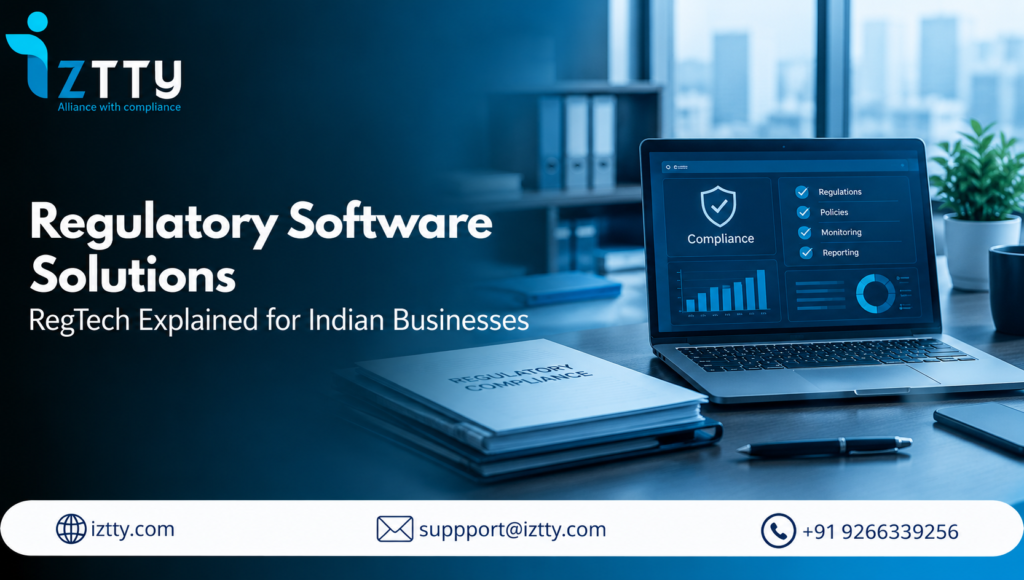
Count the logins your compliance person carries. The EPFO portal for the ECR. The ESIC portal for contributions. A state labour department site for licence renewal. Maybe a Shram Suvidha account. Then an Excel file that ties them together, and an inbox full of circulars. Somewhere in that pile sits your actual compliance. This is the gap that regulatory software solutions, the Indian end of what the world calls RegTech, are meant to close.
Most RegTech writing is about banks and anti-money-laundering. This guide is about you: an Indian employer with sites, contractors and a Labour Code transition to survive. It explains what RegTech really is, what technology sits under it, where AI helps and where it should not be trusted, and how to pick a regulatory compliance solution that fits a business your size.
Want to see how your own compliance would look inside a platform? Share your states and contractor count and we will walk you through it. GET A FREE COMPLIANCE AUDIT
What RegTech Actually Means
RegTech is short for regulatory technology: software that helps organisations meet legal and regulatory obligations faster, more accurately and with better proof. The UK’s Financial Conduct Authority helped popularise the term after a 2015 Call for Input, describing RegTech as new technologies developed to help overcome regulatory challenges in financial services.
That origin matters because it explains why so much of what you read is about banks. But the idea travelled. Anywhere there is a rulebook, a deadline and a penalty, there is a RegTech product trying to automate it. In India, one of the heaviest rulebooks sits not in banking but in employment: provident fund, ESIC, factory law, contract labour, state Shops & Establishment Acts and now the four Labour Codes.
So a plain-English definition for this guide: regulatory software solutions are tools that map the rules that apply to you, run the workflow to meet them, keep the proof and tell you when something changes.
Six Building Blocks Under the Hood
Different vendors use different jargon. Strip it away and nearly every serious product is assembled from six parts. Knowing them helps you ask better questions.
- A regulatory knowledge base. The structured list of Acts, forms, frequencies and state variations. If this is thin or stale, nothing else matters. In labour compliance it has to cope with, say, a Form 25 Muster Roll in one state and a different format in another.
- A rules engine. Logic that decides what applies to your company based on location, headcount and activity, and calculates due dates.
- Workflow. Who prepares, who checks, who signs. The maker-checker-DSC workflow is this layer.
- Document intelligence. Optical character recognition and language models that read notices, circulars and registers.
- Integrations. Connectors to payroll and HR systems so data is not re-keyed. See Iztty’s integrations and the note on API integration.
- Analytics and scoring. A live view of where you stand by Act and state, such as the Compliance Score Meter.
A product that is strong on only one of these (a pretty dashboard, say) is a feature, not a solution.
Five Lanes of RegTech in India
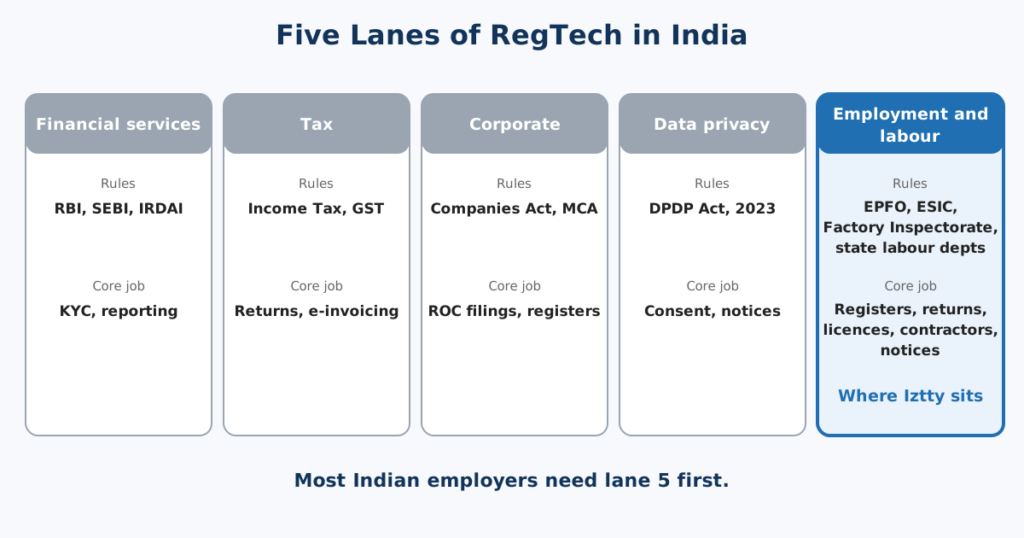
Here is something that rarely gets said. RegTech is not one market, it is several, and you almost certainly need only one or two lanes. Buying outside your lane is how companies end up with expensive tools that do not fit.
| Lane | Typical regulators and rules | Typical buyers | Core job |
|---|---|---|---|
| Financial services | RBI, SEBI, IRDAI; KYC and anti-money-laundering rules | Banks, NBFCs, insurers, fintechs | Customer checks, reporting, transaction monitoring |
| Tax and indirect tax | Income Tax Department, GST framework | Finance and tax teams | Returns, reconciliations, e-invoicing |
| Corporate and secretarial | Companies Act, MCA filings | Company Secretaries, legal teams | Board records, ROC filings, registers |
| Data privacy | Digital Personal Data Protection Act, 2023 | Legal, IT and privacy teams | Consent, notices, data requests |
| Employment and labour statutory | EPFO, ESIC, Factory Inspectorate, state labour departments, Labour Codes | HR, plant, compliance and finance teams | Registers, returns, licences, contractors, notices |
If you are a manufacturer, retailer, logistics operator or staffing company, the fifth lane is where your day-to-day risk sits. The others may matter, but they are usually handled by finance and legal tools you already own. If you want the full category comparison within that lane, see our compliance management software guide and the companion piece on regulatory compliance software.
Portals Are the Regulator’s Tech, Not Yours
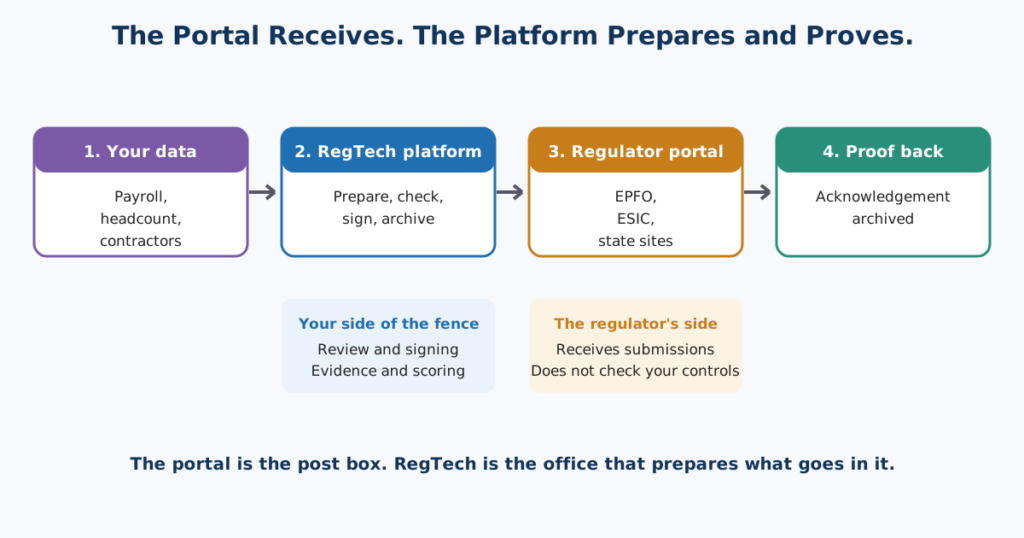
This is a distinction worth getting straight. When you log into the EPFO portal to upload an ECR, you are using the regulator’s technology. It receives your submission. It does not check whether you filed on time every month for four sites, whether the person who prepared the file is different from the person who approved it, or whether a contractor’s remittance proof is missing.
RegTech sits on your side of the fence. It helps you prepare, check, track and prove, and then hands off to the portal for submission, or integrates with it where that is supported. Think of the portal as the post box and RegTech as the office that prepares what goes in it.
What AI Does in RegTech, and What It Should Not
Every vendor now says “AI”. Here is a practical split.
What AI is genuinely good at:
- Reading a scanned notice and pulling out the allegation, the section cited and the reply deadline.
- Matching a new circular or amendment to the companies and sites it affects.
- Drafting a first version of a reply or a task list from a template and your data.
- Spotting patterns, like a contractor whose proof is slipping month on month.
What AI should not do on its own:
- Decide how an ambiguous provision applies to your business.
- Send a reply to a regulator without a person reading it.
- Change your compliance obligations because a document said so, without review.
The four Labour Codes took effect on 21 November 2025, with detailed Central and State rules still being notified. That is exactly the kind of moving ground where a monitoring tool helps and a blindly automated one hurts. Iztty’s Regulatory Change Intelligence creates tasks matched to your profile but needs human review before anything is enforced, and its AI Notice Response drafts a reply that a person then reviews. That is the right shape: AI does the reading, people make the call.
The Four-Stage Maturity Ladder
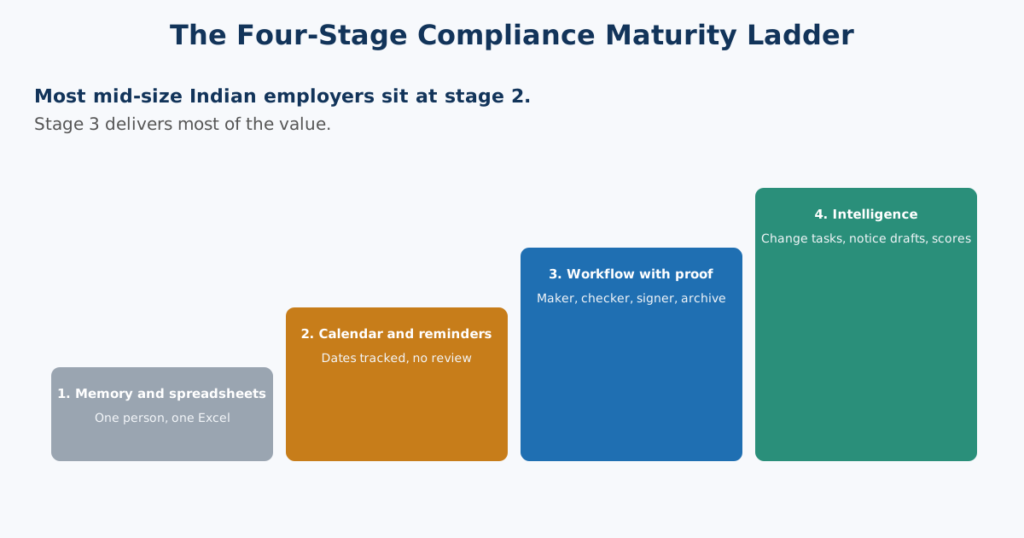
Most businesses do not need the top rung on day one. Find where you are.
| Stage | What it looks like | What breaks | What to add |
|---|---|---|---|
| 1. Memory and spreadsheets | One person, one Excel, a few email reminders | Leave, attrition, a missed renewal | A shared calendar and written owners |
| 2. Calendar and reminders | Dates tracked, but preparing and checking are informal | Wrong formats, no review, no proof | Workflow with a checker and an archive |
| 3. Workflow with proof | Maker, checker and signer; evidence stored | Rule changes arrive late; notices take days | Change monitoring and notice handling |
| 4. Intelligence | Changes create tasks, notices get drafted replies, scores show exposure | Little, if people keep the review discipline | Refinement and multi-entity views |
In our experience, many mid-size Indian employers sit at stage 2. They have a calendar and good intentions, but nobody reviews the work and nothing is stored in a way they can find under pressure. Moving to stage 3 delivers most of the value.
Buy, Build or Outsource
Three ways to get a regulatory compliance solution. They are not mutually exclusive.
| Route | Who it suits | Upside | Trade-off |
|---|---|---|---|
| Buy a platform | Multi-state employers with a compliance owner | Faster to start, maintained formats, built-in review and proof | You still need an owner and clean payroll data |
| Build in-house | Large enterprises with a technology team and unusual needs | Fits internal systems exactly | You must track every rule change and state format yourself, forever |
| Outsource to a consultant | Companies without in-house capacity | Expert hands from day one | Less visibility and less control unless paired with a system |
The honest answer for most companies is a mix: a platform for the daily workflow, with a consultant for judgement calls and inspections. That is the reason Iztty comes from a consulting firm. The people who built the registers by hand for clients are the ones who encoded them.
Data and Security Questions to Ask Any Vendor
Compliance tools handle employee wages, identifiers and contractor records. Before you sign, ask:
- Where is the data hosted, and who at the vendor can see it?
- Is access role-based, so a Maker, a Checker and a DSC holder see only what they need?
- Is there a full audit trail of who did what and when?
- How is a Digital Signature Certificate handled and stored?
- Can I export my data and records if I leave?
- How does the vendor approach obligations under the Digital Personal Data Protection Act, 2023?
A vendor that answers these in writing is worth more than one with a longer feature list.
Six Red Flags in a RegTech Pitch
- “Fully automated, no human needed.” Compliance has judgement in it. Be wary of anything that promises otherwise.
- “Covers all of India” with no list. Ask which states and registers, by name.
- AI as a headline with no example. Ask them to show a real notice being read.
- No explanation of who maintains formats and rule updates.
- A dashboard but no evidence behind the green ticks.
- A one-person signoff. If the same user can prepare, approve and sign, the control is gone.
Where Iztty Fits
Iztty is an AI-powered statutory compliance platform built by Futurex Management Solutions Limited, a New Delhi consulting firm that has handled Indian labour compliance for clients since 2014. In RegTech terms it is an employment-lane platform with a consulting backbone. It covers labour, factory, Shops & Establishment, payroll and CLRA compliance plus vendor compliance across 28+ states.
- Workflow: a four-stage Maker-Checker-DSC process (upload and validate, review and approve or reject with mandatory remarks, DSC signing, auto-archive to a Document Vault), with role-based access and a multi-branch structure.
- Intelligence: Regulatory Change Intelligence for gazette notifications, EPFO and ESIC circulars and state amendments, with human review before enforcement, plus AI Notice Response that averages 4 hours against 3 to 5 days manually.
- Visibility: a live Compliance Score Meter (0 to 100%) by Act and state with Low, Medium and High banding, and dashboards for multi-state views.
- Contractors: vendor compliance with contractor audits, proof collection and auto-calculated vendor scores.
- Connectors: payroll integrations with Tally, Zoho Payroll and Keka HR.
Compared with an HRMS module, where compliance is one menu among many, or an enterprise GRC suite built for a bank’s risk team, Iztty is purpose-built for labour and statutory work. The platform overview and AI features pages show the modules. For consultancies running several clients, a separate Compliance Consultant account type exists, and one anonymised illustration published by Iztty shows a 40-client consultancy cutting EPF and ESIC notice response from 5 days to 4 hours. It is a representative outcome, not an attributed case study.
See the platform on your own sites and states. A short demo with your locations loaded is more useful than any brochure. BOOK A DEMO
Conclusion: Pick the Lane, Then the Tool
RegTech sounds like a big, abstract idea. For an Indian employer it comes down to something plain: fewer logins and spreadsheets holding your compliance together, a second pair of eyes on every filing, proof you can find when an inspector asks, and an early warning when the rules shift. Choose the lane that matches your real risk, look for review and evidence before you look at AI, and test any platform on your own data.
Not sure where you sit on the ladder? We will tell you straight.
CHECK MY COMPLIANCE | CALL AN EXPERT
FAQs
Q1: What is RegTech?
RegTech, or regulatory technology, is software that helps organisations meet regulatory obligations more efficiently. The term grew out of financial services, and the UK’s Financial Conduct Authority described it as technologies that help overcome regulatory challenges in that sector.
Q2: Is RegTech only for banks and financial companies?
No. It began there, but the same approach now serves tax, corporate secretarial, data privacy and employment compliance. In India, labour and statutory compliance is one of the largest non-financial areas.
Q3: What are regulatory software solutions for Indian employers?
They are platforms that map applicable labour and statutory laws, run the preparation, review and signing workflow, store proof, track regulatory changes and help respond to notices. They cover EPF, ESIC, Factories Act, Shops & Establishment, CLRA, Professional Tax and Labour Welfare Fund.
Q4: How is RegTech different from GRC software?
GRC suites cover governance, risk and compliance broadly, often for enterprise risk teams. RegTech tends to focus on meeting specific regulatory obligations. Labour-focused platforms go further by carrying state-specific registers and statutory formats.
Q5: Can AI be trusted for compliance work?
For reading notices, matching circulars and drafting first versions, yes, with review. For interpreting ambiguous law or sending a reply to a regulator, no. Look for products that keep a human review step.
Q6: Does RegTech replace compliance consultants?
No. It handles the repeatable work and proof. Judgement on interpretation, inspections and complex notices still benefits from experienced professionals, which is why many companies combine a platform with a consultant.
Q7: Should we build our own compliance system?
Only if you have a technology team and unusual needs. You would need to track every rule change and state format yourself, indefinitely. Most employers are better served by buying and configuring a maintained platform.
Q8: Is employee data safe in a RegTech platform?
It depends on the vendor. Ask where data is hosted, who can see it, whether access is role-based, whether there is an audit trail, how Digital Signature Certificates are handled and how you can export your data.
Q9: How much does a regulatory compliance solution cost in India?
Pricing depends on locations, Acts, users and contractors, and on whether services are bundled. Request a quote on your own profile and compare what is included rather than headline figures.
Q10: Do the Labour Codes change what we should look for?
Yes. The four Labour Codes took effect on 21 November 2025, with detailed rules still being notified. Choose a platform that monitors changes, matches them to your profile and lets a person review each before it applies.
Images (3): regtech-five-lanes-india.png (after Section 3), regtech-portal-vs-platform.png (after Section 4), regtech-maturity-ladder.png (after Section 6).