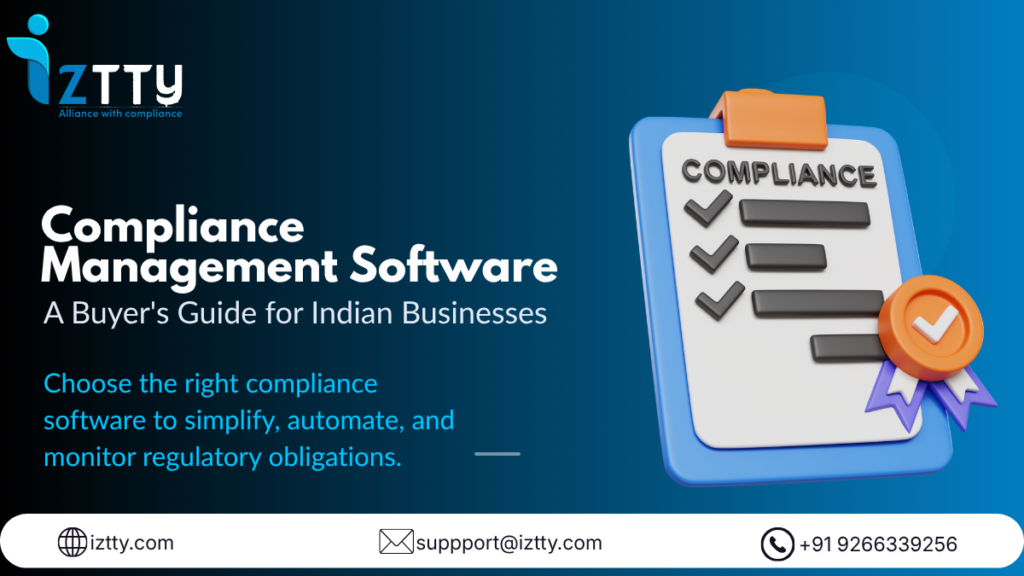
What Is Compliance Management Software, and What Should It Actually Do?
Compliance management software automates the registers, returns, and filings a business is legally required to maintain under India’s labour, factory, and tax laws, EPF under the EPF & MP Act, 1952, ESIC under the ESI Act, 1948, Factories Act 1948 registers, Shops & Establishment licences, and CLRA vendor documentation.
Done properly, it should do four specific things: generate the correct state-specific register or return format automatically, track every filing and licence deadline with advance alerts, route each document through a review step before it becomes a legal filing, and give a single, real-time view of risk exposure across every act and state a business operates in.
Most “compliance software” in the Indian market does some of this, not all of it. Knowing which part a given tool actually covers, versus which part it merely claims to cover, is the single most useful filter when evaluating options.
This distinction matters more than it sounds, because the search results for “compliance management software” are dominated by two different kinds of content: product pages from platforms built for one slice of the problem, and listicles comparing tools that are themselves mostly payroll or HRMS products with a compliance label attached. Neither tells you, directly, whether a specific tool covers factory registers, CLRA vendor liability, or a reviewed sign-off workflow, the three areas where coverage gaps actually cost companies during an inspection.
Want a direct read on what you actually need? Book a Free Compliance Audit.
Who Needs Dedicated Compliance Management Software vs. an HRMS Module?
A single-state company with no factory operations and no contract labour can often get by on the compliance module bundled into its HRMS, since the core need is accurate EPF, ESIC, and Professional Tax deductions on payroll. The calculation changes once any of three things happen: the company is covered under the Factories Act and needs state-specific registers (Form 25, Form 5, Form 17), it operates in more than one state with different S&E and Professional Tax rules, or it engages contract labour and carries principal employer liability under CLRA.
At that point, dedicated compliance management software stops being a nice-to-have and starts being the only realistic way to avoid gaps.
The Two Categories of Compliance Software in India, and the Gap Between Them
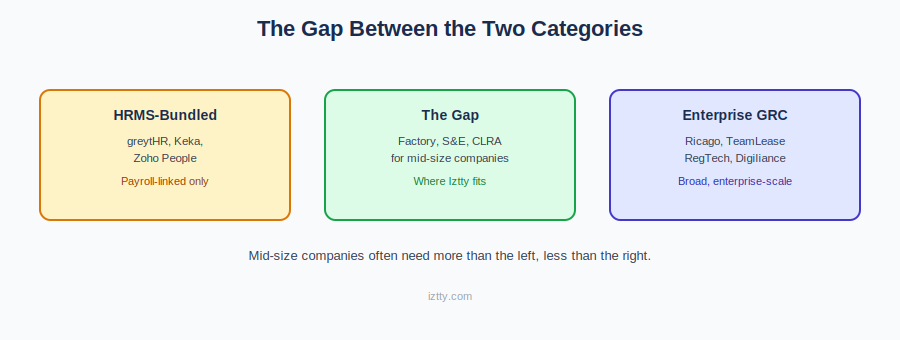
Almost every option in this market falls into one of two camps. The first is HRMS-bundled compliance, platforms like greytHR, Keka, Zoho People, and similar tools reviewed in roundups comparing HROne, Darwinbox, RazorpayX Payroll, Zimyo, PeopleStrong, ADP India, and Ramco HR, where compliance is one module alongside payroll, attendance, and leave.
The second is enterprise GRC and labour-law specialist platforms, firms like Ricago, which positions itself around tracking 1,500+ Acts and 35,000+ compliance obligations from one dashboard, or TeamLease RegTech’s RegTrack, a digital compliance management system the company describes as used across 3,300+ entities, or Digiliance’s cloud-based labour law compliance platform.
What almost none of this content addresses directly is the gap between the two camps: a mid-size manufacturer or multi-branch retailer that needs real factory, S&E, and CLRA coverage, but doesn’t need, or can’t justify the cost and complexity of, a full enterprise GRC deployment built for organizations tracking obligations across many sectors. This is the specific space a platform like Iztty is built to occupy.
It’s also worth naming the confusion this creates for buyers directly: round-ups that mix outsourced HR compliance services with software products, or that bundle labour compliance as one line item among payroll, attendance, and leave features, make it genuinely hard to tell whether a given tool was built to solve statutory compliance as its primary problem, or added compliance as a feature to an existing payroll product. The fastest way to tell the difference is to ask what happens for the specific obligations outside payroll, factory registers, licence renewals, vendor audits, since that’s where the two categories diverge sharply.
What Should You Look For in a Compliance Management System?
- Act coverage that matches your actual exposure, not just EPF/ESIC/PT, but Factories Act, S&E, and CLRA if any of those apply to you
- State-specific register generation that updates when a state amends its format, rather than a static template
- A genuine review-and-sign-off workflow before any statutory document is filed, not a single-person upload-and-submit process
- Vendor and contract labour tracking, if you engage contractors, since this is where principal employer liability concentrates
- Integration with your existing payroll or HRMS tool, rather than requiring a full system replacement
- A live, weighted risk score, not just a document repository you have to manually review to assess exposure
For the detail behind two of these specifically, see our guides on CLRA registers and returns and managing principal employer liability.
How Does Iztty Compare to Other Compliance Management Software in India?
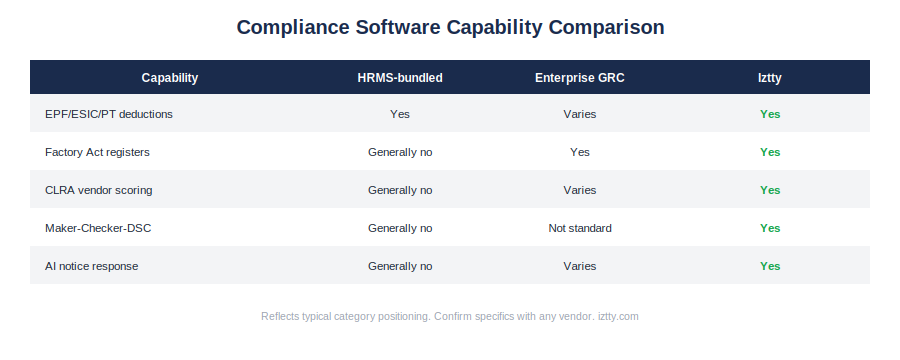
| Capability | HRMS-bundled (greytHR, Keka, etc.) | Enterprise GRC (Ricago, TeamLease RegTech, Digiliance) | Iztty |
|---|---|---|---|
| EPF/ESIC/PT payroll deductions | Yes | Varies | Yes |
| Factory Act state-specific registers | Generally no | Yes, as part of broad act coverage | Yes |
| CLRA vendor compliance scoring | Generally no | Varies by platform | Yes |
| Maker-Checker-DSC digital signing | Generally no | Not standard across the category | Yes |
| AI-assisted notice response | Generally no | Varies | Yes (approx. 4 hrs vs. 3-5 days manual) |
| Built by a compliance consultancy, not software-only | No | Varies | Yes (10+ years, Futurex Management Solutions) |
This comparison reflects each category’s typical positioning rather than every individual product’s exact feature set, since offerings do vary within each camp; confirm specifics directly with any vendor you’re evaluating, including us.
See the full platform in a live walkthrough: Explore Iztty’s platform.
What Does Compliance Management Software Actually Cost in India?
Pricing in this category typically scales with three variables: employee count, number of states and branches, and which modules are needed (payroll-only compliance costs less than a full stack including Factory, S&E, and CLRA vendor compliance). Enterprise GRC platforms built for organizations tracking obligations across many sectors tend to price at the higher end, reflecting their broader scope.
HRMS-bundled compliance is often included or low-cost as an add-on, but covers a narrower slice of actual obligations. A dedicated platform scoped specifically for Indian statutory, labour, and vendor compliance, without enterprise-wide GRC overhead, typically sits in between.
The only way to get an accurate number for your specific situation is a direct conversation scoped to your employee count, states, and which modules you actually need.
Get a scoped quote for your company: Book a Free Compliance Audit.
How Do You Evaluate a Compliance Management Tool Before Buying?
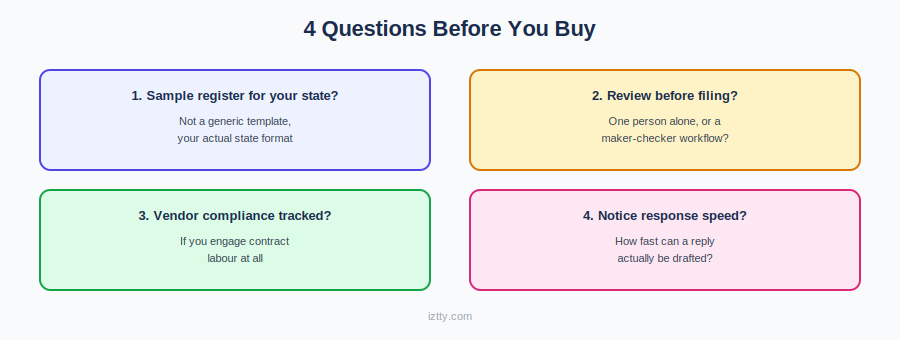
Run a short test before committing to any vendor, Iztty included: ask them to generate a sample register for your specific state and act (not a generic template), ask whether a filing can be submitted by one person alone or requires review, ask how vendor and CLRA compliance is tracked if you engage contract labour, and ask what happens when a labour notice arrives, specifically, how fast a response can realistically be drafted. The answers to these four questions tend to separate genuine statutory compliance coverage from a payroll tool with a compliance label attached.
What Makes Iztty’s Approach Different?
Three things, specifically. The Maker-Checker-DSC workflow means no single person can generate and legally sign a statutory document alone, every filing has a dated, auditable review trail. The AI Notice Response Assistant reads an EPF, ESIC, Labour, S&E, or Factories Act notice, extracts the specific allegation and deadline, and drafts a formal reply with an evidence checklist, cutting response time from the typical 3 to 5 days down to roughly 4 hours.
And the platform itself was built by Futurex Management Solutions Limited, a compliance consultancy that ran manual labour, factory, and payroll engagements for roughly a decade before automating the process, not a software team building compliance features from regulatory text alone. For the detail behind this history, see our full platform overview.
See these three differentiators in a live demo: Explore AI Features.
How Do You Get Started?
The typical starting point is a Free Compliance Audit, a state-and-act-wise review of your current exposure, followed by a walkthrough of whichever modules apply to your specific operations. This also happens to be the fastest way to directly compare Iztty against whatever else you’re evaluating, since you’ll be looking at your own data, not a generic demo dataset.
Ready to compare directly against your own compliance picture? Book a Free Compliance Audit with Iztty.
FAQs
1. What is compliance management software?
Software that automates the tracking, generation, and filing of statutory registers, returns, and contributions required under labour, factory, and tax laws, replacing manual tracking across spreadsheets and reminders.
2. What is the difference between HRMS and compliance management software?
An HRMS manages payroll, attendance, and leave with compliance as one feature focused on payroll deductions; dedicated compliance management software additionally covers factory registers, licence renewals, vendor audits, and digital sign-off workflows that most HRMS platforms don’t handle natively.
3. What does compliance management software cost in India?
Pricing depends on employee count, number of states and branches, and which modules are required; request a quote scoped to your specific situation rather than relying on a generic published price.
4. Is compliance management software only for large enterprises?
No, mid-size manufacturers and multi-branch businesses with 50 to 100+ employees commonly need it once they cross a state, factory, or vendor-compliance threshold, well below enterprise scale.
5. What are the best compliance management software options in India?
Options generally fall into HRMS-bundled platforms (payroll-focused) and enterprise GRC specialists (broad act coverage, enterprise scale), with a smaller set of platforms, including Iztty, built specifically for mid-size Indian statutory, labour, and vendor compliance without enterprise GRC overhead.
6. Does compliance management software cover the Labour Codes 2026 transition?
The four Labour Codes are formally in effect since 21 November 2025, though detailed Central and State rules are still being finalized per the Ministry of Labour & Employment. A good compliance platform should track both current Act obligations and update as new rules are notified, rather than assuming either the old or new framework exclusively.
7. Can compliance management software integrate with my existing payroll system?
Platforms like Iztty are built to integrate with existing tools such as Tally, Zoho Payroll, and Keka HR, so compliance runs alongside your current payroll data rather than requiring a replacement.
8. What is a compliance score or compliance health score?
A live, weighted measure of your statutory compliance risk, built from inputs like filing timeliness, documentation completeness, and licence validity, broken down act-wise and state-wise with risk banding.
9. Does compliance management software handle vendor and contract labour compliance?
This varies significantly by platform; dedicated vendor and contract labour compliance software (as opposed to a generic HRMS compliance module) typically runs digital contractor audits and tracks principal-employer liability documentation under CLRA.
10. How do I choose between compliance management systems?
Map your actual obligations (which acts and states apply to you) against what each system actually covers, test it with a real sample register or filing for your specific state, and confirm pricing scoped to your company size before committing.
For the full statutory compliance picture, see our pillar guide on Statutory Compliance Management in India, and our guides on Shop & Establishment Act registration, CLRA registers and returns, managing principal employer liability, payroll statutory compliance, and running a compliance risk audit. Browse more on our compliance blogs.
Image Placement (3 images, provided separately)
- compliance-software-two-categories-gap.png – Alt: “The two categories of compliance software in India, HRMS-bundled and enterprise GRC, and the gap between them” – insert after Section 3.
- compliance-software-comparison-table.png – Alt: “Comparison of HRMS, enterprise GRC, and Iztty across key compliance management capabilities” – insert after Section 5.
- compliance-software-evaluation-checklist.png – Alt: “Four questions to ask before buying compliance management software” – insert after Section 7.