This article is part of our compliance cluster. For the full statutory compliance picture across EPF, ESIC, Factories Act, and CLRA, see our pillar guide: Statutory Compliance Management in India: The Complete Guide.
What the Shop & Establishment Act Compliance Actually Regulates
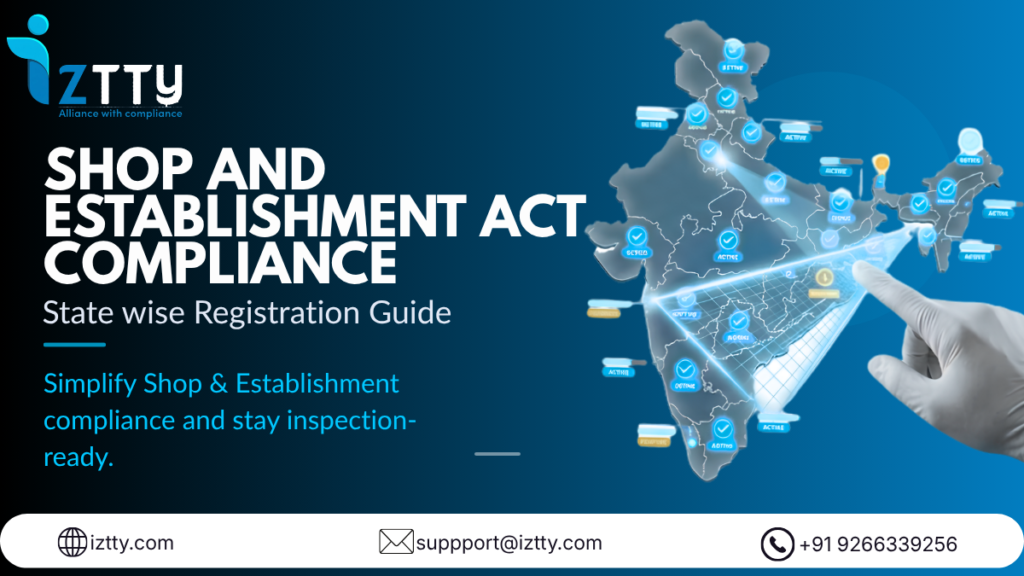
The Shops and Establishments Act is a state subject, meaning every Indian state and union territory has its own version of the law, its own registration form, and its own renewal cycle. There is no single central “Shops Act.” What’s common across states is the subject matter: working hours, rest intervals, weekly holidays, opening and closing hours, employment of young persons and women, maintenance of registers for wages and leave, and the registration of the establishment itself with the local labour or municipal authority.
This is the compliance obligation that applies to almost every commercial establishment in India, retail stores, offices, IT companies, restaurants, and warehouses, regardless of whether they are also covered under the Factories Act 1948. If you run a shop, office, or commercial establishment (as opposed to a manufacturing unit that falls under the Factories Act), S&E registration is typically your first statutory obligation, not an optional one.
Not sure if your business falls under S&E or Factories Act, or both? Book a Free Compliance Audit and get a clear answer mapped to your specific operations.
Who Needs to Register: Applicability Thresholds by State
Applicability thresholds (the employee count above which registration becomes mandatory, or the point at which additional obligations like a welfare officer kick in) are not uniform. Some states require registration regardless of employee count once a commercial establishment is operational; others set a minimum headcount. Because these thresholds are amended by individual state governments from time to time, the safest approach is to confirm the current threshold with your state’s labour department or the relevant state Shops and Establishments Act notification before assuming a number from an old reference.
What is consistent across states: registration is triggered by opening the establishment for business, not by reaching a specific employee count in most states, which means many businesses register far earlier than they expect, often within 30 to 90 days of commencing operations depending on the state’s specified window.
State-wise Registration Process: Documents, Timelines, and Fees
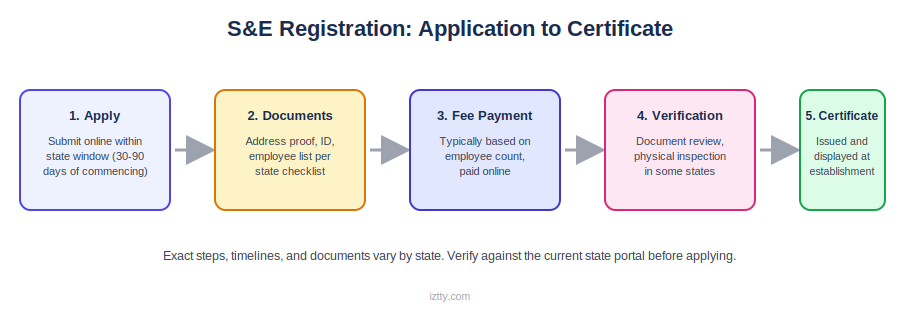
While the exact portal and form numbers vary, the registration process follows a broadly similar structure across most states:
- Application submission, typically online through the state labour department’s portal, within the state-specified window from commencement of business (commonly 30 to 90 days).
- Supporting documents, generally including proof of establishment address (rent agreement or property documents), identity proof of the employer, a list of employees with basic details, and in some states, a photograph of the establishment’s signboard.
- Fee payment, calculated in most states based on the number of employees, payable online at the time of application.
- Verification and approval, which can involve a physical inspection in some states and a purely document-based review in others.
- Certificate issuance, after which the certificate must typically be displayed prominently at the establishment.
Because document requirements and portals change with state government IT modernisation drives, verify the exact current list from the relevant state labour department website before submitting, rather than relying on a document checklist from a previous filing cycle.
Skip the manual document chase: See how Iztty tracks S&E registration and renewal status across every branch.
State-wise Comparison: Major States at a Glance
| State | Governing Act | Registration Trigger | Typical Renewal Cycle |
|---|---|---|---|
| Maharashtra | Maharashtra Shops and Establishments (Regulation of Employment and Conditions of Service) Act, 2017 | Commencement of business | 1, 3, 5, or 10 years (business’s choice at registration) |
| Karnataka | Karnataka Shops and Commercial Establishments Act, 1961 | Commencement of business | Multi-year validity, state-notified |
| Delhi (NCT) | Delhi Shops and Establishments Act, 1954 | Commencement of business | registration certificate is valid for 5 years and must be renewed before expiry |
| Tamil Nadu | Tamil Nadu Shops and Establishments Act, 1947 | Commencement of business | Annual or multi-year, state-notified |
| Telangana | Telangana Shops and Establishments Act, 1988 | Commencement of business | State-notified renewal cycle |
| Gujarat | Gujarat Shops and Establishments (Regulation of Employment and Conditions of Service) Act, 2019 | Commencement of business | State-notified renewal cycle |
| Uttar Pradesh | Uttar Pradesh Shops and Commercial Establishments Act, 1962 | Commencement of business | State-notified renewal cycle |
| West Bengal | West Bengal Shops and Establishments Act, 1963 | Commencement of business | State-notified renewal cycle |
Note: Several states have moved toward longer validity periods or one-time registration as part of ease-of-doing-business reforms in recent years. Renewal periodicity and fee slabs should always be verified against the current state notification, since these are exactly the kind of details that change without much national press coverage.
Get your multi-state renewal calendar built for you: See our compliance calendar in action.
Renewal Cycles and Why They Differ by State
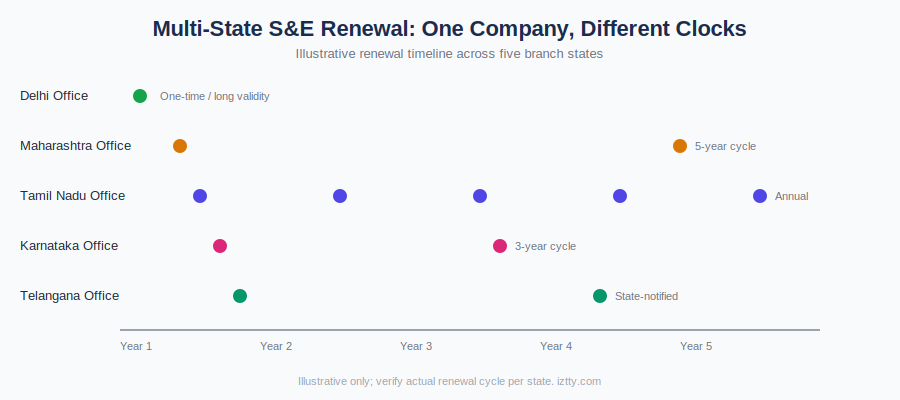
Unlike EPF or ESIC, where the compliance cycle is monthly and identical nationwide, S&E renewal cycles are set independently by each state, ranging from annual renewal to multi-year validity periods of 5 or 10 years in states that have modernised their registration frameworks. This is precisely why a multi-branch retailer or IT company operating in six states cannot manage S&E renewals on a single calendar reminder; each state licence has its own expiry date, and missing one doesn’t just risk a fine, it can affect the legal standing of the establishment to operate at that specific location.
A Plant HR Head or Admin & Legal Manager tracking this manually across multiple branches typically resorts to a shared spreadsheet with expiry dates, which works until a renewal date is entered incorrectly or a state amendment shifts a validity period retroactively, both of which happen more often than compliance teams expect.
Common Registration Mistakes That Delay Approval
- Address mismatch. The registered address on the application doesn’t match the rent agreement or utility bill exactly, causing a rejection or a request for resubmission.
- Wrong establishment category. Classifying an IT services office incorrectly as a “shop” versus “commercial establishment” (the categories carry different obligations in some states) leads to processing delays.
- Missing employee declaration updates. Many states require the registered employee count to be kept current; failing to update it after headcount changes can flag the registration during a later inspection.
- Applying under the wrong state Act for a remote or hybrid workforce. Companies with employees working from a registered office in one state but operating client-facing work in another sometimes register incorrectly, which surfaces later during a labour department query.
What Happens If You Operate Without S&E Registration
Operating a commercial establishment without valid S&E registration exposes the business to penalties under the relevant state Act, which can include fines and, in some states, the ability of the labour department to direct closure of operations until registration is completed. Beyond the direct penalty, an unregistered establishment typically cannot produce the S&E certificate that banks, landlords, government tenders, and increasingly, enterprise customers during vendor onboarding, ask for as a basic proof of legal operation.
This is also one of the first documents requested during funding due diligence for startups, since an investor’s legal team will check whether the company is operating from a properly registered establishment in every state it claims to have a presence in.
S&E Compliance for Multi-State and Multi-Branch Businesses
For a retail chain, IT services company, or logistics provider with branches across states, S&E compliance is not one registration but as many registrations as there are physical locations, each with its own renewal date, its own register format for leave and wages, and its own local labour department point of contact. A CHRO or COO overseeing this across, say, eight states needs visibility into all eight without relying on eight separate branch teams to self-report status accurately.
This is where a consolidated dashboard view, the same principle covered in our pillar guide’s section on multi-state compliance management, becomes operationally necessary rather than a nice-to-have.
See multi-branch S&E tracking live: Book a Demo.
How S&E Registration Connects to Your Other Statutory Obligations
S&E registration is often the first domino. Many states link Professional Tax registration and Labour Welfare Fund applicability to the existence of a valid S&E certificate, since it establishes the legal existence of the establishment at that address. If your S&E registration lapses or was never obtained for a specific branch, it can create downstream complications for Professional Tax filings and LWF contributions tied to that location.
This is why S&E compliance shouldn’t be tracked in isolation from your broader statutory calendar covering Professional Tax and Labour Welfare Fund obligations.
Manual Filing vs. a Compliance Platform: What Actually Saves Time
For a single-location business, manual S&E registration and renewal is entirely manageable with a calendar reminder and a folder of documents. The calculation changes once a business crosses three or four states, because at that point, tracking renewal dates, document formats, and category classifications correctly for each state becomes a dedicated task, not a five-minute admin job.
A dedicated platform’s value here isn’t “digitising a PDF,” it’s maintaining the correct, current register and renewal format per state (since these change with state amendments), sending tiered alerts before each state’s specific renewal date, and giving a CHRO or COO one dashboard instead of eight branch-level spreadsheets.
Check your current S&E status across every branch: Get a Free Compliance Audit.
FAQs
1. Is Shops and Establishment registration mandatory for all businesses in India?
Yes, in most states, any commercial establishment, including shops, offices, and IT companies, is required to register under the applicable state Shops and Establishments Act, generally within a specified window after commencing business.
2. Is there a central Shops and Establishment Act for all of India?
No, it is a state subject, so each state and union territory has its own Act, registration process, and renewal cycle, which is why requirements differ significantly between, for example, Maharashtra and Tamil Nadu.
3. How long does S&E registration take to process?
This varies by state and depends on whether physical inspection is required; some states process purely online applications within a few working days, while others take longer if verification is needed.
4. Does S&E registration need to be renewed every year?
Not always. Some states have moved to multi-year validity periods (3, 5, or even 10 years) as part of ease-of-doing-business reforms, while others retain annual renewal. Confirm the current cycle for your specific state.
5. What documents are needed for Shops and Establishment registration?
Commonly required documents include proof of establishment address, employer identity proof, and employee details, though the exact list varies by state and should be confirmed against the current state labour department checklist.
6. What is the penalty for not registering under the Shops and Establishment Act?
Penalties vary by state and can include fines and, in some cases, the labour department’s ability to restrict operations until registration is completed.
7. Does a company need separate S&E registration for each branch office?
Yes, registration is typically required for each physical establishment location, since the Act applies at the establishment level, not at the company level.
8. Is S&E registration different from Factories Act registration?
Yes, the Factories Act 1948 applies to manufacturing units meeting specific worker and power-usage thresholds, while the Shops and Establishments Act applies to commercial establishments like offices, shops, and retail outlets. A business could need one, the other, or neither, depending on its operations.
9. Can Shops and Establishment compliance be managed through an HRMS?
Most HRMS platforms don’t natively generate state-specific S&E registers or track multi-state renewal dates; this is typically handled better by a dedicated statutory compliance platform, as covered in our complete statutory compliance guide.
10. How much does Shops and Establishment registration cost?
Fees are typically calculated based on employee count and vary by state; confirm the current fee slab with your state’s labour department portal at the time of application.
For the full picture across EPF, ESIC, Factories Act, and CLRA compliance, read our pillar guide: Statutory Compliance Management in India: The Complete Guide. Browse more on our compliance blogs.