This article on CLRA Compliance is part of our compliance cluster. See the full picture in our pillar guide, Statutory Compliance Management in India: The Complete Guide.
What CLRA Actually Regulates
The Contract Labour (Regulation and Abolition) Act, 1970 governs any establishment that engages workers through a contractor rather than employing them directly, security guards, housekeeping staff, production-line contract workers, or third-party staffing arrangements. The Act exists to make sure contract labour gets the same basic protections as direct employees: timely wages, proper working conditions, and a documented, inspectable employment record, and to fix accountability on the establishment that ultimately benefits from the work, not just the contractor who technically employs the workers.
For the current statutory text, refer to the Contract Labour (Regulation and Abolition) Act, 1970 on India Code and the accompanying Central Rules, 1971, which prescribe the exact register and return formats covered below.
Who Needs to Register: Principal Employer vs. Contractor
CLRA creates two separate obligations that are frequently confused:
- The principal employer (your company, if you’re engaging contract labour) must obtain registration of the establishment under Section 7 of the Act.
- The contractor (the staffing agency or labour supplier) must separately obtain a licence under Section 12, valid for 12 months and renewable via Form VII at least 30 days before expiry.
Both obligations are triggered at the same threshold: an establishment or contractor that employs, or employed, 20 or more workmen as contract labour on any day in the preceding 12 months. Some states have amended this threshold through their own notifications, so confirm the current applicable number for your state before assuming 20 is universal.
Not sure which side of this obligation applies to you? Book a Free Compliance Audit and get a clear read on your registration status.
When Registration, Licensing, and Notices Are Required
Beyond the one-time registration and licence, CLRA requires ongoing, per-contract notifications that are easy to miss because they’re not calendar-based, they’re triggered by events:
- Form VI-A, the contractor’s notice of commencement or completion of contract work, filed with the relevant authority when a specific contract starts or ends.
- Form VI-B, the corresponding notice filed by the principal employer for the same commencement or completion event.
- Form XIV, the employment card, which the contractor must issue to each worker within 3 days of employment, not at the end of the month or the end of the contract.
- Form XV, the service certificate, issued by the contractor on termination of a worker’s employment for any reason.
This is precisely why CLRA compliance breaks down in practice: it’s not one annual filing, it’s a set of obligations triggered by specific events (a new contract starting, a worker joining or leaving) that need to be tracked as they happen, not reconstructed later from memory.
The Complete CLRA Register Checklist: Forms XII Through XXIII
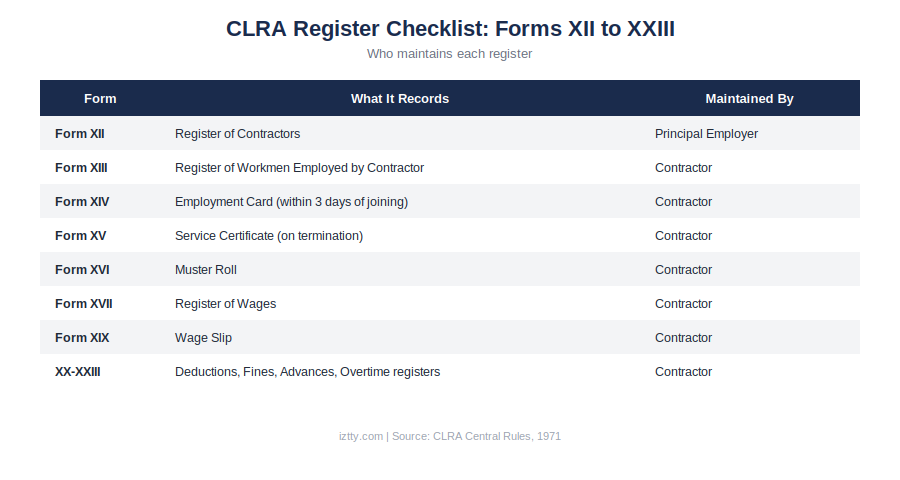
| Form | What It Records | Maintained By |
|---|---|---|
| Form XII | Register of Contractors, every contractor engaged, nature of work, period, and maximum workmen employed | Principal Employer |
| Form XIII | Register of Workmen Employed by Contractor | Contractor |
| Form XIV | Employment Card, issued to each worker within 3 days of employment | Contractor |
| Form XV | Service Certificate, issued on termination | Contractor |
| Form XVI | Muster Roll | Contractor |
| Form XVII | Register of Wages | Contractor |
| Form XVIII | Register of Wages-cum-Muster Roll (combined format, where used) | Contractor |
| Form XIX | Wage Slip, issued at least a day before wage disbursement where the wage period is a week or more | Contractor |
| Form XX | Register of Deductions for Damage or Loss | Contractor |
| Form XXI | Register of Fines | Contractor |
| Form XXII | Register of Advances | Contractor |
| Form XXIII | Register of Overtime | Contractor |
A frequent inspection failure isn’t the absence of these registers altogether, it’s inconsistency between them. A contractor’s payroll may show one headcount while the Form XVI muster roll shows another, because the muster roll wasn’t updated in real time as workers rotated on and off site. Our Factories Act registers checklist covers a similar register-consistency problem on the factory side.
How to File the CLRA Returns: Form XXIV and Form XXV
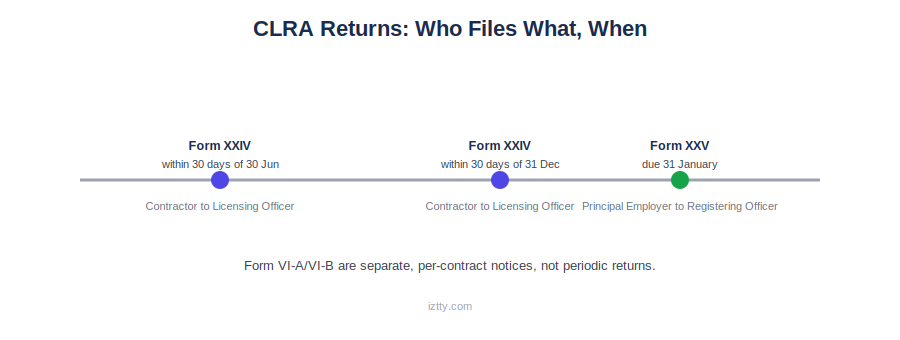
Beyond the ongoing registers, two periodic returns are mandatory:
- Form XXIV, the half-yearly return filed by the contractor to the Licensing Officer, due within 30 days of the close of each half-year (30 June and 31 December), meaning by roughly end of July and end of January.
- Form XXV, the annual return filed by the principal employer to the Registering Officer, due by 31 January.
Both returns are increasingly tracked through the Ministry of Labour and Employment’s Shram Suvidha Portal, which means a missed or inconsistent filing is now a digital, cross-referenceable record rather than a paper file that might not surface again until an active inspection.
See how these returns get tracked and filed: Explore Iztty’s CLRA & Ease of Compliance module.
Where Liability Actually Sits: Principal Employer Responsibility
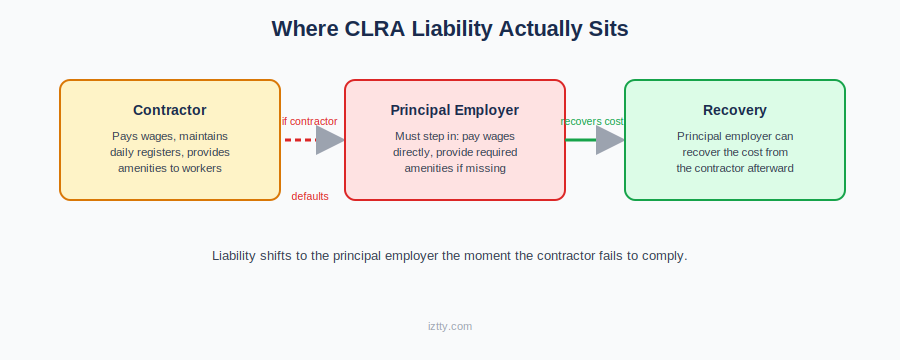
This is the part of CLRA that catches companies off guard: if a contractor fails to pay wages on time, or fails to provide amenities like rest rooms, drinking water, or first aid required under the Act, the principal employer is legally required to provide these directly and can recover the cost from the contractor afterward. In practice, this means the principal employer cannot treat contractor compliance as the contractor’s problem alone; it is a documented, ongoing obligation to verify.
This is why vendor documentation, monthly proof of EPF, ESIC, and minimum wage payment for every active contractor, matters as much as your own direct payroll compliance. Our pillar guide covers this in more detail under multi-state compliance management.
Why CLRA Compliance Fails: The Gaps Inspectors Actually Find
- Form VI-A/VI-B not filed per contract. Teams remember the initial registration but forget that every new or renewed contract needs its own commencement notice.
- Employment cards issued late, or not at all. Form XIV is meant to be issued within 3 days of employment; in practice, it’s often batched monthly, which is technically non-compliant.
- Muster roll and payroll headcount mismatch. The contractor’s actual payroll and the Form XVI muster roll drift apart when workers are added or removed without an update.
- Form XXIV filed, but not cross-checked against the principal employer’s Form XXV. Since these are filed by two different parties, inconsistencies between them are one of the first things an inspector or the Shram Suvidha system’s digital cross-referencing flags.
How a Digital Vendor Audit Trail Closes These Gaps
A digital vendor compliance process addresses each of the failure points above directly: it prompts for a Form VI-A/VI-B filing the moment a new contract is logged, tracks employment card issuance against the 3-day window per worker, reconciles contractor-submitted muster rolls against payroll data monthly, and cross-checks Form XXIV and Form XXV figures before either is filed, catching a mismatch before an inspector does. This also feeds directly into a live compliance score, so a CHRO or Compliance Manager can see vendor-side risk without waiting for the next audit cycle.
See vendor compliance automation in action: Explore Vendor Compliance features.
When CLRA Does Not Apply: Exemptions
CLRA does not apply to establishments where the work performed is of an intermittent or casual nature, or where the establishment has not carried out any work for more than 21 days in the preceding 12 months. Certain seasonal work performed for 60 days or fewer in a year, and establishments within Special Economic Zones under specific state notifications, may also fall outside the Act’s direct applicability. These exemptions are narrowly interpreted in practice, so treat them as exceptions to verify with a compliance professional rather than a default assumption for infrequent contractor use.
Penalties for Non-Compliance
Operating without the required registration or contractor licence, or failing to maintain the registers listed above, exposes both the principal employer and the contractor to penalties under the Act, including fines and, for repeated or serious violations, imprisonment provisions under the relevant sections. Beyond the direct penalty, an establishment without a clean CLRA record faces a genuine practical cost: this is exactly the documentation set requested during funding due diligence, government tender eligibility checks, and enterprise vendor onboarding.
Manual Tracking vs. a CLRA Compliance Platform
For a company with one or two small contractor relationships, manual tracking, a shared folder of monthly challans and a checklist, is workable. It stops being workable once a business is managing multiple contractors across multiple sites, because at that point, tracking event-triggered filings (a new contract starting, a worker joining) alongside calendar-based ones (Form XXIV, Form XXV) manually becomes a dedicated, error-prone task rather than an occasional admin item.
A platform’s real value here is treating CLRA as the event-driven compliance workflow it actually is, not a static checklist, prompting the right form at the right trigger, and maintaining the audit trail a principal employer needs to demonstrate it verified contractor compliance, not just assumed it. Our Maker-Checker-DSC workflow guide covers how the same review-before-sign principle applies to CLRA returns as it does to other statutory filings.
Check your current CLRA compliance status: Get a Free Compliance Audit.
FAQs
1. What is the threshold for CLRA to apply?
An establishment or contractor employing 20 or more workmen as contract labour on any day in the preceding 12 months, though some states have amended this threshold, so confirm the current number for your state.
2. Is Form VI-B a periodic return?
No, Form VI-B is a notice filed by the principal employer for the commencement or completion of a specific contract, not a recurring calendar filing. The actual periodic returns are Form XXIV (half-yearly, filed by the contractor) and Form XXV (annual, filed by the principal employer).
3. Who is responsible for maintaining CLRA registers, the principal employer or the contractor?
Most day-to-day registers (muster roll, wage register, overtime register) are maintained by the contractor, while the principal employer maintains the Register of Contractors (Form XII) and carries backup liability if the contractor fails to comply.
4. What happens if a contractor doesn’t pay minimum wages to contract workers?
The principal employer can be held liable to ensure payment and may need to pay the workers directly, recovering the amount from the contractor afterward.
5. How often must the employment card (Form XIV) be issued?
Within 3 days of a worker’s employment, and it must be kept updated with any change in particulars.
6. What is the difference between Form XXIV and Form XXV?
Form XXIV is the contractor’s half-yearly return to the Licensing Officer; Form XXV is the principal employer’s annual return to the Registering Officer, due by 31 January.
7. Does CLRA apply to security guards and housekeeping staff hired through an agency?
Yes, if the numerical threshold is met, contract labour engaged for security, housekeeping, or similar support functions falls under CLRA regardless of the nature of the work.
8. Can a company be penalised if the contractor, not the company itself, fails to comply?
Yes, the principal employer carries independent liability for verifying and, in some circumstances, directly ensuring contractor compliance, which is why documented vendor audits matter.
9. Is CLRA registration a one-time process?
The principal employer’s registration is generally ongoing once granted, but the contractor’s licence is valid for 12 months and must be renewed via Form VII at least 30 days before expiry.
10. Can CLRA compliance be tracked on the same platform as EPF/ESIC and Factories Act compliance?
Yes, and doing so is generally more reliable than tracking it separately, since CLRA liability is directly connected to a company’s broader statutory risk profile, covered in our complete statutory compliance guide.
For the full compliance picture, see our pillar guide on Statutory Compliance Management in India and our guide to Shop & Establishment Act state-wise registration. Browse more on our compliance blogs.
Suggested Placement of This Blog in Existing Content
- In the pillar guide, Section 7 (“Vendor and Contract Labour Compliance Under CLRA”) should link its “Form VI-B and Form XXIV” reference to this blog for the full register/return breakdown, and its corrected explanation.
- In the Shop & Establishment cluster blog, add a link from the closing section to this blog for readers whose S&E-registered establishment also engages contract labour.
- In iztty.com/vendor-compliance/ and iztty.com/clra-compliance/, this blog is a natural “learn more” link for visitors who land on the product page before understanding the underlying obligation.
Schema Recommendation
FAQPage schema for the FAQ section; Article schema for the full post; BreadcrumbList reflecting Pillar > Cluster hierarchy.
Image Placement (3 images, provided separately)
- clra-register-checklist-forms.png — Alt: “CLRA register checklist showing Forms XII to XXIII and who maintains each” — insert after Section 4.
- clra-returns-timeline.png — Alt: “CLRA Form XXIV and Form XXV filing timeline for contractor and principal employer” — insert after Section 5.
- clra-liability-flow-principal-employer.png — Alt: “Diagram showing where CLRA liability sits between contractor and principal employer” — insert after Section 6.