This blog on Vendor and Contractor Compliance is part of our compliance cluster. See the pillar guide, Statutory Compliance Management in India, and the related guide on CLRA Compliance: Contract Labour Registers and Returns Explained for the legal mechanics behind the liability discussed here.
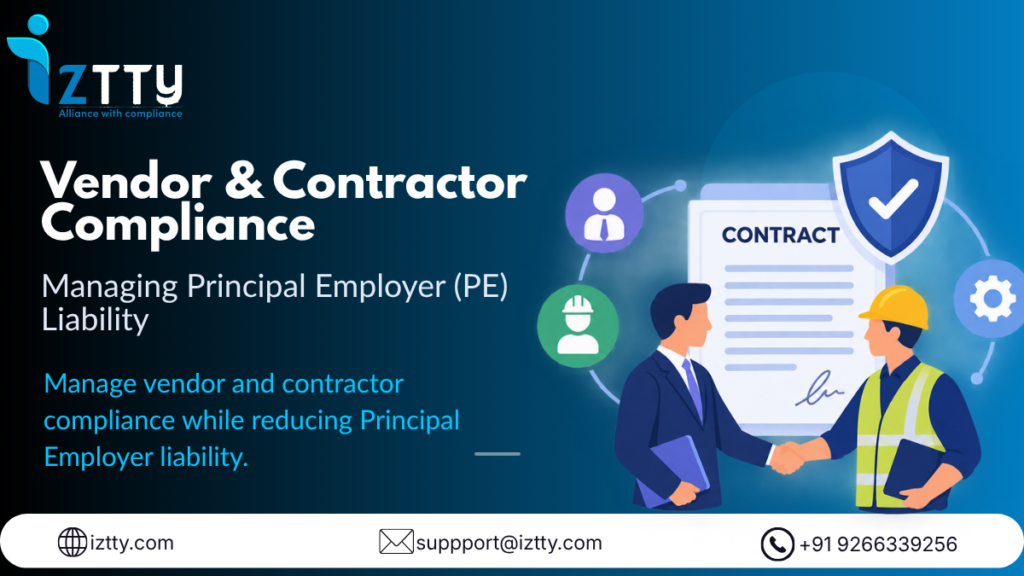
What Is Principal Employer Liability, and Why Does It Extend Beyond Your Own Payroll?
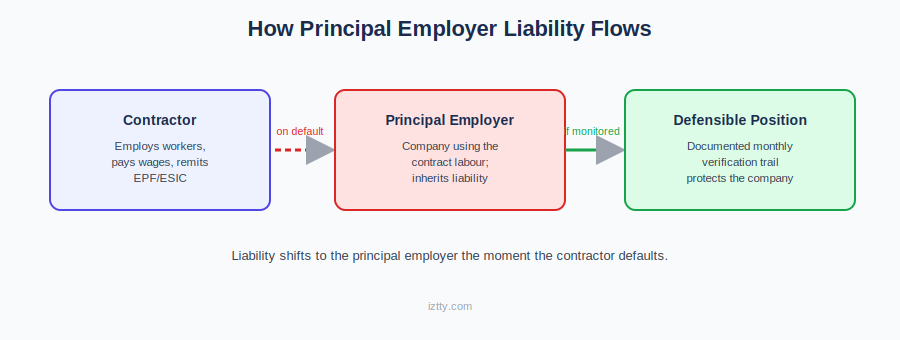
Principal employer (PE) liability is the legal exposure a company carries for a contractor’s statutory failures, wage defaults, missing EPF or ESIC remittance, or unmet welfare obligations, under the Contract Labour (Regulation and Abolition) Act, 1970. It exists whether or not the company actively monitors the contractor, which is precisely why “the vendor handles their own compliance” is not a defensible position once a labour inspection or an EPFO notice arrives.
The full legal basis, including which forms establish this liability and how it shifts back to the contractor, is covered in our CLRA compliance guide. This piece is about the operational side: how a company actually runs vendor oversight so that liability never becomes a live problem in the first place. Tracking this manually is exactly the gap Iztty’s dedicated CLRA compliance software is built to close, since it treats registration, licensing, and vendor documentation as one continuous obligation rather than a set of annual filings.
Not sure how exposed you currently are? Book a Free Compliance Audit and get a vendor-by-vendor risk read.
How Do You Structure a Vendor Onboarding Compliance Check?
Onboarding is the point where most vendor compliance programs either get built correctly or get skipped entirely under commercial pressure to start the engagement quickly. A functional onboarding check confirms four things before the first worker is deployed: the contractor holds a current CLRA licence valid for the relevant state and workforce size, the contractor has an active EPF and ESIC establishment code, the commercial contract explicitly names the wage rate against the current state minimum wage notification, and a named point of contact exists for monthly document submission.
Skipping this step doesn’t save meaningful time. It just moves the same verification work to a later date, usually the date an inspector or auditor asks for it, when the cost of catching a gap is far higher than the cost of preventing one.
What Should You Verify From a Contractor Every Month?
Annual or onboarding-only checks miss the failures that actually happen, which occur mid-contract, not at the start. A working monthly verification cycle covers:
- The contractor’s EPF Electronic Challan cum Return (ECR) and payment challan for the month
- ESIC contribution proof for the same period
- An updated muster roll reflecting actual daily headcount, not a static figure carried over from the previous month
- Wage register entries consistent with the current state minimum wage rate
A contractor who was fully compliant at onboarding can fall behind within two or three months if their own cash flow tightens, and this is exactly the pattern that goes unnoticed without a monthly check built into the relationship, rather than a courtesy request sent when someone remembers.
How Does a Vendor and Contractor Compliance Score Actually Get Calculated?
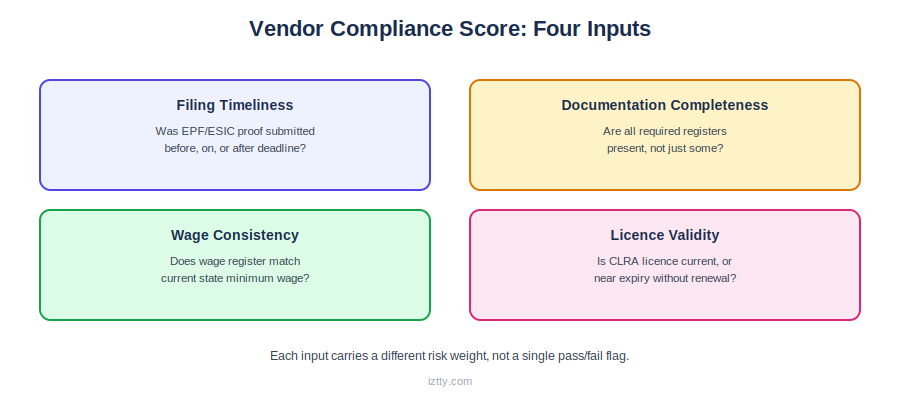
A useful vendor compliance health score isn’t a single pass/fail flag. It weighs distinct inputs that each carry different risk implications: filing timeliness (was this month’s EPF/ESIC proof submitted before, on, or after the internal deadline), documentation completeness (are all required registers present, not just the ones the vendor chose to send), wage consistency (does the wage register match the current minimum wage notification for that state), and licence validity (is the contractor’s CLRA licence current, or within 30 days of expiry without a renewal filed).
Weighting these separately matters because a vendor who is one day late on a filing carries a very different risk profile than a vendor whose licence lapsed two months ago without anyone noticing. Our Compliance Score Meter guide covers how this scoring model works at the company level; the same logic applies at the individual vendor level.
What Happens When a Vendor’s Compliance Score Drops?
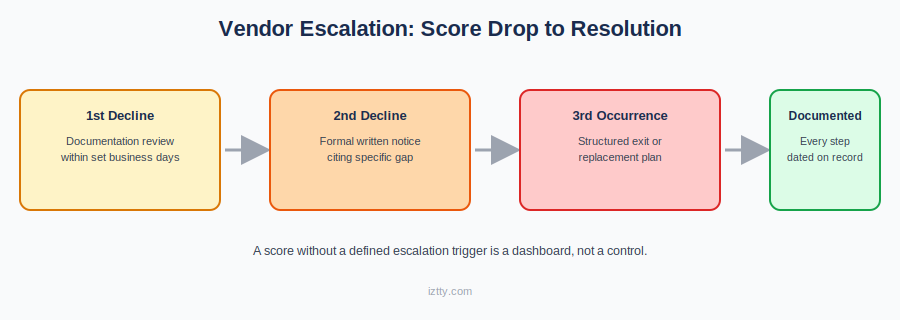
A scoring system is only useful if a low score triggers a defined action, not just a red indicator on a dashboard nobody checks. A working escalation path looks like this: a score drop below a set threshold flags the vendor for a documentation review within a set number of business days, a second consecutive month of decline triggers a formal notice to the contractor citing the specific gap, and a third occurrence without correction moves the relationship to a structured exit or replacement plan, initiated before the gap becomes a liability event, not after.
Without this defined escalation path, a compliance score becomes a reporting exercise rather than a risk control, which defeats the reason for tracking it at all.
How Do You Manage PE Liability Across Multiple Vendors and States?
Managing PE liability across several vendors and states is, at its core, a multi-state compliance management problem, not a vendor-relationship problem. A company running contract labour through six vendors across four states is managing 24 separate compliance relationships, each with its own state minimum wage notification, its own CLRA licensing authority, and its own monthly submission cadence. Treating this as one undifferentiated “vendor compliance” task is how gaps get missed; a Delhi-based security vendor’s minimum wage obligation has nothing to do with a Karnataka-based housekeeping vendor’s ESIC filing deadline, and a single shared spreadsheet rarely captures both accurately for long.
A consolidated view still matters at the leadership level, a CHRO or COO needs to see aggregate vendor risk without reviewing 24 individual files, but the underlying tracking has to stay state-specific and vendor-specific to be accurate. This mirrors the same structural challenge covered in our pillar guide’s section on multi-state compliance management.
Managing this across several vendors and states manually? Talk to our compliance team about consolidating it into one view.
What Documentation Actually Protects You If a Contractor Defaults?
If a contractor stops paying wages or EPF and the principal employer has to step in, the documentation that actually matters afterward isn’t the original commercial contract, it’s the monthly verification trail showing the company was actively checking compliance throughout the relationship, not discovering the default alongside everyone else. This includes dated copies of every monthly EPF/ESIC submission requested and received, a documented escalation history if the vendor’s score had already been declining, and a record of when the company first flagged the issue relative to when it was resolved.
This distinction, between a company that was monitoring and one that wasn’t, is frequently what separates a defensible liability position from an indefensible one during an inspection or a legal dispute.
Why Do Most Vendor Compliance Programs Fail in Practice?
Most vendor compliance programs are designed around collection, get the documents in a folder, rather than verification, confirm the documents are actually correct and current. A folder full of PDFs that nobody cross-checks against the current minimum wage notification or the actual on-site headcount provides no real protection; it only feels like protection until an inspector asks a specific question the folder can’t answer. This is precisely the gap Iztty’s statutory compliance automation India is meant to close, treating verification as an ongoing system function rather than a document-collection habit.
The second common failure is treating vendor compliance as an annual audit event rather than a monthly operating rhythm. By the time an annual audit surfaces a gap, it has typically existed for months, which is the exact period during which the principal employer’s liability was live and unmanaged.
How Does Automation Change the Vendor Audit Cycle?
The shift automation makes isn’t replacing human judgment on compliance decisions, it’s removing the dependency on someone remembering to chase 24 vendors individually every month. A platform-driven cycle sends the document request automatically on a fixed date, flags a non-submission within days rather than at the next scheduled review, cross-checks submitted wage data against the current state minimum wage rate without manual lookup, and rolls every vendor’s status into the same score used at the company level.
This is the core promise of Iztty’s AI compliance management India tools purpose-built as vendor and contract labour compliance software, rather than a generic HRMS retrofitted to do a job it wasn’t designed for. This is the specific gap our Vendor Compliance module is built to close, alongside the Maker-Checker-DSC review process for the internal sign-off before any escalation decision is finalized.
FAQs
1. Who qualifies as a “principal employer” under labour law?
The company or establishment that engages contract labour through a contractor and benefits from that work, regardless of whether the workers are on the company’s own payroll.
2. Is the principal employer liable even if the contract states the vendor is solely responsible for compliance?
Yes, a commercial contract clause allocating compliance responsibility to the vendor does not override the statutory liability the principal employer carries under CLRA.
3. How often should vendor compliance documents be collected?
Monthly, at minimum, since contractor compliance can lapse mid-contract even when the vendor was fully compliant at onboarding.
4. What’s the difference between a vendor compliance score and a company compliance score?
A company compliance score aggregates the organization’s own statutory filings and registers; a vendor compliance score tracks a specific contractor’s filing timeliness, documentation completeness, and licence validity, and typically feeds into the company-level score as one input.
5. Can a company terminate a vendor relationship for compliance failures without breaching the commercial contract?
This depends on the termination clauses in the specific commercial agreement; compliance failures are commonly written in as grounds for termination, but confirm this against your actual contract language rather than assuming it by default.
6. Does PE liability apply to staffing agencies supplying white-collar contract staff, or only blue-collar labour?
CLRA applies based on the numerical threshold of contract labour engaged, not the nature of the work, so white-collar contract staffing above the applicable threshold falls under the same obligations.
7. What’s the fastest way to check current vendor compliance exposure?
Run a documentation completeness check against the last three months of EPF/ESIC proof, muster rolls, and licence validity for every active vendor, rather than waiting for the next scheduled audit.
8. Can multiple vendors be managed on one compliance dashboard?
Yes, and doing so is generally more reliable than tracking vendors individually across separate files, provided the underlying data stays state-specific and vendor-specific rather than blended into a single aggregate figure.
9. What happens if a vendor’s CLRA licence expires mid-contract?
Engaging contract labour through an unlicensed contractor exposes the principal employer to liability, so licence expiry should trigger an immediate hold on new deployments until renewal is confirmed.
10. Is vendor compliance different from statutory compliance for direct employees?
Yes, direct employee compliance (EPF, ESIC, PT for your own payroll) is the company’s own statutory obligation, while vendor compliance is a verification obligation for a third party’s statutory compliance, with liability that shifts to the principal employer if the vendor fails.
See how ongoing vendor verification actually runs on a live platform. Book a Free Compliance Audit with Iztty.
For related reading, see our pillar guide on Statutory Compliance Management in India, our guide on CLRA registers and returns, and our Shop & Establishment Act state-wise registration guide. Browse more on our compliance blogs.