What Is a Compliance Risk Audit, and Why Not Wait for an Inspector to Run One?
A compliance risk audit is a structured, internal review of every statutory obligation your company carries, EPF, ESIC, Professional Tax, Factories Act registers, Shops & Establishment licences, and CLRA vendor documentation, run before a regulator asks for it, not in response to a notice. The distinction matters because an inspector’s review and your own audit are looking for the same gaps, but only one of them gives you time to fix what’s found before it becomes a finding on record.
Since 21 November 2025, this landscape has an added layer: the four Labour Codes, including the Code on Wages and the Occupational Safety, Health and Working Conditions Code, are now formally in effect, even though the detailed Central and State rules under them are still being finalized. During this transition, existing Act provisions continue to apply, so a risk audit run today still checks against the Factories Act, CLRA, and EPF/ESIC frameworks you already know, while also flagging which of your policies will need revisiting once the Labour Code rules are notified.
Not sure where your own gaps sit right now? Book a Free Compliance Audit.
Who Should Actually Run This Audit Internally?
In practice, this splits across three roles, and treating it as one person’s job is a common reason audits stall. The Compliance Manager or Company Secretary owns the act-wise register review, checking that Form 25 muster rolls, CLRA registers, and EPF/ESIC challans are current and consistent with each other. The Plant HR Head or Factory Manager owns the on-ground reality check, confirming the muster roll actually matches who is on site, not just what payroll says. The CHRO or CFO owns the risk prioritization step, deciding which gaps get fixed first based on penalty exposure and inspection likelihood.
A Compliance Consultant managing this across multiple client companies faces the same three-role split multiplied by every client, which is exactly the scenario Iztty’s separate Compliance Consultant account type is built for.
Where Do Most Compliance Gaps Actually Hide?
Gaps rarely show up where companies expect them. The obvious filings, this month’s EPF ECR, this month’s ESIC contribution, tend to be current because they’re tied to payroll processing that happens regardless. The gaps concentrate in the obligations that don’t have a payroll trigger attached:
- Factory or Shops & Establishment licence renewals, which run on their own calendar disconnected from payroll
- Vendor and contractor documentation, since a contractor’s compliance doesn’t automatically surface in your own systems
- Register consistency, where the muster roll, wage register, and actual headcount drift apart over months without anyone cross-checking them
- Event-triggered CLRA filings, like the commencement notice for a new contract, which are easy to forget because they aren’t calendar-based
This is the same pattern covered in our guide on CLRA registers and returns: the failures that matter are rarely the ones with a fixed monthly deadline. A useful internal test: for every obligation your company carries, ask whether missing it would trigger an automatic alert somewhere in your process, or whether it depends entirely on a person remembering. Anything in the second category is where a gap audit should start.
What Should a Pre-Inspection Audit Check, Act by Act?
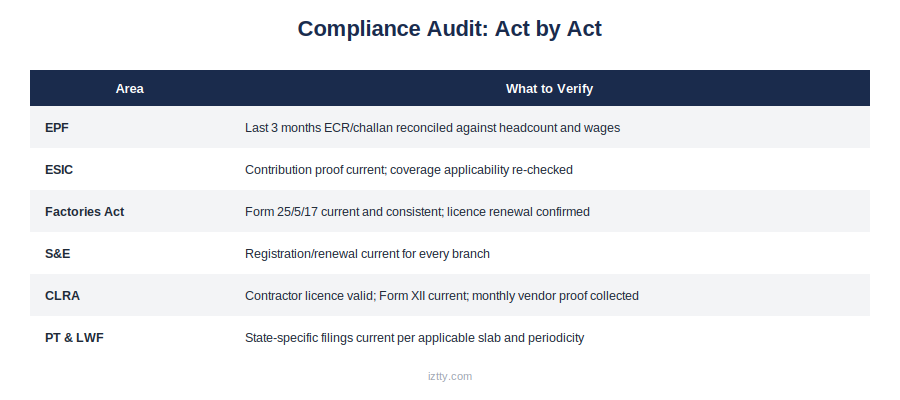
| Area | What to Verify |
|---|---|
| EPF | Last 3 months of ECR filings and challans reconciled against actual headcount and wage data |
| ESIC | Contribution proof current, and coverage applicability re-checked if headcount has changed |
| Factories Act 1948 | Form 25 (Muster Roll), Form 5 (Register of Accidents), Form 17 (Overtime) current and consistent; factory licence renewal date confirmed |
| Shops & Establishment | Registration and renewal status current for every branch location, not just head office |
| CLRA (if contract labour engaged) | Contractor licence validity, Form XII register current, monthly EPF/ESIC proof collected from every active vendor |
| Professional Tax & LWF | State-specific filings current against each state’s own slab and periodicity |
For the S&E-specific detail behind this table, see our state-wise S&E registration guide, and for the vendor-side checks, our guide on managing principal employer liability.
When Should You Run This Audit?
An annual audit is better than none, but it means any gap that opens up in month two of the year runs undetected for up to ten months. A monthly reconciliation cycle for the fast-moving items, EPF/ESIC filings, vendor documentation, register consistency, combined with a quarterly deeper review of licence renewals and CLRA event-based filings, catches problems while they’re still small enough to fix quietly rather than explain to an inspector.
The specific trigger points worth adding an audit around: onboarding a new vendor, opening a branch in a new state, and any headcount change that shifts you across an applicability threshold (ESIC coverage, CLRA’s 20-workmen threshold, Factories Act power-usage or headcount criteria).
How Do You Score and Prioritize the Gaps You Find?
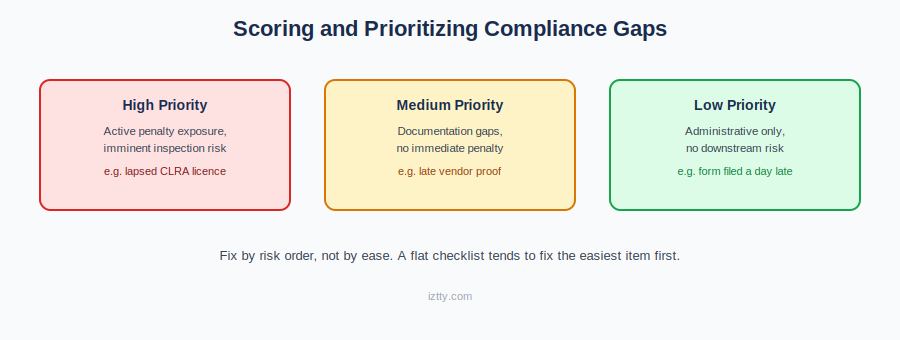
Not every gap carries the same risk. A useful way to prioritize: weight each finding by filing timeliness (how overdue is it), documentation completeness (is something missing entirely, or just late), and penalty exposure (does this specific Act carry meaningful fines or imprisonment provisions for the gap found). This is the same logic behind a live compliance health score: a single missed filing from yesterday is a different risk category than a factory licence that lapsed two months ago unnoticed.
In practice, this means building a short prioritized list rather than a flat one: gaps with active penalty exposure and imminent inspection risk go first, gaps that are purely administrative (a form filed a day late with no downstream consequence) go last. A compliance team working from an unprioritized checklist of forty items tends to fix whichever one is easiest, not whichever one matters most.
What Does a Labour Inspector Actually Look at First?
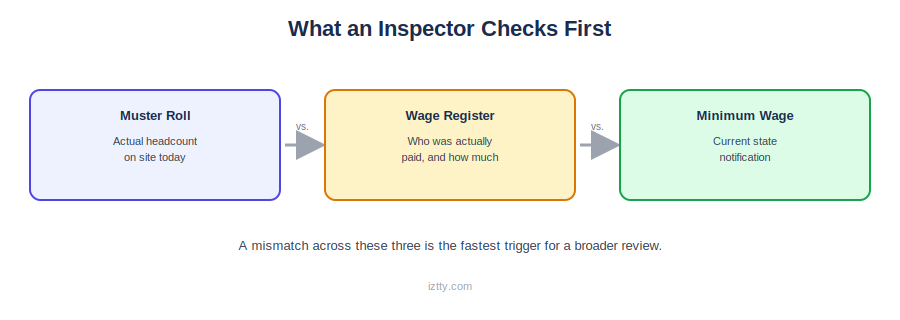
In practice, inspectors tend to start with the documents that are quickest to cross-check for internal consistency: the muster roll against the wage register, the wage register against the current state minimum wage notification, and (where contract labour is present) the contractor’s registers against the principal employer’s own Form XII. A mismatch here is the fastest way to trigger a broader review, since it signals the underlying records aren’t being actively verified, not just that one document is late.
How Do You Fix a Gap Without Creating a Paper Trail of Non-Compliance?
This is a common concern, and the honest answer is that a documented, timely correction is a materially better position than an undocumented one, not a liability in itself. Backdating a register to hide when a gap existed is falsification and carries its own penalty exposure under most of these Acts. The defensible approach is the opposite: date the correction accurately, note when the gap was found and how it was resolved, and let that documented timeline demonstrate active monitoring rather than obscure it. This is exactly the kind of record a Maker-Checker-DSC workflow creates automatically, since every correction is dated and signed off, not quietly edited.
Want this audit trail built into your process rather than reconstructed after the fact? Talk to our compliance team.
How Does Automation Change a Manual Audit Cycle?
A manual audit depends on someone remembering to pull every register, cross-check every figure, and flag every renewal date, across every state and every vendor, on a recurring basis. This is exactly the kind of repetitive, high-stakes checking that statutory compliance automation India tools are built to remove from a compliance team’s plate. An AI compliance management India platform can run the cross-checks (muster roll versus wage register, contractor documentation versus CLRA licence status) continuously rather than in a periodic sweep, and roll every finding into the same compliance health score used at the leadership level. This is the specific problem our platform and AI features are built to address.
FAQs
1. What is a statutory compliance audit checklist?
A structured list of every statutory obligation, EPF, ESIC, Factories Act, S&E, CLRA, checked for current, consistent documentation before an inspector or regulator asks for it.
2. How often should a compliance risk audit be run?
Monthly for fast-moving items like EPF/ESIC filings and vendor documentation, quarterly for licence renewals and deeper register review, and immediately around triggers like a new branch or a headcount threshold change.
3. What’s the difference between a compliance audit and a compliance score?
An audit is the review process itself; a compliance score is the resulting output, a weighted, ongoing measure of risk that updates as filings and documentation change, rather than a one-time snapshot.
4. Are the Labour Codes 2026 relevant to a current compliance audit?
Yes, the four Labour Codes are formally in effect since 21 November 2025, though detailed Central and State rules are still being finalized. A current audit should still check against existing Act provisions, which remain in force during this transition, while flagging policies that will need revisiting once the Labour Code rules are notified.
5. What’s the fastest way to check current compliance exposure?
Run a documentation completeness check against the last three months of EPF/ESIC proof, muster rolls, and licence validity, rather than waiting for the next scheduled annual audit.
6. Does a documented, late correction look worse than no correction at all?
No, a dated, documented correction demonstrates active monitoring and is generally viewed far more favourably than an undocumented gap discovered by an inspector.
7. Can one compliance audit cover multiple states?
Yes, though the underlying checks need to stay state-specific, since minimum wage rates, S&E renewal cycles, and CLRA licensing authorities differ by state even when the audit itself is run centrally. This is the same principle covered in our pillar guide’s section on multi-state compliance management.
8. Does an HRMS compliance module cover this kind of audit?
Generally not fully; an HRMS compliance module focuses on payroll-linked deductions, while a compliance risk audit needs to cover factory registers, CLRA vendor documentation, and licence renewals that fall outside standard HRMS coverage.
9. What should a company do immediately after finding a compliance gap?
Document when it was found, correct it with an accurate current date, and record the corrective action taken, rather than delaying the fix or attempting to backdate the correction.
10. Can vendor and contract labour compliance software help with this audit?
Yes, since contractor documentation is one of the most common places gaps hide, dedicated vendor and contract labour compliance software can automate the monthly collection and cross-checking that a manual audit often misses.
Ready to see your own gaps before an inspector does? Book a Free Compliance Audit with Iztty.
Suggested Internal Linking Placement
- In the pillar guide, the “Choosing a Statutory Compliance Platform” section should link the phrase “compliance audit” to this blog for the full pre-inspection checklist.
- In the CLRA cluster blog, the “Why CLRA Compliance Fails” section can link here as the broader audit framework this specific failure pattern fits into.
- In the S&E cluster blog and the Vendor/PE Liability blog, the closing “next step” sections can link here for readers ready to move from a single-topic guide to a full audit.
- On iztty.com/compliance-calendar/, this blog is a natural companion link, since the calendar answers “when is it due” and this blog answers “how do I check if I’m actually compliant.”
Schema Recommendation
FAQPage schema for the FAQ section; Article schema for the full post; BreadcrumbList reflecting Pillar > Cluster hierarchy.
Image Placement (3 images, provided separately)
- compliance-audit-act-by-act-checklist.png – Alt: “Act-by-act compliance audit checklist covering EPF, ESIC, Factories Act, S&E, and CLRA” – insert after Section 4.
- compliance-gap-scoring-priority.png – Alt: “How to score and prioritize compliance gaps by risk exposure” – insert after Section 6.
- inspector-first-checks-flow.png – Alt: “What a labour inspector checks first: muster roll, wage register, minimum wage consistency” – insert after Section 7.