Part of our Labour Law Compliance Software cluster – see the complete buying, implementation & ROI guide for the full picture. This piece goes deep on one question that guide deliberately left for a dedicated page: which category of tool do you actually need?
Table of Contents
- 1. Quick answer: three types, one decision
- 2. Type 1 – HRMS with a bundled payroll-statutory module
- 3. Type 2 – Specialist statutory compliance platform
- 4. Type 3 – Enterprise GRC platform
- 5. The fourth option nobody markets: outsourced compliance service
- 6. Side-by-side comparison
- 7. Coverage matrix: what each type actually handles
- 8. Decision tree: which type do you need?
- 9. Cost models compared
- 10. Migration paths: how companies typically move between types
- 11. Recommendation by persona
- 12. Recommendation by sector
- 13. Where a specialist platform like Iztty fits
- 14. FAQs
- 15. Sources checked
Quick answer: three types, one decision
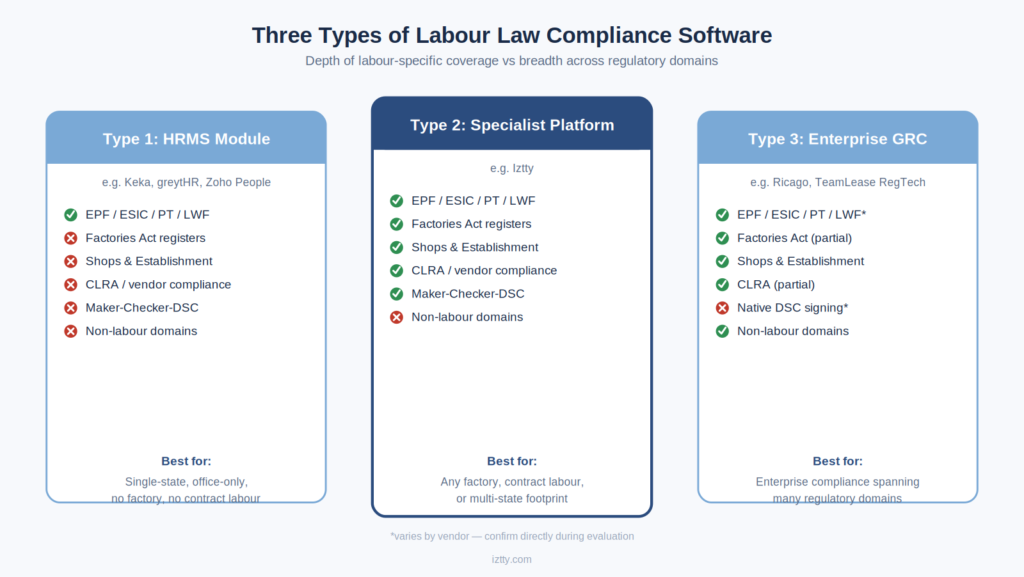
Three genuinely different types of Labour law compliance software in India: an HRMS with a bundled payroll-statutory module (covers EPF/ESIC/PT/LWF only), a specialist statutory compliance platform (covers Factories Act, Shops & Establishment, CLRA, and payroll-statutory together), and an enterprise GRC platform (covers labour compliance as one category among 1,000+ regulatory obligations spanning many domains).
The right choice depends on three yes/no questions: do you have a factory, do you use contract labour, and do you operate in more than one state. Answer yes to any of them, and an HRMS module alone is very likely insufficient – see the decision tree below for the full logic.
Why “labour law compliance software” gets used as if it were one thing
Search results, vendor marketing, and even internal procurement conversations routinely treat “labour law compliance software” as a single, comparable product category – the same way “CRM software” or “accounting software” are shopped for on a shared feature checklist. The comparison breaks down here because the three types described in this article aren’t competing implementations of the same idea; they’re built around three different core objects (the payroll transaction, the establishment and its registers, and the enterprise-wide regulatory obligation) that only partially overlap.
A buyer who shops across all three types using one feature checklist will consistently either overpay for breadth they don’t need or underbuy on depth they do need – which is exactly the confusion this article exists to resolve before you request a single demo.
Type 1 – HRMS with a bundled payroll-statutory module
This is what you get when “compliance” is a feature inside a broader HR/payroll suite – Keka, greytHR, Zoho People, Darwinbox, HROne-reviewed platforms, RazorpayX Payroll, and similar tools all fall here. The compliance feature is, specifically, the payroll-statutory layer: EPF ECR generation, ESIC contribution and challan filing, Professional Tax deduction against state slabs, and Labour Welfare Fund contribution where applicable.
What it’s genuinely good at: automating a real, recurring, well-defined calculation – payroll deductions and their corresponding government challans – tightly integrated with the same system that already holds your salary data.
What it structurally cannot do: maintain Factories Act registers, track Shops & Establishment renewals across states, audit a contractor’s CLRA compliance, or provide a Maker-Checker-DSC signing workflow – because none of these were part of the product’s original design brief. The core data object in an HRMS is “employee + salary,” not “establishment + register.”
Signs you’ve outgrown Type 1: you’ve opened a factory or warehouse requiring registration, you’ve engaged your first contractor or staffing vendor for any function, or you’ve expanded into a second state and discovered your HRMS has no view of that state’s Shops & Establishment renewal cycle at all.
Best fit: single-state, office-only businesses with no factory registration and no contract labour, where payroll-statutory compliance genuinely is the full extent of the obligation.
Type 2 – Specialist statutory compliance platform
This category – where Iztty, Ricago’s more labour-focused modules, TeamLease RegTech, and Digiliance compete – is built around the establishment and its registers, not the payroll transaction. It handles Factories Act registration and register-keeping (commonly the register of adult workers, overtime register, and leave-with-wages register), state-specific Shops & Establishment registers and renewals, CLRA contractor licensing and returns, vendor/contractor compliance auditing, and the payroll-statutory layer as well – all within one system, ideally with a Maker-Checker-DSC signing workflow that makes every register defensible, not just stored.
What it’s genuinely good at: the full breadth of labour, factory, and contract-labour compliance specifically – deep coverage in a focused domain, built by people who understand the actual forms and section numbers involved, rather than a generic compliance framework applied to labour law after the fact.
What to watch for: not every platform marketed in this category has equally deep state coverage or equally native signing workflows – ask to see your specific state’s register format populated with sample data before assuming coverage (see the evaluation checklist in the pillar guide).
Best fit: any organisation with a factory, any contract labour, or any multi-state footprint – which, in practice, describes most manufacturers, multi-location retailers, staffing firms, and construction companies.
What separates a genuine specialist platform from one that just claims the category
Not every tool that markets itself as “statutory compliance software” delivers equally on this category’s promise. Three checks separate the genuine article from a payroll module with extra marketing language: can it produce your specific state’s Factories Act or S&E register format, populated with real data, on request; does it support DSC-based signing natively rather than as a manual off-platform step; and does it treat vendor/contractor compliance as a first-class module with auto-scoring, rather than a static checklist item. A platform that clears all three is doing the category’s actual job.
Type 3 – Enterprise GRC platform
Platforms like Ricago (at the broader end) and similar enterprise governance, risk, and compliance tools track labour compliance as one category among a much wider scope – often 1,000+ Acts spanning environmental regulation, sector-specific licensing, corporate governance, and more, alongside labour law.
What it’s genuinely good at: giving a large enterprise a single pane of glass across regulatory domains that have nothing to do with labour law – useful when your compliance function is centralised and covers far more than HR-adjacent obligations.
What tends to be shallower: the labour-specific depth – Maker-Checker-DSC signing built natively into the workflow, and vendor/contractor compliance auditing with auto-scoring, are less consistently native features in this category compared to a labour-focused specialist platform, because labour compliance is one slice of a much broader product scope rather than the core design brief.
Best fit: large enterprises whose compliance obligations extend meaningfully beyond labour law – where the value of one consolidated dashboard across many regulatory domains outweighs losing some labour-specific depth.
A note on the “1,000+ Acts” positioning
Several enterprise GRC platforms market breadth in terms of the sheer number of Acts and obligations tracked – a genuinely different value proposition from a labour-focused specialist platform’s depth-first approach. Neither positioning is “better” in the abstract; the right question is whether your compliance function’s actual scope matches the breadth-first or depth-first model.
A company whose compliance risk is overwhelmingly concentrated in labour, factory, and contract-labour law gets more practical value from depth; a company managing labour compliance as one line item within a much larger enterprise risk function gets more value from breadth.
The fourth option nobody markets: outsourced compliance service
Worth naming explicitly because it’s a genuine alternative to buying any software at all: engaging a compliance consultancy to handle filings, registers, and audits on your behalf, without you operating a platform yourself. This isn’t “no solution” – for organisations that want compliance fully handled externally, it’s a legitimate path.
The trade-off: visibility. A pure service relationship, without a shared platform or dashboard, can create a black box where you only learn about a risk when the consultancy tells you – which is precisely why the strongest setups often combine a specialist platform (Type 2) with an advisory relationship layered on top, rather than choosing outsourcing instead of software entirely.
Side-by-side comparison
| HRMS module | Specialist platform | Enterprise GRC | Outsourced service | |
|---|---|---|---|---|
| Payroll-statutory (EPF/ESIC/PT/LWF) | Strong – core feature | Strong | Tracked, sometimes not processed end-to-end | Handled by the consultancy |
| Factories Act registers | None | Strong | Tracked as a task, not always a native register | Handled, but visibility depends on the consultancy’s reporting |
| S&E Act, multi-state | None | Strong | Usually covered | Handled externally |
| CLRA / vendor compliance | None | Strong – often a dedicated module | Varies by vendor | Handled externally |
| Maker-Checker-DSC signing | Rare | Common in this category | Rare – often manual, off-platform | N/A – no platform |
| Breadth beyond labour law | None | None (by design – labour-focused) | Very broad | Depends on consultancy scope |
| You retain direct visibility | Yes, for payroll only | Yes, across full labour scope | Yes, across broad scope | Only what’s reported to you |
| Typical buyer | Small, single-state, office-only | Manufacturer, multi-state retailer, staffing firm, construction | Large enterprise, multi-domain compliance function | Any size, wants compliance fully off their plate |
Coverage matrix: what each type actually handles
| Capability | HRMS module | Specialist platform | Enterprise GRC |
|---|---|---|---|
| EPF ECR / ESIC challan filing | Full | Full | Partial |
| Factories Act Form 25/5/17-style registers | None | Full | Partial |
| S&E state-specific registers | None | Full | Full |
| CLRA contractor licence tracking | None | Full | Partial |
| Vendor compliance auto-scoring | None | Full | Partial |
| DSC-based signing | Rare | Full | Partial |
| AI-assisted notice response | None | Available in leading platforms | Varies |
| Non-labour regulatory domains | None | None | Full |
“Partial” above means the capability is often tracked as a generic task or checklist item rather than a purpose-built register or workflow – worth confirming directly with any vendor rather than assuming from a feature list.
Decision tree: which type do you need?
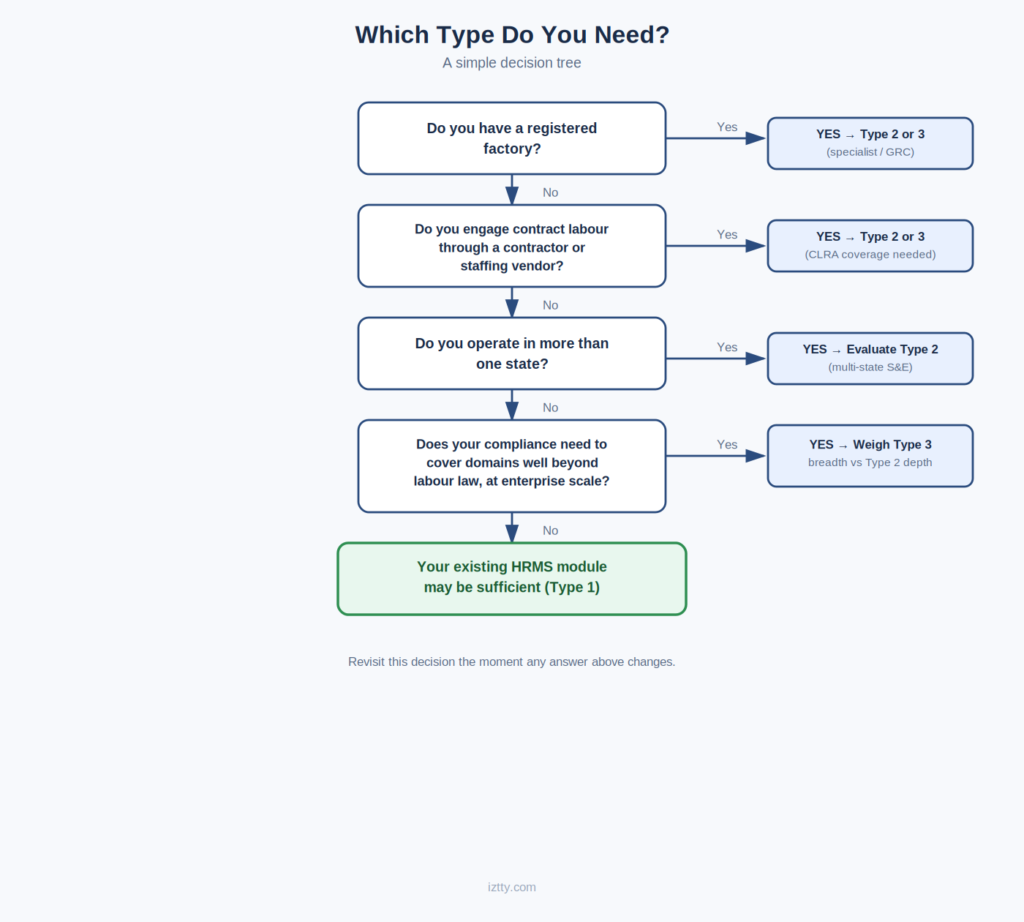
- Do you operate any factory registered under the Factories Act? If yes → you need a specialist platform (Type 2) or enterprise GRC (Type 3), not an HRMS module alone.
- If no factory – do you engage any contract labour through a contractor or staffing vendor? If yes → you need Type 2 or Type 3 for CLRA and vendor compliance coverage.
- If no factory and no contract labour – do you operate in more than one state? If yes → you at minimum need multi-state S&E tracking, which an HRMS module doesn’t provide; evaluate Type 2.
- If none of the above apply – single state, no factory, no contract labour – your HRMS’s payroll-statutory module may genuinely be sufficient. Revisit this decision if any of these three facts change.
- Separately – does your compliance function need to cover regulatory domains well beyond labour law (environmental, sector-specific, corporate governance) at enterprise scale? If yes, weigh Type 3’s breadth against Type 2’s labour-specific depth for your specific mix of obligations.
Cost models compared
Pricing structures differ meaningfully by type, which makes headline price comparisons misleading without checking the model underneath:
- HRMS module: typically bundled into a broader per-employee HR/payroll subscription – the compliance feature itself is rarely priced separately, which is part of why buyers underestimate its narrow scope.
- Specialist platform: usually priced per-employee and/or per-branch, with vendor/contractor compliance auditing sometimes included and sometimes a separate add-on – always confirm which before comparing quotes.
- Enterprise GRC: typically enterprise-licensed, often with implementation and configuration costs that scale with the breadth of regulatory domains covered, not just headcount.
- Outsourced service: usually a recurring retainer or per-filing fee structure, with cost driven by the number of locations and filings rather than software licensing.
A worked example
Consider two companies, both roughly 200 employees. Company A is a single-office IT services company in one city – its entire statutory obligation is EPF, ESIC, PT, and LWF, so its existing HRMS subscription (already paid for payroll) covers this at effectively no additional compliance cost. Company B is a three-factory manufacturer in Maharashtra, Gujarat, and Tamil Nadu using two staffing vendors for warehouse labour – its HRMS module handles the same EPF/ESIC/PT/LWF layer, but leaves entirely uncovered: three states’ worth of Factories Act registers, S&E-adjacent factory licensing, and two vendor relationships carrying CLRA principal-employer exposure.
Company B’s realistic comparison isn’t “HRMS module cost vs specialist platform cost” – it’s “specialist platform cost vs the uninsured exposure of Section 92 penalties, CLRA liability, and unrecoverable staff time spent reconstructing registers manually.” Same headcount, structurally different compliance category.
Migration paths: how companies typically move between types
The most common trajectory: a company starts on an HRMS module because it’s the default that came with payroll, discovers the gap when it opens its first factory or engages its first significant contract-labour vendor, and migrates to a specialist platform at that point – usually triggered by a specific event (an inspection, a new factory, a state expansion) rather than a proactive review. Less commonly, a large enterprise that outgrows a specialist platform’s narrower scope moves to an enterprise GRC platform once its compliance obligations expand well beyond labour law.
Migrating from an outsourced service to an in-house platform typically happens when a company wants more direct visibility than a service-only relationship provides, often while keeping the advisory relationship in place alongside the new platform.
How each type handles the ongoing Labour Codes transition
Worth factoring into the type decision itself: India’s four Labour Codes came into effect on 21 November 2025 with Central Rules notified in May 2026, but state rules remain a rolling, uneven process – meaning every organisation is currently operating under a two-layer reality (existing Acts plus incoming Code provisions) regardless of which type of software it uses. HRMS modules tend to update payroll-statutory calculations (like the Code on Wages’ 50% rule) relatively quickly, since that’s squarely inside their core scope.
Specialist platforms carry more responsibility here because they also have to track which register-level obligations (Factories Act, S&E, CLRA) are transitioning to OSH Code equivalents state by state – ask any Type 2 vendor directly how they’re handling this two-layer tracking, since it’s a genuine differentiator between platforms in this category, not a solved problem industry-wide.
Recommendation by persona
- CEO/Founder of a small, single-state, office-only business: start with your existing HRMS’s compliance module – don’t over-buy before you need to.
- CFO at a multi-state or multi-factory company: the ROI case for a specialist platform is usually clear once penalty exposure and staff time are quantified – see the pillar guide’s ROI framework.
- Compliance Manager or Plant HR Head: a specialist platform is almost always the right working tool if you’re personally responsible for producing registers on demand.
- Company Secretary / Legal: prioritise whichever type offers genuine DSC-based signing and audit-trail defensibility – this is a specialist-platform strength more consistently than an enterprise GRC one.
- Compliance Consultant managing multiple clients: a specialist platform with multi-tenant, role-segregated access scales your practice far better than manually managing each client’s compliance in spreadsheets or a generic GRC tool not built for multi-client use.
- COO overseeing multi-location operations: your priority is the consolidated dashboard view across branches – weigh Type 2’s labour-specific depth against Type 3’s breadth based on whether operational risk (labour) or enterprise risk (broader regulatory) dominates your actual incident history.
- CHRO balancing HR strategy with compliance ownership: resist the temptation to let the HRMS vendor’s “compliance module” checkbox close this evaluation – the HRMS decision and the statutory compliance decision are separable, and treating them as one purchase is the single most common source of the coverage gap this article exists to close.
Recommendation by sector
Manufacturing, Construction, and Mining almost always need Type 2 given near-universal Factories Act and CLRA exposure. Retail and Staffing/Contractors need Type 2 specifically for multi-state S&E and CLRA vendor auditing respectively. IT/Technology Services is the sector most likely to be genuinely served by an HRMS module alone, provided it stays single-state with no contract labour. Healthcare/Pharma and Logistics/Warehousing typically combine enough factory, S&E, and contract-labour exposure to warrant Type 2 as well.
Why type confusion is worse in some sectors than others
Retail and Healthcare are where type confusion causes the most missed compliance, because neither sector “feels” like a Factories Act business, so buyers reasonably default to their HRMS’s compliance module and never revisit the assumption. A retail chain sees itself as a merchandising and customer-experience business, not a regulated establishment – but every outlet still needs Shops & Establishment registration and registers, and the multi-state version of that obligation is exactly what an HRMS module can’t handle. Manufacturing and Construction rarely have this confusion, precisely because factory and contract-labour obligations are visible and well understood in those sectors from day one – the risk there is less about *which type* to buy and more about *implementing it thoroughly* across every location.
Where a specialist platform like Iztty fits
Within Type 2, Iztty’s specific differentiators are worth naming directly: Maker-Checker-DSC digital signing built into the core workflow (a capability neither the HRMS camp nor most enterprise GRC platforms handle natively), an AI Notice Response Assistant that has cut EPF/ESIC notice turnaround from roughly 3–5 days to about 4 hours in representative deployments, a live Compliance Score Meter with act-wise and state-wise breakdown, and — distinct from software-only competitors — a platform built by Futurex Management Solutions, a compliance consultancy with over a decade of hands-on labour, factory, and CLRA advisory experience. Dedicated modules for vendor compliance and CLRA compliance, alongside a consolidated compliance calendar, round out the coverage described throughout this piece.
FAQs
Is a specialist statutory compliance platform the same as an HRMS?
No. An HRMS is built around payroll and employee records, with compliance limited to EPF/ESIC/PT/LWF. A specialist platform is built around the establishment and its statutory registers — Factories Act, S&E, and CLRA — which an HRMS doesn’t natively manage.
Can I use an HRMS and a specialist platform together?
Yes, and this is the common setup for multi-location employers — the HRMS remains the system of record for payroll, while the specialist platform (often integrated via API or file import) handles registers, licences, and vendor auditing.
Which type of software is cheapest?
An HRMS module is usually the cheapest on a standalone basis because the compliance feature is bundled into a broader payroll subscription you likely already pay for — but it’s only “cheaper” if its narrower scope genuinely matches your obligations; otherwise the real cost shows up as penalty exposure rather than a software line item.
Do enterprise GRC platforms cover labour law as well as specialist platforms?
Often less deeply on labour-specific workflows like Maker-Checker-DSC signing and CLRA vendor auditing, because labour compliance is one category among many in a GRC platform’s scope rather than its core design focus. Enterprise GRC platforms win on breadth across regulatory domains beyond labour law, not on labour-specific depth.
What if my company is growing quickly and might need a different type next year?
Ask any vendor directly about migration support and data portability before committing — a company on Type 1 (HRMS module) that expects to open a factory or expand to a new state within a year should factor in the near-term likelihood of a Type 2 migration during vendor selection, not treat it as a distant hypothetical.
Is there a hybrid option that combines specialist software with human advisory support?
Yes — many organisations run a specialist platform (Type 2) alongside an ongoing advisory relationship with a compliance consultancy, particularly useful for ambiguous regulatory interpretation during the current Labour Codes transition, where judgment calls still matter alongside automation.
How do I know if my current HRMS’s compliance module is actually a Type 1 or something closer to Type 2?
Check directly against the coverage matrix above — ask the vendor specifically whether they support Factories Act registers, S&E state formats, and CLRA contractor tracking, not just EPF/ESIC/PT/LWF. Marketing language alone (“full statutory compliance”) is not a reliable indicator of which type you’re actually looking at.
Does company size determine which type I need?
Less than you’d think — the decision tree above is driven by factory registration, contract labour use, and multi-state operations, not headcount. A 50-person manufacturer with one factory has more Type 2 justification than a 500-person single-office IT company with none of those three factors.
Which type provides the best audit trail for a labour inspection?
A specialist platform with native Maker-Checker-DSC signing typically provides the strongest, most immediately producible audit trail for register-level obligations specifically, because that governance workflow is usually purpose-built rather than a generic document-approval feature repurposed for compliance.
Should a compliance consultancy managing multiple clients choose a different type than a single company would?
Yes — a consultancy needs multi-tenant, role-segregated access across client accounts, which is a distinct evaluation criterion beyond the three-type framework above; not every Type 2 platform supports this well, so confirm it explicitly if you manage compliance for multiple client companies.
Sources checked
Regulatory facts referenced above were checked against the Ministry of Labour and Employment (labour.gov.in), EPFO (epfindia.gov.in), ESIC (esic.gov.in), and bare Act text via India Code (indiacode.nic.in), current as of August 2026.
Related reading: For the full implementation roadmap and ROI framework, see the pillar guide. For the detailed HRMS-vs-specialist-platform decision walkthrough, see our companion comparison guide.