What Counts as “Payroll Statutory Compliance” in India?
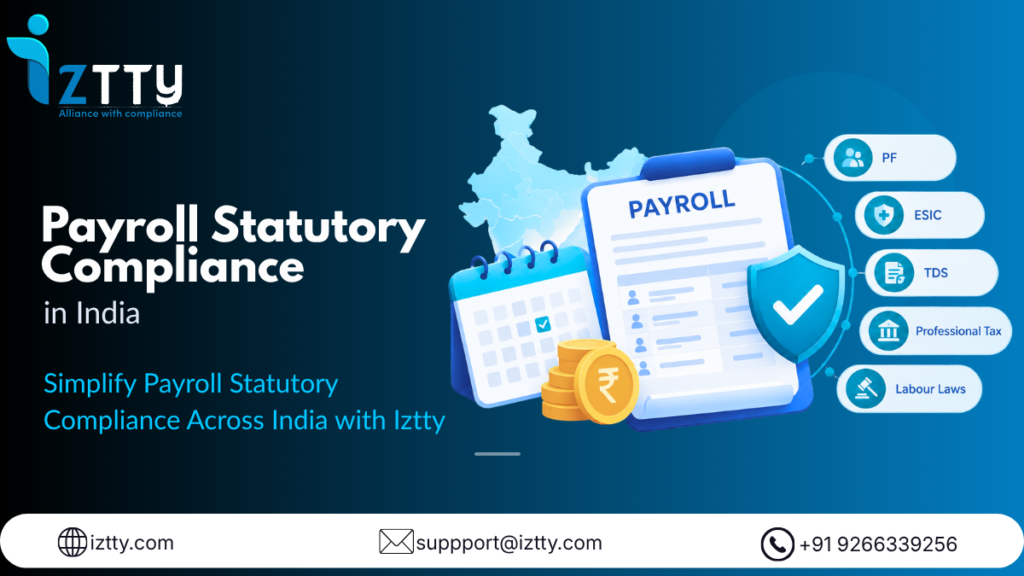
Payroll statutory compliance covers every deduction, contribution, and filing tied directly to running payroll each month: Provident Fund under the EPF & Miscellaneous Provisions Act, 1952, Employees’ State Insurance under the ESI Act, 1948, state-specific Professional Tax, and Labour Welfare Fund contributions in the states where it applies.
It’s a narrower slice than the full statutory compliance picture, it doesn’t cover factory registers or CLRA vendor documentation, but it’s the slice that touches every single payroll cycle, every month, for every employee.
Since 21 November 2025, this sits alongside a bigger structural shift: the four Labour Codes, including the Code on Wages, 2019, are now formally in effect, per the Ministry of Labour & Employment’s own notification, even though detailed Central and State rules are still being finalized. Existing EPF, ESIC, and PT frameworks continue to apply during this transition, which is what this guide covers in practical detail.
Not sure where your current payroll compliance actually stands? Book a Free Compliance Audit.
Payroll compliance also carries a different kind of scrutiny than annual filings like a factory licence renewal. Because EPF and ESIC filings happen every single month, for every employee, a single recurring error, a wrong wage base, a missed new joiner, a delayed remittance, compounds across pay cycles in a way an annual filing mistake doesn’t.
A one-time factory register error is a single finding; a payroll calculation error that’s been running for six months is six months of underpayment or under-contribution, discovered all at once.
Who Is Responsible for Payroll Compliance Inside a Company?
In most companies, this splits three ways in practice, even when it isn’t written down that way. Payroll or Finance runs the monthly calculation and deduction. HR or the Compliance Manager owns filing the actual returns, the EPF ECR, the ESIC contribution, the PT payment, on time. And the CFO or CHRO owns the consequence: if a filing is late, the penalty and the audit trail gap are theirs to answer for, regardless of which team missed the deadline.
A Compliance Consultant managing payroll compliance for multiple client companies faces the same three-way split multiplied across every client, which is the exact use case behind Iztty’s separate Compliance Consultant account type.
Which Statutory Deductions Actually Apply to Indian Payroll?
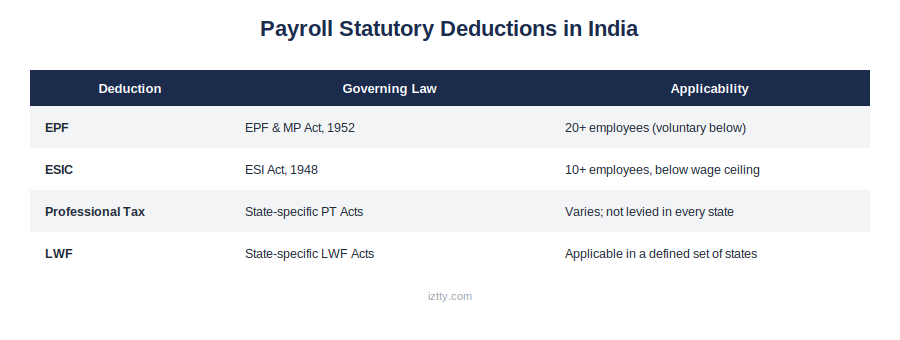
| Deduction | Governing Law | Applicability |
|---|---|---|
| Provident Fund (EPF) | EPF & MP Act, 1952 | Establishments with 20+ employees (voluntary coverage possible below that) |
| ESIC | ESI Act, 1948 | Establishments with 10+ employees (most states), employees below the notified wage ceiling |
| Professional Tax | State-specific PT Acts | Varies by state; not levied in every state |
| Labour Welfare Fund | State LWF Acts | Applicable in a defined set of states, not all; rate and periodicity vary by state |
Each of these has its own contribution rate, its own wage ceiling or slab structure, and its own filing cadence, which is exactly why a single “payroll compliance” checklist that doesn’t separate these out by state tends to miss the state-specific variations. For the S&E-linked side of this (since several states tie PT registration to a valid S&E certificate), see our state-wise S&E registration guide.
When Are These Payroll Filings Actually Due Each Month?
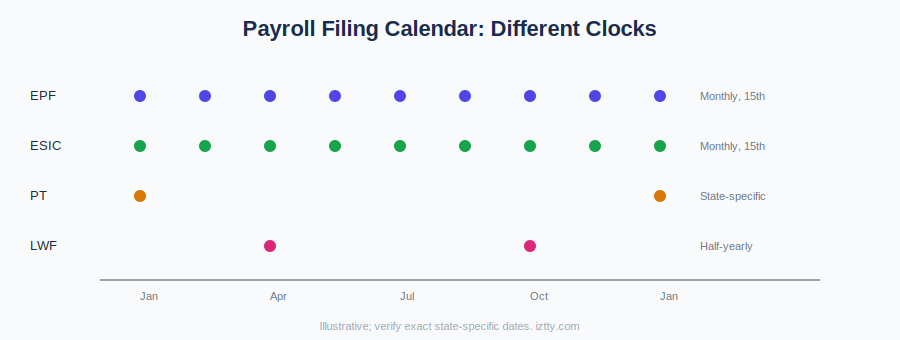
The EPF Electronic Challan cum Return (ECR) and the corresponding contribution are due by the 15th of the following month. ESIC contributions follow a similar monthly cycle, also due by the 15th. Professional Tax due dates vary by state, some are monthly, some are annual depending on the state’s own slab structure. LWF contributions are typically half-yearly or annual, again state-specific.
This mismatch in cadence, monthly for EPF/ESIC, variable for PT and LWF, is precisely why a single shared calendar reminder across all four often fails: a reminder tuned to the 15th-of-the-month EPF deadline doesn’t help with an LWF contribution due only twice a year in a completely different window.
Where Does Payroll Compliance Actually Break Down Across States?
A company running payroll for employees across five states isn’t running one PT calculation five times, it’s running five different PT slab structures, since PT is a state subject with no uniform national rate. The same applies to LWF, some states levy it, some don’t, and among those that do, the rate and periodicity differ. A payroll team that copies last state’s PT logic into a new state’s payroll run, without verifying that state’s specific slab, is a common and avoidable source of under- or over-deduction.
This is the same structural challenge covered in our pillar guide’s section on multi-state compliance management: the underlying math has to stay state-specific even when the payroll run itself is centralized.
A concrete version of this: a company running payroll centrally from Bengaluru for employees in Karnataka, Maharashtra, and Delhi needs three separate PT calculations applied correctly within the same payroll cycle, plus a check on whether LWF applies in each of those states and at what rate.
A payroll system that applies one state’s logic uniformly across all three, because that’s how the template was originally built, will get at least one of them wrong, and the error won’t surface until a state PT department cross-checks the filing against actual headcount.
Managing payroll compliance across multiple states manually? Talk to our compliance team about consolidating it into one view.
Why Does the Definition of “Wages” Matter Right Now?
The Code on Wages, 2019, one of the four Labour Codes now in effect, introduces a standardized definition of “wages” for calculating benefits like Provident Fund, Gratuity, and overtime, replacing the varying definitions currently used across different Acts.
Under the current transition, existing definitions continue to apply until the detailed rules are notified, but this is a genuine forward-looking risk for payroll teams: once the standardized definition takes effect, the base on which EPF and other contributions are calculated could shift, potentially changing the employer’s contribution cost.
Verify the current position directly against the Ministry of Labour & Employment’s published guidance before making any payroll structuring decision based on an assumption about this definition.
How Is Payroll Compliance Different From What Your HRMS Already Does?
Most HRMS platforms, greytHR, Keka, Zoho People, calculate the deduction correctly and generate the payslip. What they typically don’t do natively: route the EPF/ESIC/PT filing through a formal review-and-sign-off step before submission, maintain a state-validated register format for LWF where required, or flag a filing as at-risk before the deadline rather than after it’s missed.
This is the gap between “payroll software that calculates deductions” and “compliance software that manages the filing lifecycle,” and it’s a distinction almost none of the HRMS-bundled compliance modules or the generic listicle content comparing them actually draws out explicitly.
The practical test: ask whether your current system would catch a wrong PT slab applied to a Delhi-based employee before the filing goes out, or only after the state department flags it. If the answer is “only after,” the payroll calculation is working correctly but the compliance layer around it isn’t.
How Do You Build an Audit-Ready Payroll Compliance Trail?
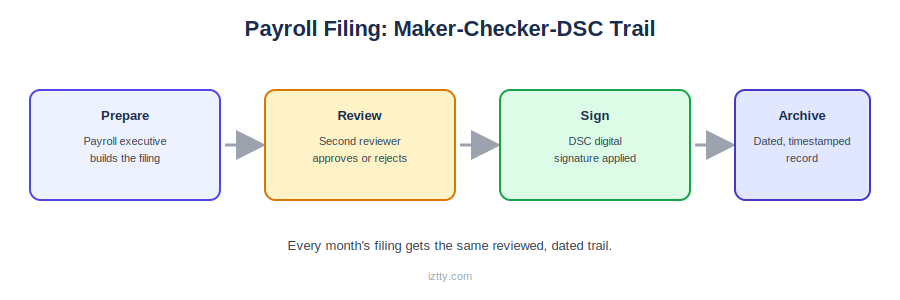
The documentation that actually protects a company during an EPFO or ESIC inspection isn’t just the filed return, it’s proof of the review that happened before filing. A Maker-Checker-DSC workflow creates this automatically: the payroll executive prepares the filing, a second reviewer approves it, and the approved version is digitally signed and archived with a timestamp, so there’s a dated record of who reviewed what, and when, for every single month’s filing. Our Maker-Checker-DSC workflow guide covers this process in detail.
Want this sign-off trail built into your monthly payroll cycle? Book a Free Compliance Audit.
How Does Automation Change Monthly Payroll Compliance?
A manual payroll compliance process depends on someone tracking four separate deadlines (EPF, ESIC, PT, LWF) across every state a company operates in, every single month, without missing one. This is exactly the kind of repetitive tracking statutory compliance automation India platforms are built to remove.
An AI compliance management India tool can generate the correct state-specific PT and LWF filing automatically, flag a filing at seven, three, and one day before the deadline rather than after, and route every one through the same Maker-Checker-DSC sign-off, rolling the result into the same compliance health score used for factory, S&E, and CLRA compliance. This is what our Provident Fund and Professional Tax modules, integrated with Tally, Zoho Payroll, and Keka HR, are built to do.
FAQs
1. What is payroll statutory compliance?
The deductions, contributions, and filings tied directly to running payroll each month, primarily EPF, ESIC, Professional Tax, and Labour Welfare Fund, governed by their respective central and state Acts.
2. What is the EPF contribution due date?
The Electronic Challan cum Return (ECR) and corresponding contribution are due by the 15th of the following month.
3. Does every state levy Professional Tax?
No, PT is a state subject and not every state levies it; where it applies, the slab structure and due dates vary by state.
4. Is Labour Welfare Fund applicable everywhere in India?
No, LWF applies only in a defined set of states, and among those, the rate and filing periodicity differ.
5. Does an HRMS handle all of this automatically?
Most HRMS platforms calculate the deduction and generate the payslip correctly, but typically don’t provide a formal review-and-sign-off workflow or state-validated register formats for LWF, which is a separate compliance layer.
6. Are the Labour Codes already affecting payroll deductions?
The four Labour Codes are formally in effect since 21 November 2025, but detailed Central and State rules, including the standardized wage definition’s practical application, are still being finalized. Current EPF, ESIC, and PT frameworks continue to apply during this transition.
7. What happens if an EPF or ESIC filing is late?
Late remittance attracts interest and, in some cases, penal damages under the respective Act, in addition to creating a documented compliance gap that surfaces during future audits or inspections.
8. Can payroll compliance be managed across multiple states from one system?
Yes, though the underlying PT and LWF calculations need to stay state-specific, since a centralized payroll run still has to apply each state’s own rates correctly.
9. What documentation should be kept for a payroll compliance audit?
At minimum, the last several months of EPF/ESIC challans, PT payment proof, and a dated record of who reviewed and approved each filing before submission.
10. How is payroll statutory compliance different from CLRA or vendor compliance?
Payroll compliance covers your own direct employees’ deductions and filings; CLRA and vendor compliance covers your liability for a contractor’s workforce, a distinct obligation covered in our guide on managing principal employer liability.
Ready to see your payroll compliance status mapped out? Book a Free Compliance Audit with Iztty.