At some point, every growing Indian company faces the same staffing question: do we hire someone to own statutory compliance full-time, do we retain an outsourced compliance services provider, or do we run some combination of both? This is a resourcing decision, not a software decision, and it’s a different question from which tool you use. A company can have excellent compliance software and still have nobody with the bandwidth or expertise to act on what it surfaces.
This guide covers the three staffing models, what each one actually costs in practice, and the specific questions to ask before signing with any compliance services provider.
If you’re deciding between software, consulting, or a hybrid approach to solving a specific compliance problem, like manual tracking breakdown or vendor liability exposure, see Compliance Management Solutions: Which Approach Actually Solves Your Problem. This guide is about a different decision entirely: who on your team, or outside it, actually does the compliance work day to day.
What “Compliance Management Services” Actually Covers
Compliance management services typically span filing preparation (EPF ECR, ESIC contributions, Professional Tax returns), statutory register maintenance (Factories Act, Shops & Establishment), CLRA vendor documentation review, licence renewal tracking, notice response drafting, and periodic audit support. Some providers offer the full scope; many specialize in a subset, payroll-linked filings only, or labour law advisory without day-to-day register upkeep. Knowing which of these your company actually needs is the first step before evaluating who should do it.
1. Model 1: In-House Compliance Team
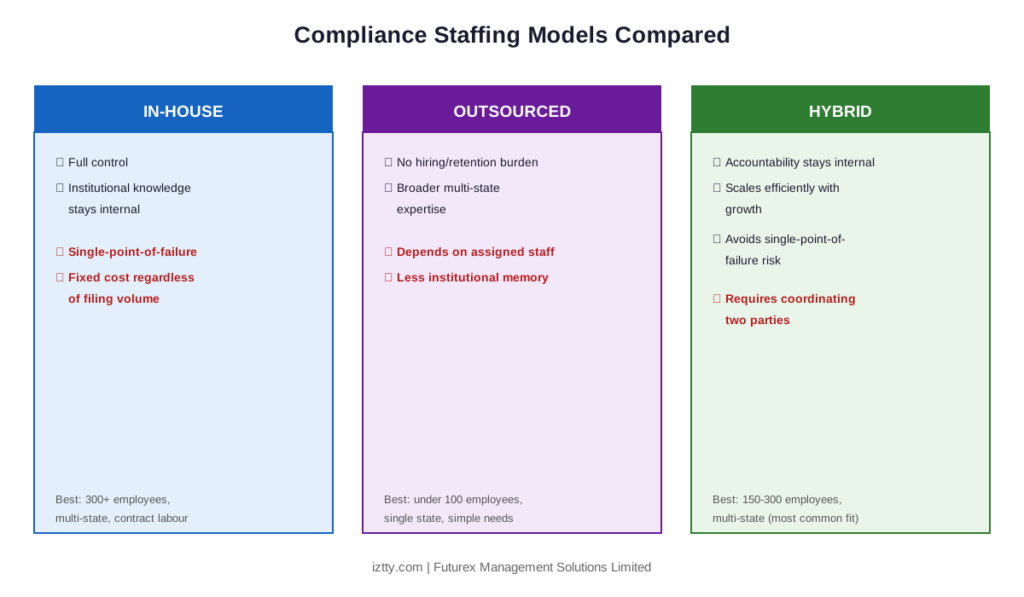
Hiring a dedicated Compliance Manager, or building out a small team with a Compliance Executive reporting to them, gives you direct control and institutional knowledge that stays with the company. It works best when you have enough recurring volume, typically 100+ employees, multiple states, or active contract labour, to justify a full-time role. The risk is the single-point-of-failure problem: a one or two person in-house team concentrates all the institutional knowledge in very few people, and losing either one creates a real gap until a replacement is fully ramped up.
2. Model 2: Outsourced Compliance Services
An outsourced provider, typically a compliance consulting firm or statutory compliance specialist, handles filings and registers on a retainer basis, usually priced per employee or per location per month. This avoids the hiring and retention problem entirely and brings broader expertise across states and acts than most single in-house hires have. The tradeoff is responsiveness and institutional memory: an external provider juggling multiple clients may not flag an emerging issue as quickly as someone embedded in your operations, and the relationship’s quality depends heavily on which individual at the provider is actually assigned to your account.
3. Model 3: Hybrid Staffing
Most mid-size and larger companies eventually land here: a single in-house Compliance Manager or Admin & Legal Manager owns the relationship and reviews outputs, while an outsourced provider or platform handles the volume work, filing preparation, register generation, multi-state rule tracking. This model keeps accountability internal (there’s always a named person who signs off) while avoiding the cost of building a full internal team for every specialization. It’s also the model that scales most naturally: the in-house role can expand as the company grows, while the outsourced or automated layer absorbs the increasing filing volume without proportional headcount growth.
Cost Comparison: In-House vs. Outsourced vs. Hybrid
Exact figures vary by city, seniority, and scope, so treat this as a structural comparison rather than a quote.
An in-house Compliance Manager’s fully loaded cost (salary, benefits, training) is a fixed monthly expense regardless of filing volume that month.
An outsourced retainer typically scales with employee count and location count, which means costs rise predictably as you grow but also means you’re paying for capacity you might not fully use in a quiet month.
A hybrid model’s cost sits between the two, a smaller in-house salary plus a lighter-scope retainer or platform subscription, and is often the most cost-efficient per filing once a company crosses roughly 150 to 200 employees or two states, since neither a single in-house hire nor a full outsourced retainer alone matches that volume efficiently.
The 12 Questions to Ask Before Hiring a Compliance Services Provider
Whether you’re evaluating an outsourced provider or the compliance arm of a hybrid setup, ask these directly rather than relying on a sales pitch:
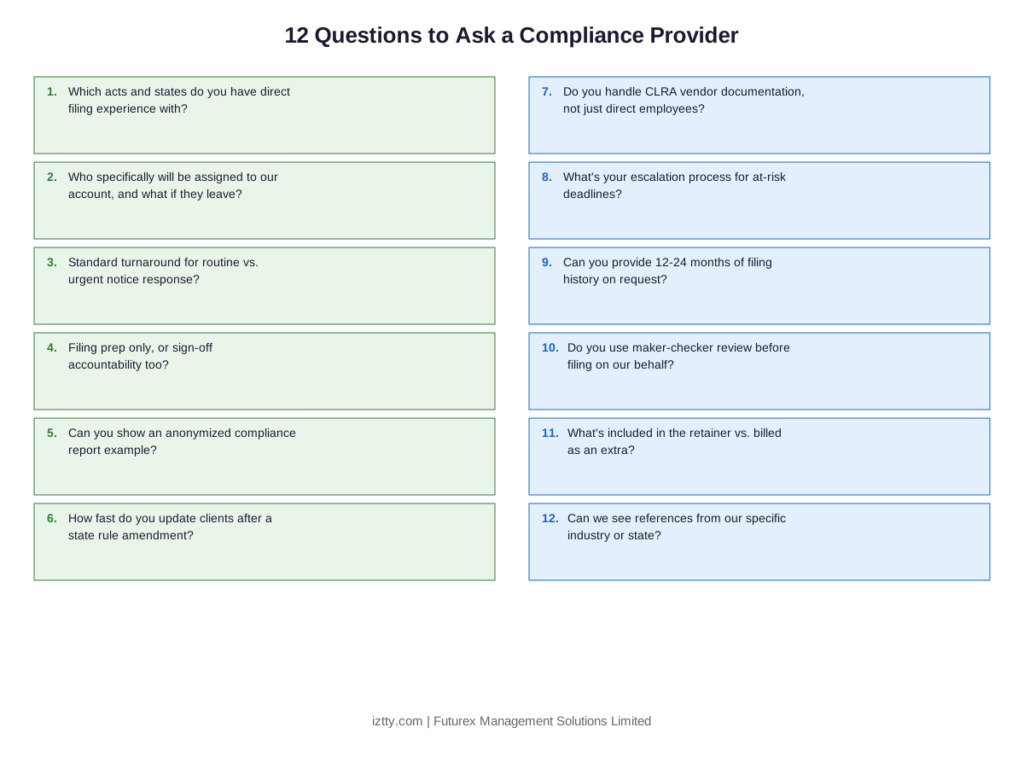
- Which specific acts and states do you have direct, current filing experience with, not just general labour law knowledge?
- Who specifically will be assigned to our account, and what happens if that person leaves the firm?
- What is your standard turnaround time for a routine EPF/ESIC filing versus an urgent notice response?
- Do you prepare filings only, or do you also hold sign-off accountability if something is filed incorrectly?
- Can you show an anonymized example of a compliance health report or filing summary you’ve produced for another client?
- What happens if a state amends a Shops & Establishment rule mid-year, how quickly do you typically update affected clients?
- Do you handle CLRA vendor documentation review, or only our own direct-employee filings?
- What’s your process if a filing deadline is at risk due to incomplete data from our side, do you escalate, or wait?
- Can you provide 12 to 24 months of filing history on request within a defined timeframe, for due diligence purposes?
- Do you use a maker-checker review process internally before anything is filed on our behalf?
- What’s included in your standard retainer versus billed as an extra, especially notice response and audit support?
- Can we see references from clients in our specific industry or state, not just general testimonials?
Red Flags When Evaluating a Provider
Watch for a provider who can’t name the specific forms relevant to your business (if they’re vague about Form 25 versus Form VI-B, they likely haven’t handled your specific compliance profile before), who won’t commit to a specific turnaround time in writing, who can’t explain their internal review process before filing on your behalf, or who positions themselves purely as a document-filing service with no proactive alerting for upcoming deadlines or regulatory changes. A provider who treats every client’s compliance needs as identical, rather than asking detailed questions about your specific states, acts, and contractor relationships, is more likely delivering template-based service than a genuinely tailored one.
Every Model Still Needs a System of Record
Regardless of which staffing model you choose, someone, in-house, outsourced, or both, needs a single, current source of truth for filing status, register versions, and documentation, rather than relying on email threads and individual memory. This is true whether you build it in-house or your outsourced provider brings their own. A provider who files on your behalf but leaves you with no independent visibility into what’s been filed and when creates its own risk, since you lose the ability to verify their work or respond quickly if they become unavailable.
How Iztty Supports Each Staffing Model
For an in-house team, Iztty’s maker-checker-DSC workflow and compliance calendar give a small team the structure a larger team would otherwise need to build manually. For companies working with an outsourced provider, the platform gives you independent visibility into filing status regardless of who’s doing the filing, so you’re never solely dependent on the provider’s own records. And for compliance consulting firms themselves managing multiple client companies, Iztty offers a dedicated Compliance Consultant account type, letting a provider manage several clients’ filing calendars, registers, and sign-off chains from one dashboard while keeping each client’s data and DSC-holder access properly separated.
Making the Decision: A Practical Framework
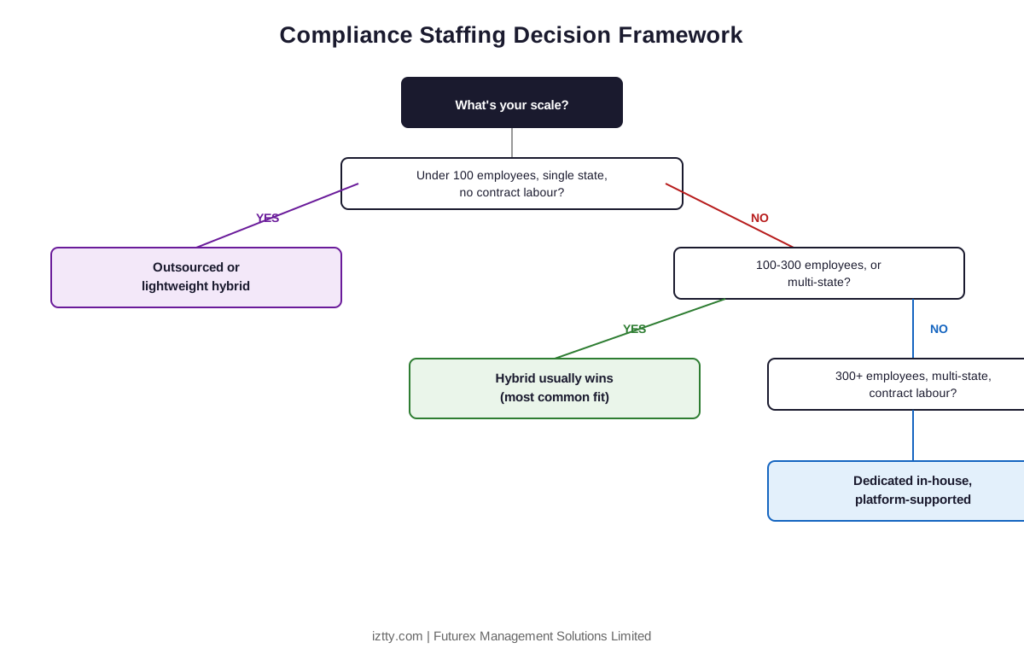
- Under 100 employees, single state, no contract labour: outsourced services or a lightweight hybrid typically costs less than a dedicated in-house hire.
- 100 to 300 employees, or multi-state: hybrid usually wins, an in-house owner with outsourced or platform-driven volume support.
- 300+ employees, multiple states, active contract labour: a dedicated in-house compliance function, often supported by a platform and selective outsourced specialist support for notice response or audits, becomes worth the investment.
- Compliance consulting firms managing multiple clients: a platform built for multi-client management, not a generic single-company tool, is the structural requirement regardless of your own firm’s size.
If you want this mapped to your specific states, headcount, and current setup, book a free compliance audit with Iztty, which includes a review of whether your current staffing model matches your actual filing volume and risk exposure.
FAQs
What’s the difference between compliance management services and compliance management software?
Services refers to who does the work, in-house staff, an outsourced provider, or both. Software is the tool used to do that work. The two decisions are related but separate; you need both, regardless of which staffing model you choose.
At what company size does outsourcing compliance usually make sense?
Under roughly 100 employees with straightforward, single-state obligations, outsourcing or a lightweight hybrid typically costs less than a dedicated in-house hire, since the filing volume doesn’t yet justify a full-time role.
Can a compliance services provider be held liable for filing errors?
Contractual liability varies by agreement, but statutory liability for the underlying compliance generally stays with the company, which is why asking about the provider’s internal review process (Question 10 above) matters regardless of what the contract says about their own liability.
How many clients does a typical outsourced compliance provider manage at once?
This varies widely by firm size and specialization. Ask directly rather than assuming, since a provider managing too many accounts per staff member may struggle with responsiveness during your most time-sensitive filings.
Is a hybrid staffing model more expensive than choosing one model fully?
Not necessarily. For companies in the 150 to 300 employee, multi-state range, hybrid is often the most cost-efficient per filing, since it avoids both the underutilized capacity of a full outsourced retainer and the fixed cost of a larger in-house team.
What should be in a compliance services contract or SLA?
Specific turnaround times for routine and urgent filings, clearly defined scope (which acts, states, and filing types are included versus billed separately), an escalation process for data delays, and a commitment to provide filing history on request within a defined timeframe.
Do compliance consulting firms need different tools than individual companies?
Yes, a firm managing multiple client companies needs multi-client account architecture with separated data and DSC-holder access per client, which a single-company compliance platform typically isn’t built to handle.
How do the Labour Codes 2026 transition affect the choice between in-house and outsourced compliance services?
Since all four Labour Codes became effective 21 November 2025 with detailed Central and State rules still being finalized, providers who proactively track regulatory change are more valuable during this transition period than during a stable regulatory period, which is worth weighing specifically when evaluating a provider right now.
Can we switch from outsourced to in-house, or vice versa, without disruption?
Yes, provided the outgoing party (whether a departing employee or an outsourced provider) hands over complete, organized filing history and documentation, which is exactly why Question 9 in the provider checklist above matters regardless of which direction you’re switching.
Should the compliance services provider be the same firm that built our compliance software?
Not necessarily, though a combined offering, like Iztty’s platform backed by Futurex’s own consulting practice, can reduce coordination overhead since the technology and the expert judgment layer are already working from the same data rather than two separate systems.