“Compliance management solutions” is a phrase that gets searched by people with very different problems. A 60-employee single-state company typing it into Google is usually trying to stop missing EPF deadlines. A 400-employee manufacturer typing the same phrase is usually trying to find out why its contractor’s non-payment of minimum wages just became its own legal liability. Both will land on lists of software. Neither will necessarily find the thing that fixes their actual problem, because the solution that fixes manual tracking breakdown is not the same solution that fixes invisible contractor liability.
This guide works backward from the problem instead of forward from a product category. If you already want a side-by-side look at compliance management software specifically, including a comparison table across HRMS-bundled tools, enterprise GRC platforms, and dedicated platforms like Iztty, read our Compliance Management Software: A Buyer’s Guide for Indian Businesses, which covers that ground in depth. This piece is deliberately organized differently: by the problem you’re actually having, and which category of solution, software, consulting services, or a hybrid of both, is built to solve it.
What People Actually Mean by “Compliance Management Solutions”
Searched as a phrase, “compliance management solutions” covers everything from a single SaaS dashboard to a full outsourced compliance retainer with a consulting firm. That breadth is the reason generic answers rarely help: the term describes an outcome (your statutory obligations are met, documented, and defensible), not a specific mechanism for getting there.
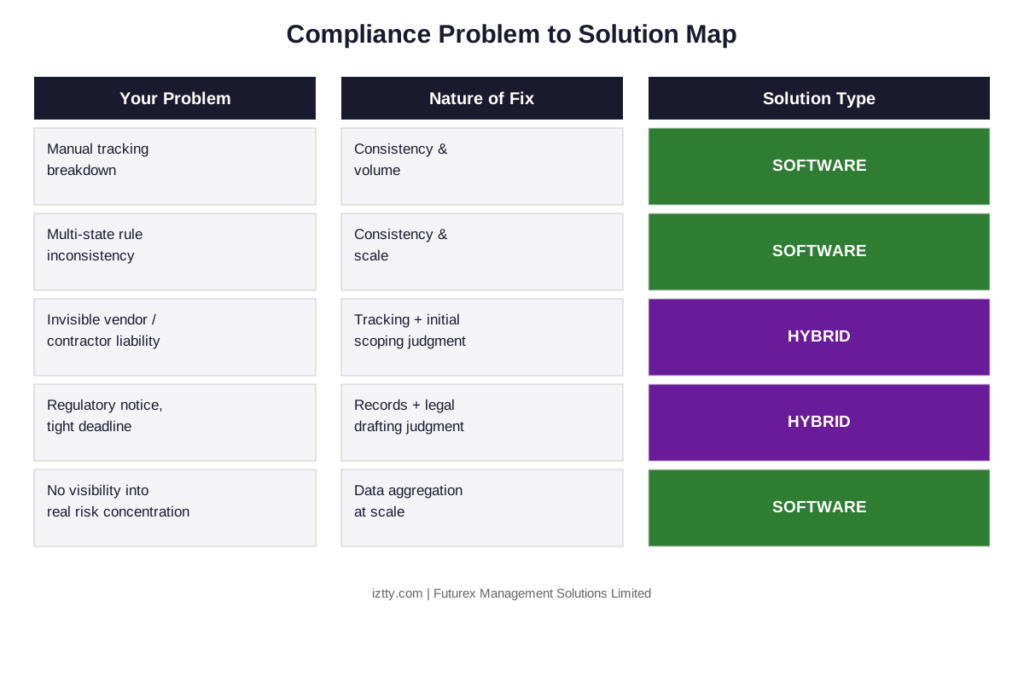
In practice, almost every business asking this question is dealing with one or more of five concrete problems, each of which points toward a different kind of fix. The rest of this guide walks through each one.
1. Problem: Manual Tracking Breaks Down
This is the most common starting point. A spreadsheet-and-calendar-reminder system works until it doesn’t, usually around the point a company crosses 50 to 80 employees, adds a second location, or the one person who “owns” the compliance calendar goes on leave during a filing week. The EPF ECR gets filed two days late not because anyone forgot the due date, but because payroll data wasn’t finalized in time and nothing flagged the dependency as a compliance risk rather than a payroll delay.
What actually fixes this: automation of the calendar-to-filing chain itself, not a better spreadsheet template. A system that locks payroll data, auto-populates the EPF/ESIC return, and escalates to a second person if the first doesn’t act within a set window removes the single point of failure that manual tracking always has. This is a problem software is well-suited to solve on its own; it rarely needs a consulting engagement.
2. Problem: Multi-State Rule Inconsistency
A company operating in Maharashtra, Karnataka, and Tamil Nadu is not running “one compliance program,” it is running three, because Shops & Establishment registration validity, renewal cycles, Professional Tax slabs, and Labour Welfare Fund contribution rates are all set independently by each state government. A process built around one state’s rules silently produces errors the moment it’s applied to another, often without anyone noticing until a renewal deadline is missed in the state nobody was watching closely.
What actually fixes this: a system that encodes state-specific rules natively, so the renewal date, form, and contribution rate shown for a Karnataka branch is never the Maharashtra default applied incorrectly. This is a case where software alone solves most of the problem, provided the underlying state rule data is kept current, since state governments amend these rules without much advance notice.
3. Problem: Invisible Vendor and Contractor Liability
This is the problem most companies don’t know they have until it surfaces. Under the Contract Labour (Regulation and Abolition) Act, 1970, the principal employer carries liability if a contractor fails to pay minimum wages or remit EPF/ESIC for the contracted workforce, regardless of whether that contractor’s payroll ever touches the principal employer’s own systems. A company can have flawless internal payroll compliance and still be exposed because its security or housekeeping vendor’s EPF challans haven’t been collected in three months.
We cover this specific liability mechanism in detail, including which CLRA forms and registers apply and how exposure actually gets triggered, in Vendor & Contractor Compliance: Managing Principal Employer (PE) Liability.
What actually fixes this: visibility into a vendor’s compliance status that the principal employer doesn’t currently have, which means collecting and verifying contractor EPF/ESIC proof monthly, not annually. Software can automate the collection and flagging; a consulting engagement is often what’s needed first to establish exactly which vendors and worksites are in scope and to set up the verification process correctly. This is frequently a hybrid problem.
4. Problem: A Regulatory Notice With No Time to Respond
An EPFO or ESIC notice typically gives a company a narrow window, often 15 to 30 days, to respond with a documented explanation and supporting evidence. Companies without an organized filing history spend most of that window just reconstructing what happened, rather than drafting the actual response.
What actually fixes this: having the underlying records (filing history, challans, registers) already organized and retrievable before a notice arrives, which is a software/record-keeping problem, combined with the judgment to draft an adequate legal response, which is where consulting expertise matters. A platform that extracts the allegation from the notice and pre-populates a draft response from existing records can compress a multi-day task into a few hours of review, but someone still needs to review it.
5. Problem: No Visibility Into Where the Real Risk Sits
Many companies that are “mostly compliant” have no way to say which act, which state, or which location carries the highest actual risk right now. Without that view, compliance effort gets spent reactively, on whatever surfaced most recently, rather than on the gap that’s actually most likely to cause a problem.
What actually fixes this: a consolidated, weighted view of compliance status across every applicable act and location, commonly delivered as a compliance health score built from filing timeliness, register completeness, licence validity, and vendor documentation completeness. We walk through how to build this view manually, and what it should surface, in Compliance Risk Audit: How to Identify Gaps Before an Inspection. This is almost always a software capability, since it requires aggregating data no single person is tracking by hand.
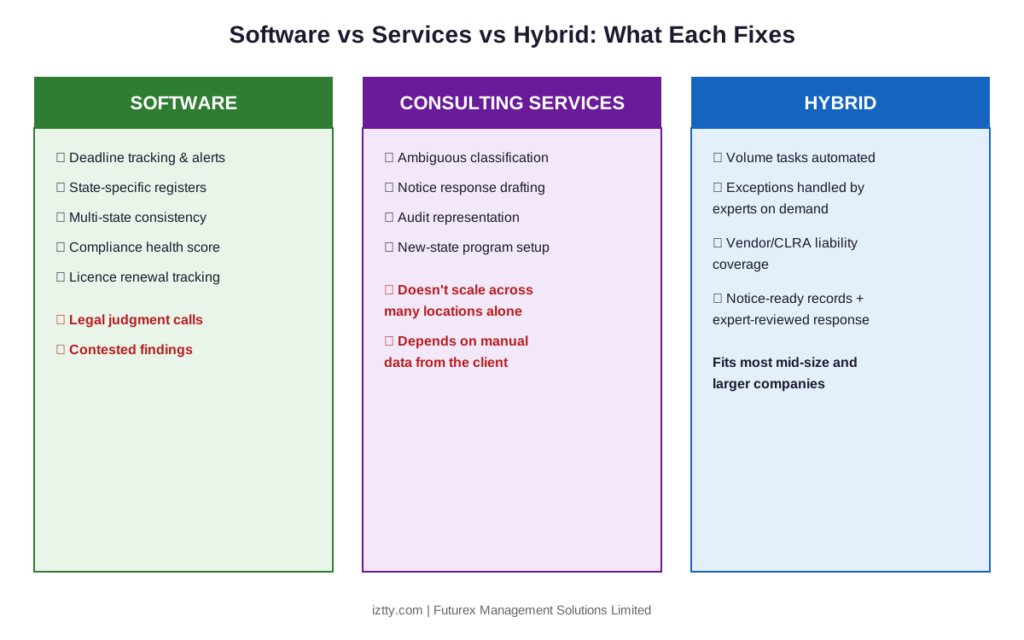
Software vs. Consulting Services vs. Hybrid: What Each One Actually Fixes
Laid out directly:
- Pure software fixes problems that are fundamentally about scale and consistency: manual tracking breakdown, multi-state rule drift, lack of a consolidated risk view. It does not fix problems that require legal judgment, such as how to classify an ambiguous worker category or how to respond to a contested inspection finding.
- Pure consulting services fix problems that require interpretation and representation: drafting a defensible response to a notice, advising on a genuinely ambiguous classification question, representing the company in an inspection. Consulting-only engagements typically don’t scale well across dozens of locations without software underneath them, because the underlying data collection is still manual.
- A hybrid approach fixes the problems most mid-size and larger companies actually have: software handles the volume (tracking, filing, documentation, alerts) while consulting judgment handles the exceptions (ambiguous cases, notice responses, audit representation). Most companies outgrow pure software or pure consulting separately before they realize they needed both together.
How Iztty Approaches These Five Problems
Iztty is built as a hybrid by design, not by accident. The platform automates the parts of compliance that are fundamentally about scale and consistency: statutory calendar and filing automation, state-specific Shops & Establishment and Factories Act register generation, a live compliance health score across acts and locations, and CLRA vendor documentation tracking. That covers four of the five problems above directly as a software capability.
For the fifth, judgment-dependent situations like a contested notice or an ambiguous classification, Iztty is backed by Futurex Management Solutions Limited’s compliance practice, built on over a decade of hands-on labour law consulting, rather than leaving that gap for the company to fill separately. The What Is Iztty overview covers the platform’s full feature set, including the maker-checker-DSC workflow that applies a second layer of review before any statutory document is filed.
How to Pick the Right Solution for Your Situation
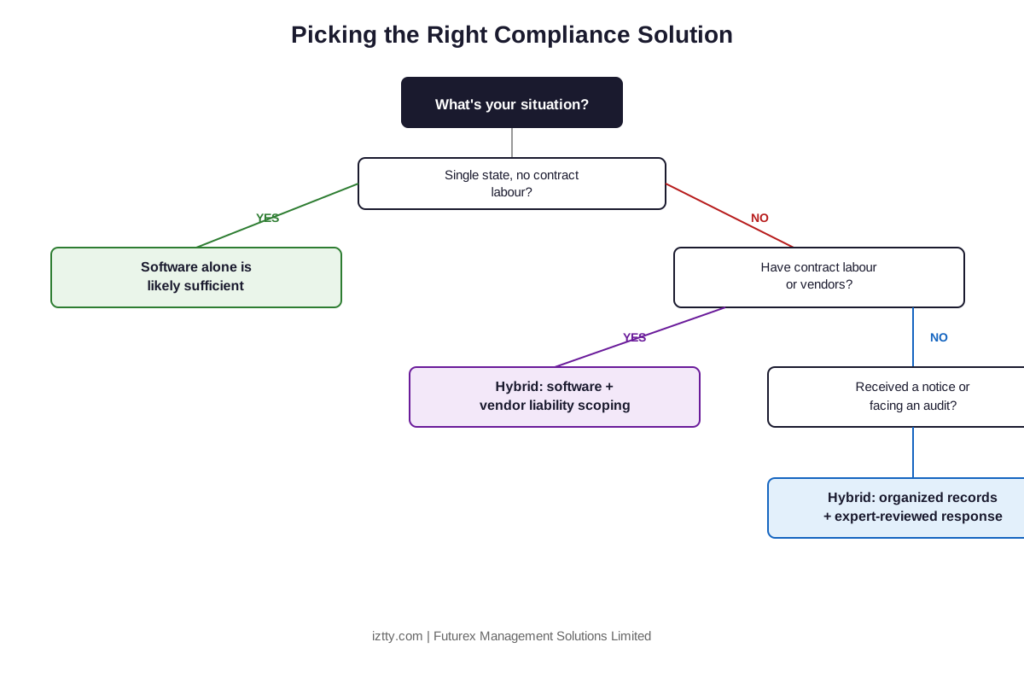
Match your situation to the problem list above rather than starting from a product category:
- If your core issue is deadlines and register upkeep across one or two states, with no contract labour, a well-built software layer alone is likely sufficient.
- If you engage contract labour through vendors, you have a liability exposure that software should surface but that may need a short consulting engagement to scope correctly the first time.
- If you’ve received a notice, or are preparing for an audit, a hybrid approach, organized records plus legal judgment on the response, is the only combination that actually closes that window safely.
- If you genuinely don’t know where your risk sits across acts and states, start with a compliance health score rather than guessing which act to shore up first.
If you want this mapped to your specific states, acts, and vendor relationships rather than worked out in the abstract, book a free compliance audit with Iztty.
FAQs
Is “compliance management software” the same as “compliance management solutions”?
Not quite. Software is one category of solution. “Solutions” is the broader term that also includes consulting services and hybrid approaches, which matters because some compliance problems, particularly those involving legal judgment, aren’t solved by software alone.
My company is small. Do I need a full compliance management solution?
If you’re single-state with under roughly 50 employees and no contract labour, a lighter software layer focused on calendar automation is usually enough. The need for a fuller solution typically appears once you add a second state or engage contractors.
Can I use a hybrid approach without committing to a large enterprise platform?
Yes. Several platforms, including Iztty, offer a software core with access to compliance expertise built in, rather than requiring a separate, large consulting retainer on top of a separate software purchase.
How does a compliance health score help me choose a solution?
It tells you where your actual risk concentration is, acts, states, or vendors, before you decide what kind of fix to invest in. Without it, companies often address the most visible problem rather than the highest-risk one.
Is outsourcing compliance to a consulting firm safer than software?
Not inherently. A consulting-only arrangement still depends on the data you give them being accurate and current. Software with embedded expert access typically produces a more current, more complete record than a periodic consulting relationship.
How do I know if my current approach is actually working?
Ask whether you can produce, right now, a complete and current filing history, register set, and vendor compliance record for every location without needing days to assemble it. If not, your current approach has a visibility gap regardless of whether it’s manual, software-based, or consulting-based.
What’s the risk of choosing a solution based on category instead of my actual problem?
You end up paying for capability you don’t need while the actual gap, often vendor liability or multi-state inconsistency, stays unaddressed, because those problems don’t announce themselves the way a missed single-state deadline does.
Do the Labour Codes change which solution I need?
They affect the underlying compliance requirements rather than the category of solution. As of the Codes’ effective date of 21 November 2025, with detailed Central and State rules still being finalized, a solution that tracks regulatory changes on an ongoing basis matters more than ever, since the obligations themselves are in a transition period. See the official PIB press release for the current status.
Can a hybrid solution scale down as well as up?
Yes, in practice most hybrid platforms let you use more or less of the consulting layer depending on how many judgment-dependent situations you’re actually facing in a given period, rather than charging a fixed consulting retainer regardless of need.
What makes Iztty’s approach different from a pure software vendor or a pure consulting firm?
Iztty combines automated, state-specific compliance tracking with Futurex’s decade of hands-on labour compliance consulting built into the same platform, so the judgment-dependent problems (notice responses, ambiguous classification, audit representation) aren’t left as a separate, unsolved gap after the software is implemented.