A CFO in Ahmedabad forwards a vendor quote to the compliance manager with one line: “Is this a lot?” The compliance manager does not know. The quote lists a platform fee, a per-location fee, a state add-on and an onboarding charge. The cheaper quote from another vendor lists none of those, and does not mention contractors at all. Which one is actually cheaper?
That confusion is why this guide exists. Compliance software in India comes in several shapes, and each one charges for different things. Comparing sticker prices across shapes is like comparing a bus ticket with a car lease. Below, you will find the main types, what drives the cost, the costs that tend to hide, and a way to work out return on investment using your own numbers. We have deliberately not invented price lists. We have shown the arithmetic so you can build yours.
Want a cost and ROI estimate for your own sites and states? Our compliance practice will size it with you before you request any quote. GET A FREE COMPLIANCE AUDIT
What Compliance Software Is, in One Paragraph
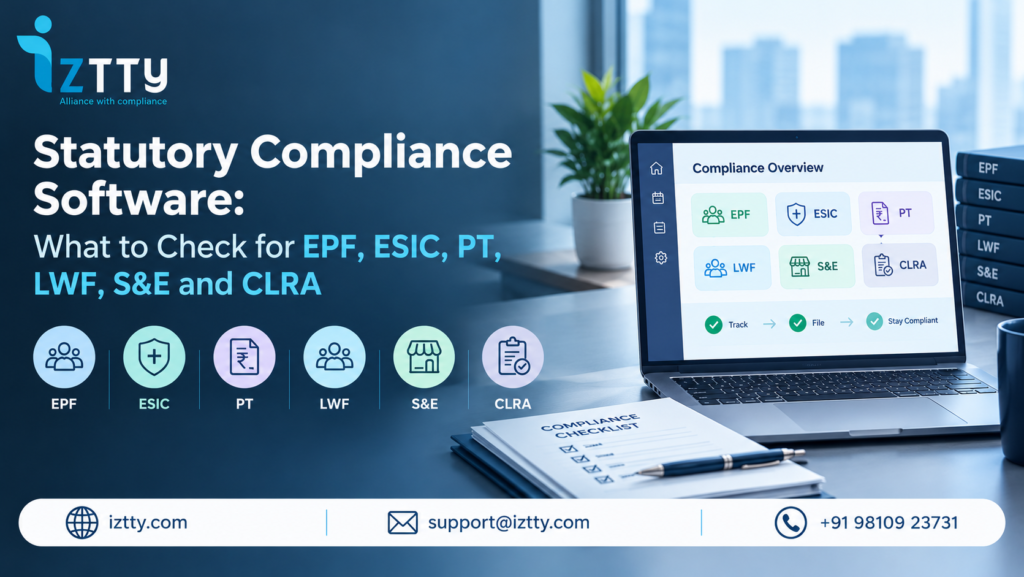
Compliance software helps an organisation meet legal obligations: it tracks what applies, reminds the right people, prepares filings and registers, routes them for review, and stores proof. In India, for employers, that mostly means labour and employment law: provident fund, ESIC, Professional Tax, Labour Welfare Fund, Shops & Establishment, the Factories Act and contract labour. Other kinds exist for financial regulation, tax and data protection, but this guide is about the employer side. For the wider background, see our guides to compliance management software and regulatory compliance software.
The Five Types and How Each One Charges
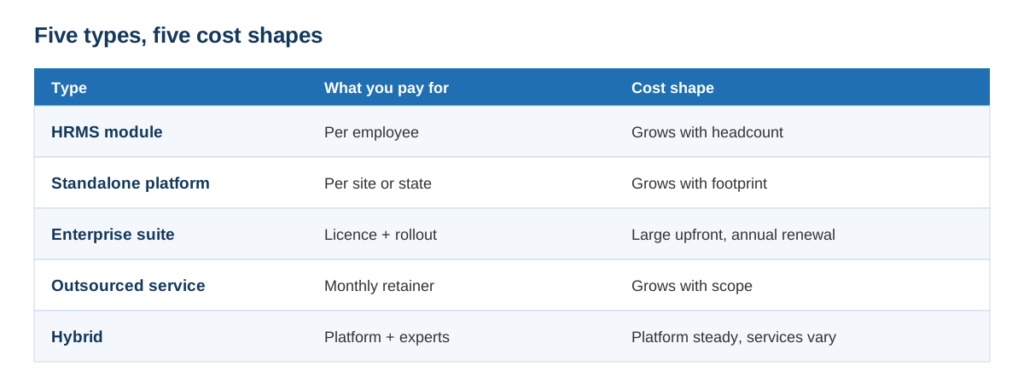
This is not a feature comparison; we have covered that elsewhere. Here we look at one thing only: what you actually pay for, because that is where quotes diverge.
| Type | What you usually pay for | Cost shape | Where it tends to fit |
|---|---|---|---|
| HRMS compliance module | An add-on or tier on your HRMS, often priced per employee | Grows with headcount | One or two states, simple payroll |
| Standalone statutory platform | Platform fee plus locations, states or users | Grows with sites and states | Multi-state employers, factories, contractors |
| Enterprise GRC or RegTech suite | Licence, implementation and often services | Large upfront, annual renewal | Large groups with cross-regulation needs |
| Outsourced compliance service | Monthly retainer per entity or site | Grows with people and scope | Employers with no in-house team |
| Hybrid: platform plus experts | Platform fee plus advisory or filing support | Platform steady, services vary | Teams that want control with backup |
The point of the table is the third column. A per-employee price looks cheap at 100 people and expensive at 2,000. A per-site price looks fair for a factory chain and punishing for a retailer with 80 small stores. Know your shape before you compare. If you are still choosing between categories, our guide to compliance management solutions maps business problems to the right type.
What Drives the Price
- Number of locations: Plants, offices, stores, warehouses, each with its own registrations.
- Number of states: Professional Tax, Labour Welfare Fund and Shops & Establishment rules differ state by state, and each state adds configuration.
- Which Acts are in scope: EPF and ESIC alone cost less to run than EPF, ESIC, PT, LWF, S&E, Factories Act and contract labour together.
- Contractors: Collecting proof from 5 contractors is not the same job as from 150.
- Users and roles: Makers, Checkers and signatories at each site.
- Integrations: Connecting payroll or accounting systems.
- Services bundled in: Filing support, notice drafting, advisory hours.
- Contract length: Multi-year terms often lower the annual price, and make exit costlier.
When you request quotes, give every vendor the same profile: the same states, sites, Acts, contractors and users. Otherwise you are comparing different questions.
Here is how these drivers interact in practice. Two employers can each have 500 people. One has a single plant in one state, mostly permanent staff and one contractor. The other has 30 small branches in nine states and 120 contract workers. The first needs a handful of registers and a clean EPF and ESIC cycle. The second needs nine sets of state rules, a registration calendar per branch and monthly proof from every contractor. Same headcount, very different bill, and very different value from the software. If a vendor quotes both on headcount alone, one of them is being quoted for the wrong thing.
Ask also how the price changes when you add a state or a location mid-year. Growth is where many contracts bite. A tool that is cheap at your current footprint and costly at the next one is not cheap.
Costs That Hide Outside the Quote
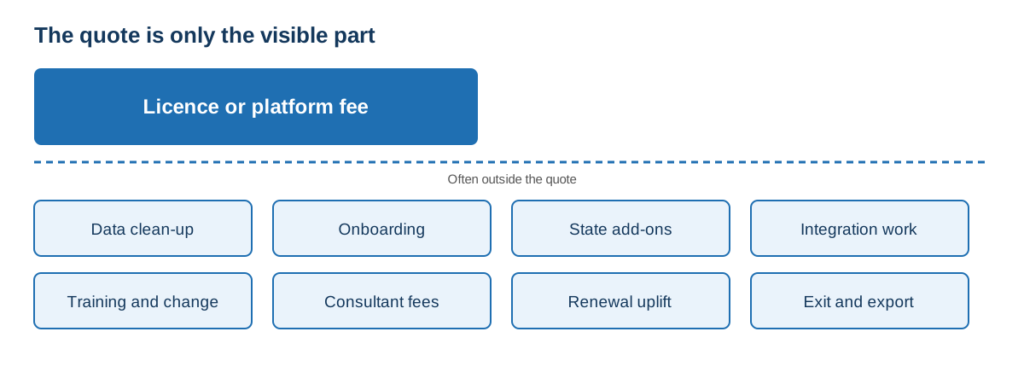
- Data clean-up: Missing UANs, duplicate employee records and inconsistent site names have to be fixed before any tool works properly. Budget your team’s hours for it.
- Implementation and onboarding: Sometimes a separate line, sometimes absorbed. Ask.
- State add-ons: A base price may cover a few states, with others charged extra.
- Integration work: Payroll connections can need your IT or payroll vendor’s time.
- Training and change: Makers and Checkers need to actually follow the new steps. That takes managers’ attention, not only a login.
- Consultant and filing fees you keep paying: Software rarely removes advisory needs, and you should know which you will retain.
- Renewal escalators: Check the price after year one.
- Exit costs: Can you export all registers, proofs and logs if you leave, and in what format?
A useful habit is to ask each vendor for a three-year total cost on your profile, with these lines itemised.
The Other Side of the Ledger: What Non-Compliance Costs
You cannot judge a price without knowing what you are protecting against. Here are the exposures that are easiest to put numbers on.
- Late provident fund payments: Interest under Section 7Q is 12% per annum, and damages under Para 32A are a flat 1% per month from 15 June 2024. Contributions fall due by the 15th of the following month on the EPFO portal. Confirm current rates against the EPFO notification before you rely on them.
- Late ESIC contributions: Also due by the 15th on the ESIC portal, with interest on delay. Check the current rate on the ESIC site.
- Contractor defaults: Under the Contract Labour (Regulation and Abolition) Act, 1970, the principal employer can be answerable for wages if a contractor fails to pay. This is the exposure that is hardest to price and easiest to underestimate.
- Notices and inspections: Staff time, consultant fees and management attention, whatever the outcome.
- Licence lapses: A factory or establishment licence expiring unnoticed can interrupt operations.
Also note that the four Labour Codes took effect on 21 November 2025, final Central Rules followed on 8 May 2026 and State Rules are arriving unevenly, so some of the rules behind these exposures are being re-papered. See the Ministry’s labour.gov.in site for the current position.
How to Work Out ROI
ROI is simple arithmetic: (annual benefits minus annual cost) divided by annual cost. The skill lies in being honest about benefits. We suggest five buckets, in order of how defensible they are.
- Hours saved: Time your team spends preparing registers, chasing proofs and building reports, multiplied by a loaded hourly cost. This is usually the largest and most reliable bucket.
- Late charges avoided: Count the months you were late last year and the interest and damages that applied. Be honest; if the answer is zero, put zero.
- Notice handling: Notices per year multiplied by the hours saved on each.
- External fees reduced: Ad-hoc consultant or filing charges you would no longer pay.
- Audit preparation time: Hours spent assembling proof for client or statutory audits.
Then add a sixth line you do not put a number on: reduced tail risk, such as a contractor default or a lapsed licence. Mention it in your business case, but keep it out of the maths. If the numbers work without it, it is a bonus.
Two cautions on the buckets. First, do not double count. If the hours you save are the same hours that would have been spent on notices, count them once. Second, ask the people who do the work, not only their managers. A compliance executive who spends two days a month on the PF and ESIC cycle will give you a number your finance team can trust, because they have no reason to inflate it.
It also helps to separate one-time effort from recurring effort. Data clean-up and onboarding are one-time costs that fall in year one. Hours saved recur every year. A three-year view therefore looks better than a one-year view, as long as you are honest about the renewal price. Many business cases stall because someone compared a three-year benefit with a one-year cost, or the other way round. Pick one window and use it for both sides.
A Worked Example With Assumptions Shown
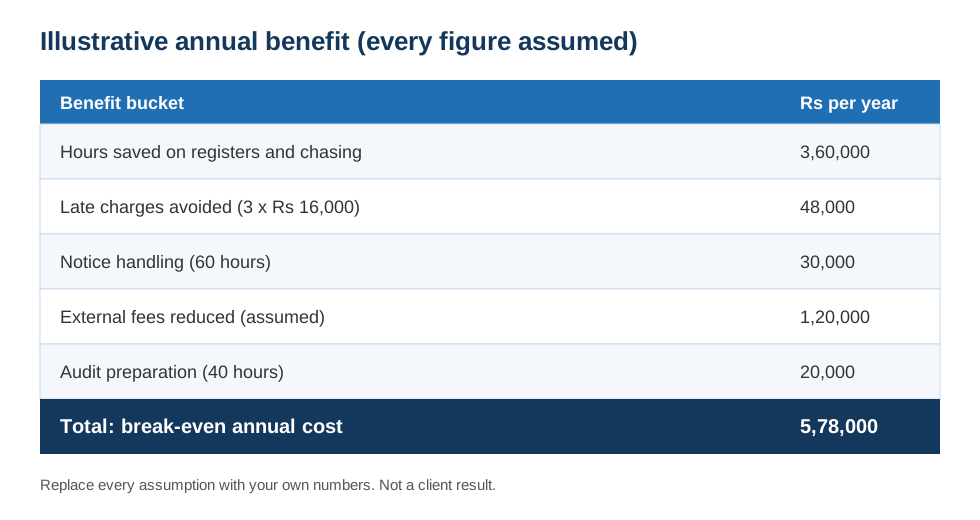
This is an illustration, not a client result. Imagine an employer with 400 employees, two plants in two states, an office in a third, 60 contract workers and a two-person compliance team. Every figure below is an assumption you should replace with your own.
| Benefit bucket | Assumption | Annual value (Rs) |
|---|---|---|
| Hours saved on registers, returns and chasing proofs | 60 hours a month at Rs 500 an hour | 3,60,000 |
| Late charges avoided | 3 late months a year on Rs 8,00,000 of contributions; 1% damages plus 12% p.a. interest for one month is Rs 16,000 each | 48,000 |
| Notice handling | 6 notices a year, 10 hours saved each at Rs 500 an hour | 30,000 |
| External fees reduced | Ad-hoc consultant charges no longer needed | 1,20,000 |
| Audit preparation | 40 hours saved at Rs 500 an hour | 20,000 |
| Total annual benefit | 5,78,000 |
On these assumptions, any all-in annual cost below Rs 5.78 lakh pays for itself, and the gap is your return. If a vendor’s three-year total comes to Rs 12 lakh, that is Rs 4 lakh a year, giving a return of (5.78 minus 4.00) divided by 4.00, or roughly 45%. Change one assumption and the answer moves, which is the point: the exercise shows you which assumptions your decision depends on.
Notice what is not in the table. The contractor default, the lapsed licence and the inspection that goes badly. They are real, and they are why many employers buy even when the visible maths is modest.
When the ROI Is Weak
We would rather say this than sell you something early. The return is thin when you operate in one state, have a small team, no contractors, a single licence and one careful person who documents everything. A spreadsheet and a calendar may serve you well. It is also thin when data is in poor shape and nobody will own the tool, because software that nobody reviews adds cost without control. Revisit when you add a second state, a first contractor or a second person who touches filings.
Not sure which side of that line you are on? We will run your numbers with you, whether or not you end up buying. BOOK A DEMO
Where Iztty Fits
Iztty is an AI-powered statutory compliance platform built by Futurex Management Solutions Limited, a New Delhi firm that has handled Indian labour compliance for clients since 2014. We do not publish a price list, because the drivers in Section 3 change the number. We give a quote against your own profile and itemise what is included.
Here is how it maps to the benefit buckets above, using only published features:
- Hours: state-specific registers and filings prepared through a Maker-Checker-DSC workflow, with integrations for Tally, Zoho Payroll and Keka HR (integrations).
- Contractors: vendor compliance collects EPF, ESIC and wage registers and calculates a vendor score.
- Notices: AI Notice Response averages 4 hours against 3 to 5 days manually.
- Visibility: the Compliance Score Meter gives a live 0 to 100% score by Act and state.
- Change: Regulatory Change Intelligence turns notifications into tasks, with human review before enforcement.
As anonymised illustrations, a representative 14-factory manufacturer moved its score from 61% to 88% in 90 days, and a representative 40-client consultancy cut EPF and ESIC notice response from 5 days to 4 hours. They are not named case studies. Consultancies can use a separate Compliance Consultant account. See the platform page.
Building the Business Case in a Week
- Day 1: List locations, states, Acts, contractors and users. This is your standard profile.
- Day 2: Pull last year’s late months, notices and consultant invoices.
- Day 3: Estimate hours spent each month on registers, returns and proof chasing, with the team’s own input.
- Day 4: Send the same profile to two or three vendors and ask for a three-year itemised total.
- Day 5: Fill the Section 7 table with your numbers and calculate break-even.
For a wider checklist of what to test, see our statutory compliance software checklist.
Conclusion
The price of compliance software is not one number, and neither is its return. Know which type you are buying, what drives the quote, which costs hide outside it and which of your own numbers decide the answer. Then ask each vendor for the same itemised three-year total.
If you would like help building that case, we can do it with you.
CHECK MY COMPLIANCE | CALL AN EXPERT
FAQs
Q1: What is compliance software?
Software that tracks which legal obligations apply to you, reminds the right people, prepares filings and registers, routes them for review and stores proof. For Indian employers it mainly covers labour and employment laws.
Q2: What are the types of compliance software in India?
Five common types: HRMS compliance modules, standalone statutory platforms, enterprise GRC or RegTech suites, outsourced compliance services, and hybrids that combine a platform with expert support.
Q3: How much does compliance software cost in India?
It depends on locations, states, Acts, contractors, users, integrations and bundled services. We do not quote figures in general because they would mislead. Send each vendor the same profile and ask for an itemised three-year total.
Q4: How much does a compliance management system cost?
Use the same method. Compare the shape of the price (per employee, per site or per state) against how your business grows, and include implementation, data clean-up, state add-ons and renewal terms.
Q5: What is the ROI of compliance software?
ROI is annual benefits minus annual cost, divided by annual cost. Count hours saved, late charges avoided, notice handling time, external fees reduced and audit preparation time. Treat avoided tail risk as a bonus, not a number.
Q6: What hidden costs should I watch for?
Data clean-up, implementation fees, state add-ons, integration work, training, continuing consultant fees, renewal escalators and the cost of exporting your data if you leave.
Q7: Is an HRMS compliance module cheaper?
Often at the start, particularly for one or two states. Check coverage of Professional Tax in your states, contract labour support and review workflows, because gaps there can create costs elsewhere.
Q8: How long does it take to see a return?
That depends on your data quality, number of sites and how quickly users adopt the workflow. Ask for a pilot on one site, with named milestones, before committing multi-year.
Q9: Do the Labour Codes change the cost?
The four Codes took effect on 21 November 2025, with final Central Rules notified on 8 May 2026 and State Rules arriving unevenly. Ask vendors how rule updates are handled and whether they are included in the price.
Q10: Do small businesses need compliance software?
Not always. A single-state employer with a small team and no contractors may manage with a calendar and a spreadsheet. Revisit when you add a second state, a first contractor or more people handling filings.