You search for “compliance software pricing”, open six vendor sites, and find three things. A “request a quote” button. A per-employee rate for a payroll product that is not quite what you asked about. And a listicle that ranks tools without a single rupee figure. If that was your morning, you are not missing something obvious. The category simply does not publish prices the way a stationery shop does.
There is a reason, and it is useful to you. In compliance software, the price is not a number. It is a formula, and the formula multiplies things only you know: your states, your locations, your Acts, your contractors. Once you understand the formula, you can read any quote, predict how it will behave when you grow, and build a three-year total cost of ownership. This guide shows how. We have not invented price lists. We have shown the arithmetic.
Want a quote built on your own states, sites and contractors? Our compliance practice will itemise it with you. GET A FREE COMPLIANCE AUDIT
Why the Price Is a Formula, Not a Number
Compliance software pricing in India depends on how much compliance work the software has to carry. Two companies with the same headcount can need very different amounts of it. A 500-person employer with one plant in one state and a single contractor has a handful of registers and one Professional Tax regime. A 500-person employer with 30 branches across nine states and 120 contract workers has nine rule sets, a renewal calendar per branch and monthly proof from every contractor.
Vendors price against that load, in different ways, which is why quotes do not line up. If you want a quick view of the types of product behind those quotes, read our guide to compliance software types, costs and ROI. This article goes deeper on one thing only: how the money is structured.
A short note on what we checked. A quick search of Indian HRMS and payroll vendors shows that many publish per-employee plans. We did not find published prices for specialist labour compliance platforms in the same quick check, and it was not an exhaustive review. Verify current pricing pages yourself before relying on any comparison.
Eight Pricing Models and What Each One Multiplies
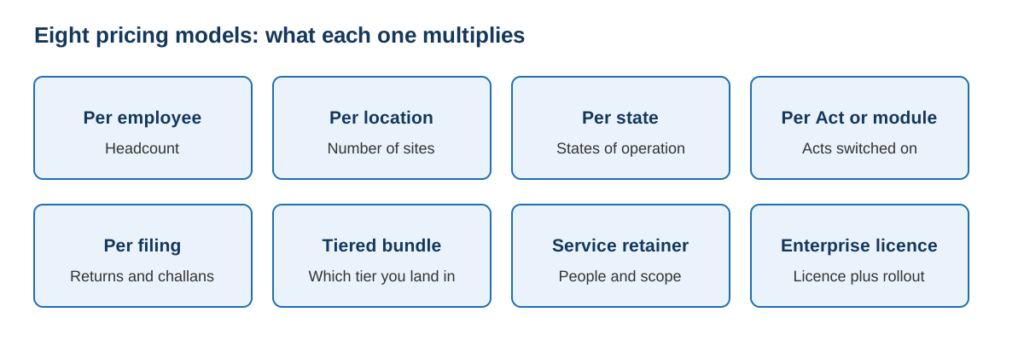
| Model | What it multiplies | Looks cheap when | Gets expensive when |
|---|---|---|---|
| Per employee per month | Headcount | Few people, many sites | Headcount grows or swings seasonally |
| Per location or establishment | Number of sites | Few large sites | Many small stores or branches |
| Per state | States of operation | Single-state employer | You expand across states |
| Per Act or module | Acts switched on | You only need EPF and ESIC | You add Professional Tax, LWF, S&E, CLRA |
| Per filing or transaction | Returns and challans | Few filings | Many entities, frequent filings |
| Tiered bundle | Which tier you land in | You fit a tier neatly | You sit just above a tier boundary |
| Service retainer | People and scope | You have no in-house team | Scope creeps beyond the retainer |
| Enterprise licence plus implementation | Licence, rollout and customisation | You are a large group | You need only a fraction of the suite |
Many real quotes blend two or three of these: a platform fee, plus a charge per location, plus state add-ons. Treat each blended element as its own multiplier and ask what it multiplies.
One more warning on the bottom row. Enterprise suites often bundle financial, tax and data privacy compliance with employment compliance. If your need is labour law alone, you may pay for breadth you will not use. Our guide to regulatory software solutions explains the different lanes.
How Each Model Reacts When You Grow
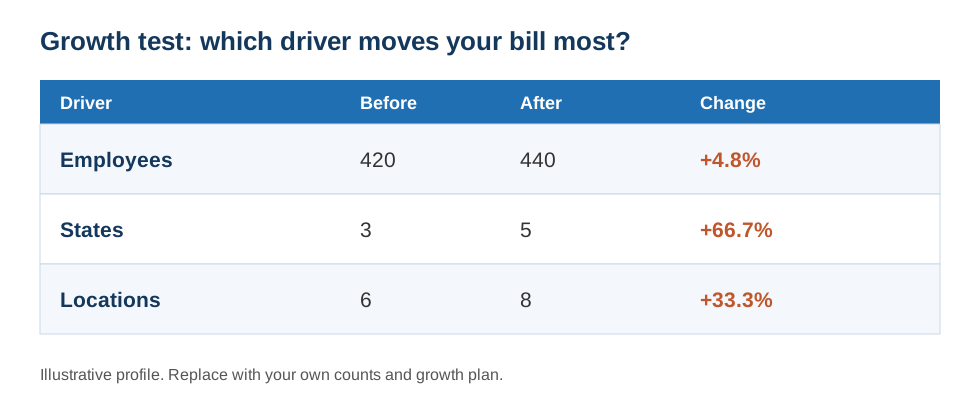
Here is a test that costs nothing. Take a standard profile: 420 employees, 3 states, 6 locations. Now imagine a year of growth: 20 more employees, 2 more states and 2 more locations. That gives 440 employees, 5 states and 8 locations. What happens to a bill that scales with each driver?
| If the price scales with | Before | After | Change in that part of the bill |
|---|---|---|---|
| Employees | 420 | 440 | About 4.8% higher |
| States | 3 | 5 | About 66.7% higher |
| Locations | 6 | 8 | About 33.3% higher |
Same company, same year, three very different outcomes. If your growth plan is hiring, a per-employee model grows gently. If your plan is new states, a per-state model punishes it. So the right question is not “which is cheapest today?” It is “which driver will grow fastest in our plan?” Then pick the model that scales with something else, or negotiate a cap.
Reading a Quote Line by Line
Take any quote and run each line through three questions: what does it multiply, what is included, and what happens at renewal?
- Platform or licence fee: What does it cover, and is any usage limit hidden inside, such as users, locations or filings?
- Implementation or onboarding: Is it one-time? Does it include data migration, or only setup?
- State or location add-ons: How many are included in the base? What is the price of the next one?
- Users and roles: Makers, Checkers and DSC holders are different people. Are they all priced as users?
- Integrations: Is the connection to your payroll or accounting system included, or a separate project?
- Digital Signature Certificates: Where signing is part of the workflow, DSCs are issued by licensed Certifying Authorities (see the Controller of Certifying Authorities), have a validity period and need renewal. Ask whether they are in the quote or yours to buy.
- Services: Notice drafting, filing support and advisory hours: included, capped or chargeable by the hour?
- Taxes: Does the figure include GST? Check the applicable rate and treatment on the CBIC GST site or with your tax adviser.
- Renewal: What is the price after year one, and is there a cap on the uplift?
If the vendor cannot answer any of these in writing, the quote is not finished.
Building a Three-Year Total Cost of Ownership
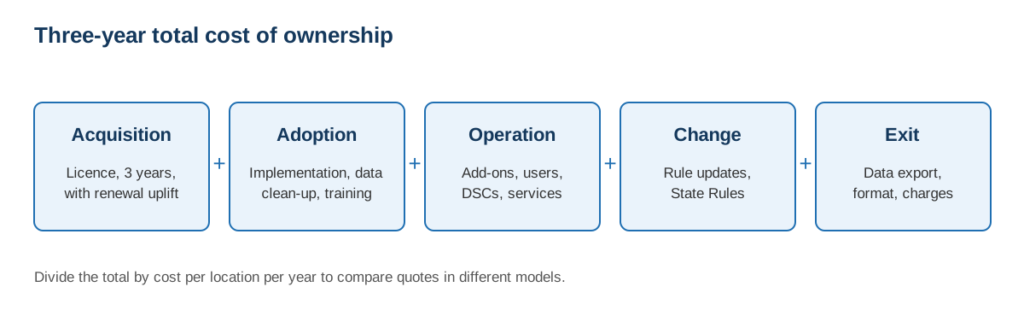
Total cost of ownership, or TCO, is everything you spend over a fixed period to own and run the tool. A workable formula for a three-year window is:
TCO = acquisition + adoption + operation + change + exit
- Acquisition: licence or platform fees for three years, with the renewal uplift applied to years two and three.
- Adoption: implementation, data clean-up (your team’s hours, priced at a loaded hourly cost), integration and training.
- Operation: add-on states and locations as you grow, extra users, DSC purchase and renewal, and any recurring service fees.
- Change: what it costs to keep the tool right as rules change. This matters more than usual now. The four Labour Codes took effect on 21 November 2025, final Central Rules followed on 8 May 2026, and State Rules are arriving unevenly. Ask whether rule updates are included or billed as change requests.
- Exit: data export, format, and any charge for it.
Then do two things most people skip. First, compute TCO under your growth plan, not today’s footprint. Second, divide by something meaningful, such as cost per location per year or cost per 100 employees, so quotes in different models compare on one yardstick. For the benefit side of the ledger, including a worked example with its assumptions shown, see the ROI section of our cost guide linked above.
Contract Terms That Move the Price
- Term length: Multi-year terms often lower the annual fee and make leaving costlier.
- Minimum commitments: A floor on employees or locations that you pay even when you shrink.
- True-up clauses: Charges adjusted upward when your counts exceed the contract at a review date.
- Uplift caps: A ceiling on renewal increases, stated as a percentage.
- Scope of rule updates: Whether new State Rules and Code changes are covered.
- Service levels: Support response times, and what is credited if they are missed.
- Data ownership and export: Your registers, proofs and logs, in a usable format, at exit.
- Termination: Notice period and any early-exit fee.
Pricing Red Flags
- “Unlimited” with no definition. Unlimited users, filings or locations usually has a fair-use limit somewhere. Ask where.
- A price with no scope. If the quote does not list your states, Acts and contractors, it was written for someone else.
- Silence on contractors. If you have contract workers and the quote never mentions collecting their proof, the work stays with you.
- “Free” setup, expensive services. The cost moved; it did not vanish.
- Per-filing pricing that rises with corrections. Ask what a rejected or resubmitted filing costs.
- Pressure to sign for three years before a pilot. A confident vendor lets you test on one site first.
- No itemised renewal. A low year one with a blank year two is a loan, not a price.
Holding a quote you are not sure about? Send it over and we will walk through it line by line, whether or not you end up buying. BOOK A DEMO
Four Company Profiles, Four Pricing Watch-Outs
| Profile | Driver likely to grow fastest | Watch-out |
|---|---|---|
| Single-state SME, 100 to 200 people | Headcount | Per-employee tiers with a jump just above your size |
| Multi-state manufacturer | States and plants | State add-ons and factory register formats priced separately |
| Retail chain with many outlets | Locations | Per-location pricing across dozens of small stores |
| Compliance consultancy with many clients | Client entities | Whether multi-client accounts are priced per entity or as a bundle |
These are tendencies, not rules. The only reliable test is the growth table in Section 3 using your own numbers.
What to Ask For Before You Sign
- A cap on renewal uplift, written as a percentage.
- A bundled price for the states you already plan to add within 12 months.
- A pilot on one site, with named milestones, before a multi-year commitment.
- Written confirmation that rule updates, including State Rules under the Labour Codes, are in scope.
- An itemised list of what is outside the quote.
- A data export clause in plain language.
Item five is the most useful. A vendor that tells you honestly what is outside the quote has done half your homework.
Where Iztty Fits
Iztty is an AI-powered statutory compliance platform built by Futurex Management Solutions Limited, a New Delhi firm that has handled Indian labour compliance for clients since 2014. We do not publish a price list, for the reasons in Section 1. We quote against your own profile and itemise the lines so you can compare them with any other quote.
Here is how the platform maps to the cost lines above, using published features only:
- Workflow and signing: a Maker-Checker-DSC workflow with review, DSC signing and auto-archive to a Document Vault.
- Integrations: Tally, Zoho Payroll and Keka HR (see integrations).
- Contractors: vendor compliance collects EPF, ESIC and wage registers and calculates a vendor score.
- Change: Regulatory Change Intelligence turns notifications into tasks, with human review before enforcement.
- Notices: AI Notice Response averages 4 hours against 3 to 5 days manually.
As anonymised illustrations, a representative 14-factory manufacturer moved its Compliance Score from 61% to 88% in 90 days, and a representative 40-client consultancy cut EPF and ESIC notice response from 5 days to 4 hours. They are not named case studies. Consultancies managing several clients use a separate Compliance Consultant account. See the platform page.
A Five-Day Quote Comparison
- Day 1: Write your standard profile: locations, states, Acts, employees, contractors and users, plus your 12-month growth plan.
- Day 2: Send the same profile to two or three vendors and ask for an itemised three-year total, with the Section 4 questions.
- Day 3: Run the Section 3 growth test on each quote.
- Day 4: Build each TCO using the Section 5 formula and divide by cost per location per year.
- Day 5: Score the contract terms in Section 6 and shortlist.
To test what each tool actually does for the Acts you care about, pair this with our statutory compliance software checklist.
Conclusion
You will not find a single honest price for compliance software, because there is not one. You will find a formula, and the way to beat it is to know your own multipliers. Know what each line multiplies, test how the bill grows with your plan, and build a three-year total with the exit and rule-change costs included.
If you would like help turning a quote into a comparable total, we can do it with you.
CHECK MY COMPLIANCE | CALL AN EXPERT
FAQs
Q1: How much does compliance software cost in India?
There is no standard price. It depends on your locations, states, Acts, contractors, users, integrations and bundled services. Send every vendor the same profile and ask for an itemised three-year total.
Q2: What are the common pricing models for compliance software?
Per employee per month, per location, per state, per Act or module, per filing, tiered bundles, service retainers, and enterprise licences with implementation fees. Many quotes blend two or three.
Q3: Is per-employee or per-location pricing better?
Neither is better in general. Per-employee pricing grows with headcount, per-location pricing grows with sites. Pick the model that scales with the driver that will grow slowest in your plan.
Q4: What is total cost of ownership for compliance software?
It is everything you spend over a fixed period: licence fees, implementation, data clean-up, integrations, training, add-ons, DSCs, rule-change costs and exit costs. A three-year window works well.
Q5: What hidden costs should I look for in a quote?
State and location add-ons, integration work, DSC purchase and renewal, services billed by the hour, renewal uplifts, rule-update charges and data export fees.
Q6: How much does a compliance management system cost?
Use the same method. Compare the shape of the price against your growth plan and include every cost line over three years, not only the first-year fee.
Q7: Why do compliance software vendors not publish prices?
Because the price depends on your profile. A fixed list price would be wrong for most buyers. That is also a reason to insist on an itemised quote for your own profile.
Q8: Is an HRMS compliance module cheaper than a specialist platform?
It often is at the start, especially for one or two states. Check Professional Tax coverage, contract labour support and review workflows, because gaps there can create costs elsewhere.
Q9: Do the Labour Codes affect compliance software pricing?
They can. The four Codes took effect on 21 November 2025, final Central Rules were notified on 8 May 2026 and State Rules are arriving unevenly. Ask whether rule updates are included in the price or billed separately.
Q10: How can I negotiate compliance software pricing?
Ask for a cap on renewal uplift, a bundled price for planned state additions, a pilot before a multi-year commitment, written confirmation that rule updates are included and a clear data export clause.