A plant manager in Manesar, an HR head in a Bengaluru tech park, a store operations lead in Lucknow and an administrator at a 150-bed hospital in Nagpur all open the same kind of email in the first week of the month: “Compliance status, please.” The four answers could not be more different. One is counting overtime hours against a register. One is checking whether a night-shift cab policy matches state rules. One is chasing renewals for forty small outlets. One is trying to prove that the housekeeping contractor paid its people.
That is the problem with buying regulatory compliance software solutions as if every employer were the same. The Acts are shared, but the pain is not. This guide walks through four sectors, manufacturing, IT/ITES, retail and healthcare, and shows what each one should demand from a platform before signing. If you want the general explanation first, read our guide to regulatory compliance software. This one starts where that ends.
Want to see how your sector’s obligations map to your own sites and states? Our compliance practice will walk you through it before you shortlist anything. GET A FREE COMPLIANCE AUDIT
Why One Sector’s Checklist Fails Another
Most buying guides give you one list of features and tell you to tick them. The trouble is that the same feature matters very differently depending on how you employ people.
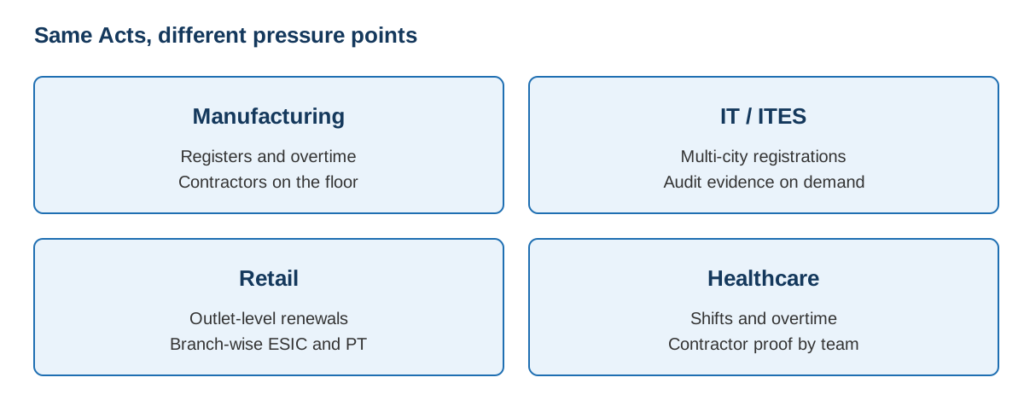
A factory lives and dies on registers kept at the plant, and on whether those registers agree with payroll. An IT services firm may have fewer registers but several offices, a client auditor and a night-shift policy. A retailer has a large number of small registrations, each with its own renewal date. A hospital has round-the-clock shifts, a large contractor share and a stack of licences, only some of which are labour-related.
So the question is not “which software has the most features?” It is “which features break first in my sector, and does this platform hold up there?” That shapes the rest of this guide.
The Labour Codes Layer Over All Four
Whatever your sector, one change sits on top of everything. The four Labour Codes took effect on 21 November 2025, the Central Government notified final Central Rules on 8 May 2026, and State Rules are arriving at different speeds. The Code on Occupational Safety, Health and Working Conditions now covers factories, contract labour and working conditions. The Code on Social Security covers provident fund and ESIC. State Shops & Establishment Acts continue alongside.
In practice, forms, portals and notices will mix legacy Act names with Code names for a while. Ask any vendor how its rules are dated and updated, and who reviews a change before it reaches your account. Check the Ministry’s labour.gov.in site for the current position. Our process guide to regulatory change management explains the loop. The rest of this article uses legacy Act references because that is what most registers, forms and notices still carry today. Confirm the applicable rule for your state before acting.
A quick word on who should read which part. If you are a CFO or founder, skim the “What to demand” line under each sector and the table in Section 7. If you are a compliance manager or plant HR head, the bullet lists are where the detail sits. When should you act? Usually when you add a second state, a first contractor, a second plant or a third person who touches filings. Why bother now? Because the Labour Codes are changing the paperwork underneath, and a manual process that coped last year may not cope with a mixed set of old and new forms.
Manufacturing: The Register and the Shop Floor
Think of a mid-sized auto-components maker with two plants, three shifts and about 150 contract workers across both sites. Where does compliance hurt?
- Registers that must match reality: Muster rolls, overtime registers and leave registers under the Factories Act, 1948 and your state’s Factories Rules. Form numbers differ by state, so a tool needs your state’s format, not a national template. Our Factories Act registers checklist lists them.
- Overtime and hours: Under the Act, overtime is paid at twice the ordinary rate (Section 59), and weekly and daily limits apply. Registers, attendance and payroll must agree, or the first inspection finds the gap. Ask whether the tool compares them.
- Licence renewal: A factory licence and its renewal are tied to a date. A tiered alert, say 90, 60 and 30 days, is more useful than one reminder.
- Contractors on the floor: Under the Contract Labour (Regulation and Abolition) Act, 1970, you carry responsibility if a contractor defaults on wages. That means monthly contractor EPF and ESIC proof per site. See our guide to CLRA registers and returns.
- Plant-to-plant variation: Two plants in two states means two sets of Rules. One score per plant, not one blended number, shows where to look.
What to demand: state-specific factory registers, overtime reconciliation with payroll, licence alerts in tiers, contractor proof by plant and a per-plant score.
IT/ITES: Few Registers, Many Questions
Picture a 400-person software services company with offices in Pune, Noida and Chennai and a client who audits compliance every year. There is no factory floor, but the exposure is real.
- Shops & Establishment registrations by city: Each office sits under its state’s Act, with its own registration, renewal period and register formats. Some states have special provisions for IT and ITES establishments on working hours or night work, so confirm per state. See our state-wise Shops & Establishment guide.
- Professional Tax, PF and ESI in several states: The mix of Professional Tax slabs across Maharashtra, Karnataka and Tamil Nadu means payroll deductions differ by employee location.
- Night shifts and women employees: State rules commonly attach conditions to night work. Under the new Rules, published advisory summaries point to written consent and transport. Check your state’s position.
- Crèche and maternity obligations: The Maternity Benefit Act, 1961 requires a crèche in establishments with 50 or more employees. A tool that does not track it is not the end of the world, but you should know who does.
- Client and investor audits: The audit asks, “Show us last quarter’s PF challan and the register.” Speed matters, so a searchable archive with the signed document is worth more than a dashboard.
- Housekeeping and security contractors: Easy to overlook in an IT firm, and still covered by contract labour rules once headcount thresholds apply.
What to demand: multi-city Shops & Establishment handling, Professional Tax by employee location, an audit-ready archive and a clear answer on what adjacent obligations (for example, internal committee reporting) sit outside the tool.
Retail: Forty Outlets, Forty Small Deadlines
A fashion retailer has 40 stores across eight states and about 600 employees. No single store is complicated. The volume is the problem.
- One registration per outlet: Each store needs its own Shops & Establishment registration, usually with a renewal date. At 40 outlets, that is a renewal almost every week.
- Opening hours, weekly off and overtime: State rules differ, and festival seasons stretch hours. See our page on leave and working hours for how these interact.
- Branch-wise ESIC and Professional Tax: Contributions are tracked per registered location and per state. A single misallocated branch can cause a short-payment notice.
- Seasonal and part-time staff: Headcount swings change which thresholds apply and which registers need new rows.
- Outsourced housekeeping and security: Contract workers at stores are still your concern if the contractor fails to pay. Check proof by contractor and by city.
- Head office visibility: The regional manager needs to see which five outlets are behind, not 40 green ticks.
What to demand: a store-level registration tracker with tiered alerts, state-specific formats, branch-wise statutory tracking and a dashboard that ranks outlets by risk.
Running many outlets, plants or wards? See a multi-location view built from your own states. BOOK A DEMO
Healthcare: Shifts, Contractors and Mixed Licences
A 150-bed hospital has doctors, nurses, technicians, front desk staff and a large outsourced team for housekeeping, security, laundry and kitchen. Add a pharmacy and a diagnostic centre and the picture grows.
- Round-the-clock shifts: Nurses on 12-hour shifts bump against daily and weekly limits in state rules. The tool should flag hours against the state’s limit, and overtime records must agree with payroll.
- A very high contractor share: In many hospitals, a large part of the headcount sits with contractors. The same monthly proof of EPF, ESIC and wages applies. Our vendor compliance page shows the approach.
- ESIC and EPF mix: Wage levels vary widely across roles, so coverage by employee must be right. Check how the tool handles an employee crossing the ESIC wage ceiling mid-period.
- Licences that are not labour licences: Hospitals hold clinical, biomedical waste, fire and pharmacy approvals. Many are outside labour compliance software. Ask what the platform tracks and what stays with your administration team.
- Pharma units: A pharmaceutical plant is a factory, so the manufacturing checklist applies.
- Notices: Provident fund or ESIC local office notices land in a general inbox and wait. Speed of reply matters.
What to demand: shift and overtime reconciliation, contractor proof by department, clear boundaries on non-labour licences and a defined path for notices.
What Breaks First in Each Sector
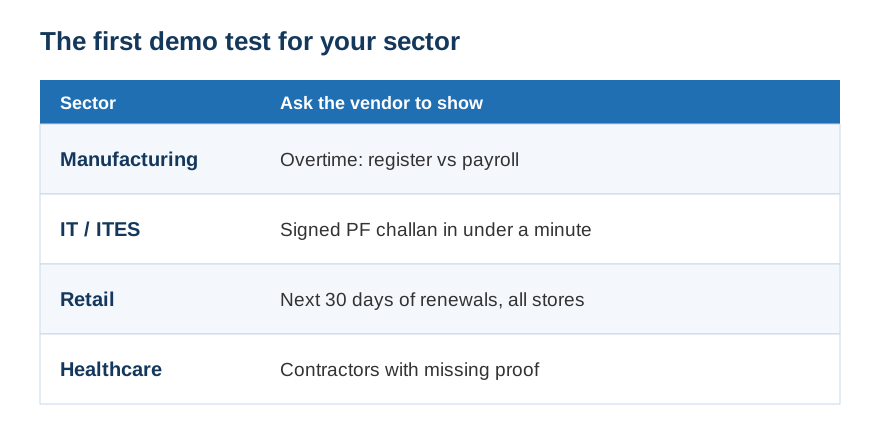
| Sector | First thing to break | Question that exposes it |
|---|---|---|
| Manufacturing | Register and payroll disagree on overtime | Show me overtime hours reconciled across register and payroll |
| IT/ITES | Multi-city registrations and client audit evidence | Show me a signed PF challan found in under a minute |
| Retail | An outlet’s licence expires unnoticed | Show me the next 30 days of renewals across all stores |
| Healthcare | A contractor stops remitting | Show me contractors with missing proof this month |
If a vendor’s demo does not touch the row for your sector, say so politely and ask for it.
Construction, staffing, logistics and mining follow the same logic with different pressure points. A construction firm has contractors that arrive and leave with each project. A staffing company deploys workers to client sites in several states and answers to principal employers. A logistics operator runs many warehouses with high attrition. A mine has its own regime that is moving into the Occupational Safety, Health and Working Conditions Code. Each deserves its own test row, and we will cover them separately rather than squeeze them in here.
Here is how this plays out in a real week. Say a retail operations lead gets a call from a state office about one outlet’s lapsed registration. In a spreadsheet, finding that store’s file takes ten minutes and a phone call. In a platform that tracks tiered alerts per outlet, the alert fired weeks ago and the renewal receipt sits next to the registration. The difference is not glamour. It is that the call becomes a two-minute reply instead of a scramble.
The same pattern holds for a plant. An inspector asks for the overtime register for the last quarter. If the register, attendance and payroll agree, the answer is a printout. If they do not, the next hour is spent explaining the difference. That gap is what the manufacturing test in the table is designed to find before an inspector does.
Five Questions to Ask Any Vendor in Your Sector
- Can you show our two least common states, not the biggest?
- Where does a second person review before anything is signed?
- What happens when a state notifies new rules, and who checks it?
- Which of our obligations does the tool not cover, in writing?
- How does it connect to our payroll system?
Question four is the most useful. A vendor that says “everything” is guessing.
Where Iztty Fits by Sector
Iztty is an AI-powered statutory compliance platform built by Futurex Management Solutions Limited, a New Delhi firm that has handled Indian labour compliance for clients since 2014. These are the pieces most relevant to the sectors above.
- Manufacturing: Factories Act registers, licence renewal with tiered expiry alerts and a score by Act and state. A representative 14-factory manufacturer moved its Compliance Score from 61% to 88% in 90 days. That is an anonymised example, not a named case study.
- IT/ITES and retail: state-specific Shops & Establishment registers, licence renewals and a multi-branch, multi-state dashboard, with payroll connections to Tally, Zoho Payroll and Keka HR.
- Healthcare: vendor compliance collects contractor EPF, ESIC and wage registers and calculates a vendor score, supporting principal-employer liability records under CLRA.
- Every sector: a Maker-Checker-DSC workflow with review, DSC signing and archive to the Document Vault, the Compliance Score Meter, and AI Notice Response, which averages 4 hours against 3 to 5 days manually.
See the platform page for the full picture. Consultancies serving several sectors can use the separate Compliance Consultant account.
How to Start in Your Sector
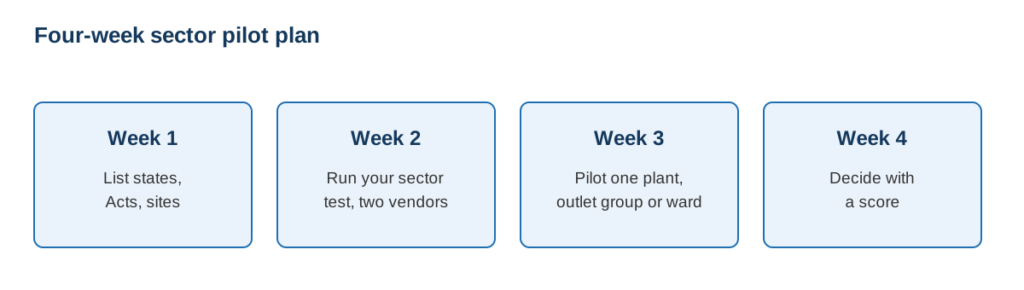
- Week 1: list your states, Acts and sites. Mark the row from the Section 7 table that matches your sector.
- Week 2: run that one test with two vendors, live.
- Week 3: pilot one plant, one outlet group, one office or one department.
- Week 4: decide with a score, not a feeling.
For a broader checklist across the main Acts, our statutory compliance software checklist goes Act by Act.
Conclusion
The right regulatory compliance software solution is the one that holds up where your sector is weakest. For a plant, that is registers and contractors. For an IT firm, evidence and multi-city registrations. For retail, volume. For a hospital, shifts and contractor proof. Test that first.
If you would like an expert to run the test against your own sites, we can do it with you.
CHECK MY COMPLIANCE | CALL AN EXPERT
FAQs
Q1: What are regulatory compliance software solutions?
They are platforms that map the labour and employment laws that apply to you, prepare filings and registers, route them for review and signing, track licences and deadlines and keep proof.
Q2: Does the right software differ by industry?
The core Acts overlap, but the pressure points differ. Factories need registers and overtime reconciliation, retail needs outlet-level tracking, IT needs multi-city handling and audit evidence, and hospitals need shift and contractor control.
Q3: What does a manufacturer need from compliance software?
State-specific Factories Act registers, overtime reconciliation with payroll, licence renewal alerts, contractor proof by plant and a score per plant.
Q4: Do IT and ITES companies need labour compliance software?
If you have more than one office or state, usually yes. Shops & Establishment registrations, Professional Tax, PF and ESI, and client audits create steady work even without a factory.
Q5: How should retailers track licences across many stores?
Use a tracker with one registration per outlet, tiered renewal alerts and a view that ranks stores by risk.
Q6: What about hospitals and contract staff?
Collect EPF, ESIC and wage proof from each contractor monthly and score them. The principal employer can be responsible if a contractor defaults on wages.
Q7: Do the Labour Codes change what I should buy?
The four Codes took effect on 21 November 2025, with final Central Rules notified on 8 May 2026 and State Rules arriving unevenly. Choose a platform that tracks legacy Act and Code references together and updates promptly.
Q8: Can an HRMS compliance module cover my sector?
For one state and simple payroll, often. For factories, many outlets or contractor-heavy sites, check state formats, contractor proof and review workflows.
Q9: How much does compliance software cost in India?
Pricing depends on locations, Acts, states, users and services bundled. Ask for a quote against your own profile.
Q10: What should I test in a demo for my sector?
Use the row for your sector in the table in Section 7, then ask which of your obligations the tool does not cover.