It is the 23rd of November 2026, two days after the first anniversary of the four Labour Codes. An HR head in Pune opens her notes and finds three different answers to one question: which rules apply to her plants in Maharashtra, her warehouse in Gujarat and her sales office in Delhi? The Centre has notified its rules. Some states have notified theirs. Others have only published drafts. Payroll still runs on a salary structure designed in 2024.
That is where most employers stand with the labour codes 2026 picture. The law is in force, the Central Rules are final, and the state layer is still uneven. This guide separates what has actually changed from what is still pending, flags where the reports disagree with each other, and ends with a ten-point list of things worth fixing in the next 30 days.
Not sure which Labour Code rules apply to each of your states and sites today? Our compliance practice can map it with you. GET A FREE COMPLIANCE AUDIT
Where the Labour Codes Stand After One Year
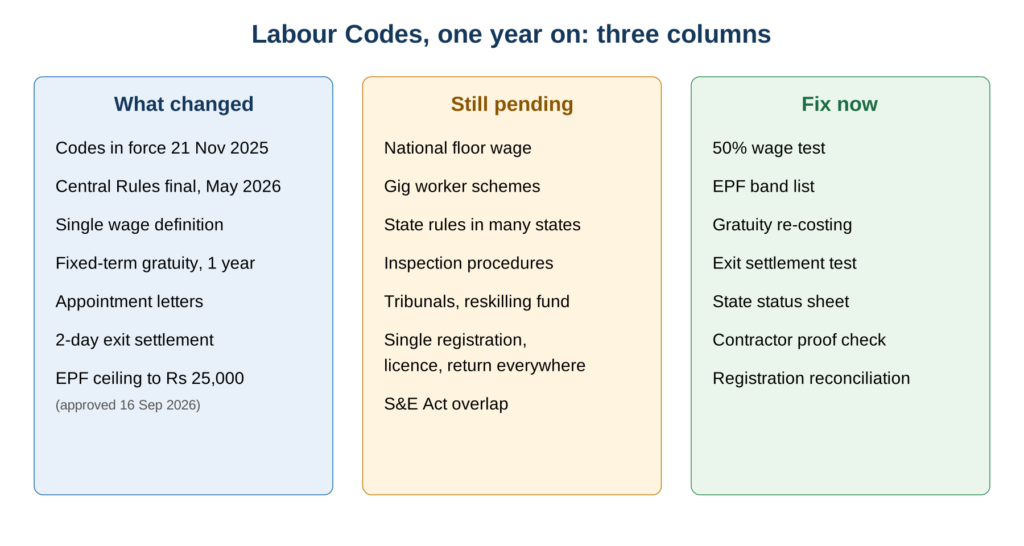
The four Labour Codes took effect on 21 November 2025. The Press Information Bureau announced that they consolidate 29 central labour laws into the Code on Wages, 2019, the Industrial Relations Code, 2020, the Code on Social Security, 2020 and the Occupational Safety, Health and Working Conditions Code, 2020. You can read the government’s own account in the PIB release on the implementation of the Labour Codes.
A year later, the short version is this:
- The Codes are in force. Employers cannot wait for “full clarity” before acting. The old Acts they replaced are no longer the operating law.
- The Central Rules are final. The Centre notified its final rules in May 2026. Those rules apply where the Centre is the “appropriate government”, such as railways, mines, ports, banking, insurance and central public sector units.
- Most private employers sit under State Rules. This is the layer that is still patchy.
- Several national pieces are pending. A national floor wage, gig worker schemes and some institutional bodies have not yet delivered.
If you want the month-by-month sequence of how the Codes arrived, our earlier guide on regulatory change management for Labour Code updates covers it. This article does not repeat that timeline. It asks a different question: one year in, where are we, and what should you do on Monday morning?
What Has Actually Changed for Employers
Strip away the commentary and a handful of changes touch almost every employer. These are the ones to check first.
A single wage definition
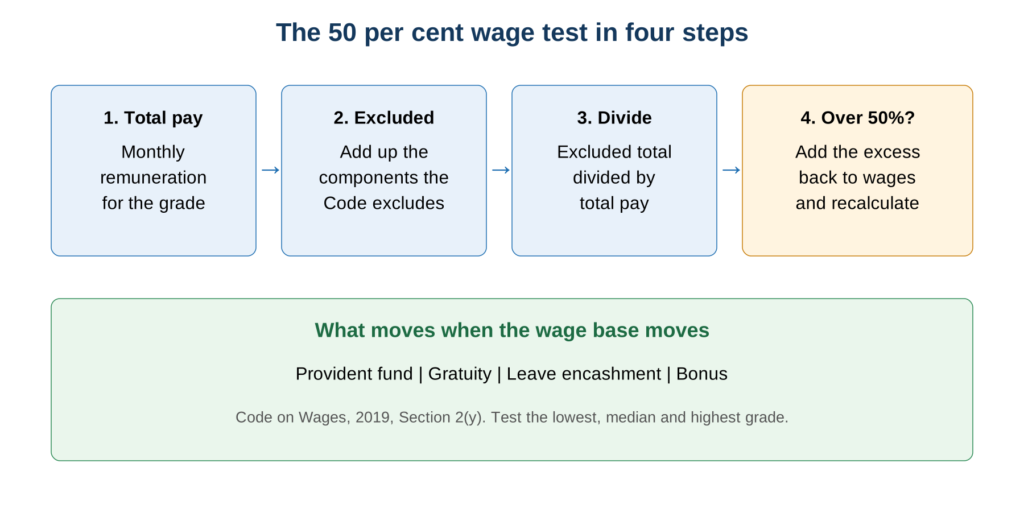
The Code on Wages, 2019 defines “wages” in Section 2(y). Certain components are excluded, but if the excluded items add up to more than 50 per cent of total remuneration, the excess is added back to wages. This is the change that sent payroll teams back to their salary structures. Basic pay, dearness allowance and retaining allowance are inside the definition. A pay structure that keeps basic pay low and parks the rest in allowances can now fail the test.
Why it matters beyond payroll: the same wage figure feeds provident fund, gratuity, leave encashment and bonus calculations. Fix it once, and several downstream numbers move with it.
Gratuity for fixed-term employees
Under the Code on Social Security, 2020, fixed-term employees become eligible for gratuity after one year of service, rather than the five years that applied to permanent staff under the old law. If you hire on fixed-term contracts, you now carry a gratuity liability that did not exist before. Business Today, reporting on the anniversary, notes that gratuity provisions took effect when the Codes became operational.
Overtime and timely payment
Section 13 of the Code on Wages sets overtime at twice the normal rate of wages. That is not new for factories, where the Factories Act already required it, but the Code extends the principle across establishments covered by it. Section 17 sets payment timelines, including settlement of dues within two working days when a worker is removed, dismissed or resigns. Check your full-and-final process against that two-day clock. Most exit processes were built around 30 to 45 days.
Appointment letters, health check-ups and women in night shifts
The Ministry of Labour has highlighted mandatory appointment letters, universal minimum wages, free annual health check-ups and permission for women to work in all sectors, including night shifts, subject to conditions. The conditions, such as consent and transport, sit in the rules, which is why state notification matters here. The Ministry’s written reply in Parliament is available as a PDF on the labour.gov.in website.
Registration, licence and return, in theory
The Codes promise a single registration, a single licence and a single return. That promise is only as good as the state portals behind it. We come back to this in Section 4.
Central Rules and State Rules: The Uneven Layer
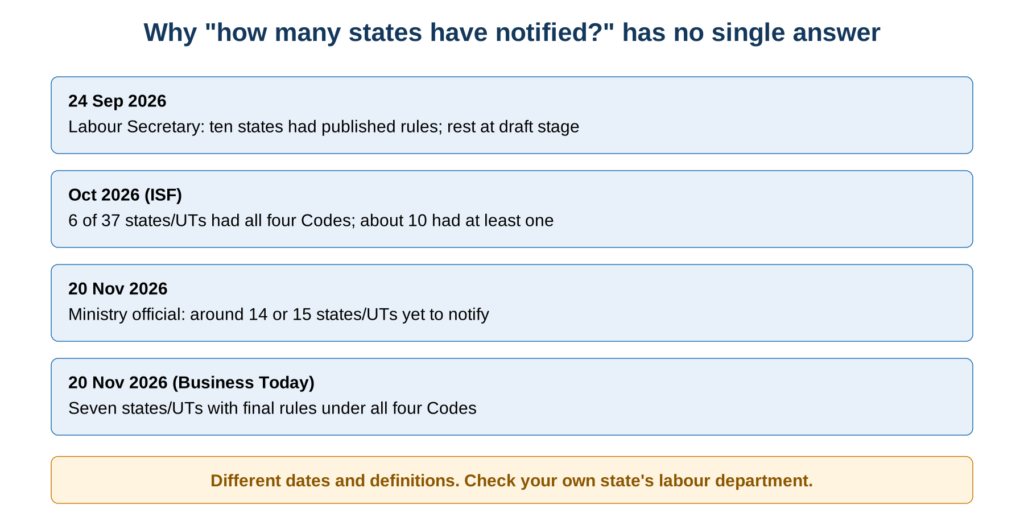
The question employers ask most is simple: have my states notified their rules? The honest answer is that the count depends on who you ask and when they counted.
| Source and date | What it reported |
|---|---|
| Labour Secretary, as reported by Business Standard, 24 September 2026 | Ten states had published rules. The rest had issued drafts. The Secretary said he hoped all states and Union Territories would have rules by 31 October. |
| Indian Staffing Federation tracking, cited by Business Standard, 20 November 2026 | Six of 37 states and UTs had notified rules under all four Codes as of October. About 10 more had notified at least one Code. |
| Unnamed Labour Ministry official, same article | Around 14 or 15 states and UTs had not yet notified state rules. |
| Business Today, 20 November 2026 | Seven states and UTs had final rules under all four Codes. The report gave no total for the rest. |
These numbers do not contradict each other as much as they appear to. One counts states with any rules, another counts states with all four Codes. One was taken in September, another in October. A fair reading is that a small group of states has finished, roughly ten have partial coverage, and a long tail has not. The 31 October target the Labour Secretary mentioned was not met everywhere.
What this means for you: do not rely on a national headline count. Find your own states on the state labour department website, check which of the four Codes each has notified, and note the date. That one-line record per state is worth more than any summary.
Where states diverge
The Indian Staffing Federation’s executive director, Suchita Dutta, told Business Standard that “divergence in timing and interpretation, not the codes’ text, is now the principal friction point.” The areas of divergence reported include working hours, overtime, inspections, conditions for women on night shifts, standing order thresholds and the interpretation of the wage definition. If you operate in three states, expect three slightly different answers to the same question.
What Is Still Pending
Reports around the anniversary agree on a core list of items that have not yet been delivered. Treat this as a watch list, not a to-do list. Most of it is for the government to act on, but each item changes something for you once it lands.
| Pending item | Status as reported | Why an employer should care |
|---|---|---|
| National floor wage | Not notified. The Central Advisory Board under the Code on Wages is constituted, but sources report little progress. | It sets the minimum below which no state can fix its wages. |
| Gig and platform worker schemes | A National Social Security Board was notified in October 2026. Contribution mechanisms are still being operationalised. | Aggregators face a contribution of 1 to 2 per cent of annual turnover, capped at 5 per cent of amounts paid to these workers. |
| Single registration, licence and return | Not working fully across all states. | You may still file in the old way in some states and the new way in others. |
| Inspection procedures | Formal standard procedures are awaited. | Inspector-cum-facilitators are appointed, but how they inspect is not uniform. |
| Tribunals and reskilling fund | Not yet fully in place. | Affects retrenchment and dispute handling. |
| Shops and Establishments overlap | Unresolved, including treatment of leave balances accrued under earlier laws. | State Shops and Establishments Acts continue to run alongside the Codes. |
One more item deserves a mention. Trade unions have kept the Codes in the political conversation. On 20 November 2026, unions raised them at a pre-Budget meeting with the Finance Minister, and CITU has called for repeal. Whatever one thinks of that debate, it is a reminder that the rules can still be amended. Build your processes so a rule change is a small edit, not a rebuild.
The EPF Wage Ceiling and Why Reports Differ
This is the item most likely to hit payroll in the next quarter, and the reporting on it is not consistent.
On 16 September 2026 the Union Cabinet approved raising the wage ceiling for mandatory EPFO coverage from Rs 15,000 to Rs 25,000 per month. The Prime Minister’s Office page says the change is expected to bring more than 51 lakh additional employees under mandatory coverage. You can read the announcement on the Prime Minister of India website. The same page says the Ministry of Labour and EPFO “will undertake the necessary statutory and administrative steps for implementation.” It does not give an effective date.
Some secondary reports state that coverage began on 17 September 2026. Others describe the EPF Scheme, 2026 and EPS, 2026 as notified in June 2026 and approved by EPFO’s Central Board of Trustees on 19 November 2026. Those dates have not been confirmed against a gazette notification in this review.
What to do with that uncertainty:
- List the employees earning between Rs 15,001 and Rs 25,000. You need this list whichever date turns out to be right.
- Read the EPFO circular, not the news. Check the EPFO website for the notification and effective date before changing contributions.
- Decide the contribution basis. Reports indicate employers may contribute on the ceiling rather than full basic pay. That is a policy decision with take-home pay consequences, so take it to leadership with numbers.
- Remember the 15th. Contributions through the ECR are due by the 15th of the following month, and late payment attracts interest under Section 7Q (12 per cent a year) and damages under Paragraph 32A (1 per cent a month). Our EPF and ESIC compliance guide walks through the monthly cycle.
Establishments running their own exempt PF trusts should check the transition requirements closely, since reports suggest they must formally seek continuation of exemption.
Six Grey Areas Where Employers Are Guessing
Consultants quoted in the anniversary coverage agree that several questions still lack a clear answer. If your business sits in one of these, document your reasoning today so you can show a good-faith position later.
- IT and ITeS pay structures. Allowance-heavy salaries have not been restructured widely, and the classification of workers versus non-workers in the sector is unclear, according to a Deloitte partner quoted by Business Standard.
- Managerial staff. How overtime and leave encashment apply to managerial employees is not settled.
- Legacy registrations. What happens to registrations and licences issued under the repealed Acts is unclear in several states.
- Leave balances under Shops and Establishments laws. Overlap between state Acts and the Codes is unresolved.
- MSME cost impact. Higher wage bases push up provident fund and social security costs for small employers.
- Contract labour thresholds. The Occupational Safety, Health and Working Conditions Code changes the threshold for contractor licensing. Confirm the number your state rules use before relying on any national summary.
A short written note for each grey area, signed off by HR and finance, is cheap. It also tells an inspector that you saw the issue and made a decision rather than ignoring it.
Running contract labour across more than one state? The principal employer carries the risk when a contractor slips. CHECK MY COMPLIANCE
What to Fix Now: A Ten-Point List
This is the practical part. Each item below is something you can start without waiting for another notification.
- Run the 50 per cent wage test on every salary structure. Pull a sample from each grade. If excluded allowances exceed half of total remuneration, model the new wage figure and its effect on PF, gratuity and leave encashment.
- List employees in the Rs 15,001 to Rs 25,000 band. Confirm the EPFO effective date and decide your contribution basis before the next ECR.
- Re-cost gratuity for fixed-term staff. Ask finance to provide for the one-year eligibility. Check that the provision method is consistent across entities.
- Shorten your exit settlement process. Test whether you can settle dues within two working days of a resignation or removal. If not, identify which step (assets, approvals, payroll cut-off) is slowing it.
- Issue appointment letters to everyone, not just new joiners. Check that the letters state wage components, working hours and the applicable establishment.
- Build a state-by-state status sheet. One row per state: which Codes have notified rules, the date, the source URL and who checked it. Update it monthly.
- Review overtime and working-hours settings in your attendance system. Match them to the state rules where each site operates, not to a single group policy.
- Re-check women night-shift conditions. Where you employ women on night shifts, confirm that consent and safety arrangements match the state rules.
- Re-verify contractor documentation. Confirm contractor licences, wage payment proof and the principal employer’s own records for every site. Our guide to CLRA compliance covers the registers and returns that carry over as evidence.
- Reconcile registrations. Compare the registrations on your master list against what each state portal now shows. Flag anything issued under a repealed Act without a confirmed transition.
A 30-Day Action Plan
| Week | Focus | Owner | Output |
|---|---|---|---|
| Week 1 | State status sheet and wage test sample | Compliance lead, payroll | Status sheet; list of structures failing the 50 per cent test |
| Week 2 | EPF band list and contribution basis decision | HR, finance | Employee list; written decision note |
| Week 3 | Gratuity re-costing, exit settlement test, appointment letters | Finance, HR operations | Revised provision; letter template; settlement gap list |
| Week 4 | Contractor and registration reconciliation | Site HR, compliance | Reconciled registration list; contractor exceptions log |
Do not try to fix everything in parallel. The first two weeks carry the money. The last two carry the audit risk.
Watching Your States Without a Full-Time Analyst
Keeping a state sheet up to date sounds easy until you operate in eight states. Notifications appear in gazettes, on labour department sites and in circulars from EPFO or ESIC. Nobody owns the job, so it slides.
A workable routine looks like this:
- Name one owner per state. A person, not a team.
- Check on a fixed day each month. Pick the first Monday and keep it.
- Log the source. A screenshot or URL with a date beats a memory of what someone read.
- Translate every change into an action. “State X notified Wages Code rules” means little until it becomes “update overtime settings at the Hosur plant by the 10th.”
The same discipline applies to the Rs 25,000 EPF ceiling and any later change. If you want the full change-handling loop, our article on regulatory change intelligence sets out how alerts, review and action fit together.
Where Iztty Fits
Iztty is an AI statutory compliance platform for Indian employers. Applied to the Labour Code transition, a few published features are relevant:
- Regulatory Change Intelligence: tracks regulatory updates and puts them through human review before they are enforced in your compliance calendar.
- Compliance Score Meter: shows a 0 to 100 per cent score, broken down by Act and by state, with Low, Medium and High risk bands, so you can see which state is behind.
- Maker-Checker-DSC workflow: a four-stage approval chain for filings, so a changed rate or ceiling is reviewed before submission.
- Vendor compliance: keeps contractor documents and proofs visible to the principal employer.
- Integrations: works with Tally, Zoho Payroll and Keka HR.
- AI Notice Response: prepares responses to departmental notices in about 4 hours, against the 3 to 5 days many teams take manually.
As a representative example, a manufacturer with 14 factories moved its compliance score from 61 per cent to 88 per cent in 90 days after bringing its filings into one system. A consultancy managing 40 clients cut a recurring reporting task from 5 days to 4 hours. Both are anonymised and illustrative, not named case studies. Results depend on your starting data and how many states you cover. See the Iztty platform for the full feature set.
See your state-wise Labour Code exposure in one view. We will walk you through the platform using your own states and Acts. BOOK A DEMO
Conclusion
The labour codes 2026 story is not one of chaos. The Codes are in force, the Central Rules are final, and a few states have finished their own. What is missing is uniformity, and that gap will stay open for some months. Employers who wait for it to close will spend next year in catch-up mode.
Start with money: the wage definition, the EPF ceiling and gratuity. Then fix process: exit settlements, appointment letters, state-wise status tracking. Write down your reasoning on the grey areas. And keep one eye on the pending list, because the national floor wage and the gig worker schemes will land eventually.
If you would like a second pair of eyes on your state coverage, CALL AN EXPERT at Futurex or ask for an audit.
FAQs
Q1: When did the four Labour Codes come into force?
On 21 November 2025. The Press Information Bureau announced that the Codes consolidate 29 central labour laws.
Q2: Are the Central Rules under the Labour Codes final?
Yes. The Centre notified its final rules in May 2026. They apply where the Centre is the appropriate government. Most private employers are governed by State Rules.
Q3: How many states have notified their Labour Code rules?
Counts differ. In late 2026, reports cited six to ten states with full or substantial coverage and around 14 or 15 states and UTs yet to notify. The figure depends on the source, the date and whether all four Codes are counted. Check your own state’s labour department.
Q4: What is still pending under the Labour Codes?
Reports point to a national floor wage, gig and platform worker schemes, formal inspection procedures, tribunals, the reskilling fund and fully working single registration, licence and return systems across states.
Q5: What is the 50 per cent wage rule?
Under Section 2(y) of the Code on Wages, 2019, if allowances and other excluded components exceed 50 per cent of total remuneration, the excess is added back to wages. This raises the base for provident fund, gratuity and other calculations.
Q6: Do fixed-term employees get gratuity now?
Yes. The Code on Social Security, 2020 makes fixed-term employees eligible for gratuity after one year of service.
Q7: Has the EPF wage ceiling changed?
The Union Cabinet approved raising it from Rs 15,000 to Rs 25,000 per month on 16 September 2026. The official announcement does not give an effective date, so confirm it against the EPFO notification before changing contributions.
Q8: How fast must dues be settled when an employee leaves?
Section 17 of the Code on Wages provides for settlement within two working days of removal, dismissal, retrenchment or resignation. Check your state rules for any detail.
Q9: Do the Labour Codes replace the Shops and Establishments Acts?
Not entirely. State Shops and Establishments Acts continue, and the overlap with the Codes, including leave balances, is reported as unresolved.
Q10: What should an employer do first?
Run the wage test on salary structures, list employees in the Rs 15,001 to Rs 25,000 band, re-cost gratuity for fixed-term staff and build a state-wise status sheet. Those four steps cover the money and the rules you depend on.