For organisations operating across multiple establishments, states, business units, or workforce models, statutory compliance is not simply a matter of remembering filing dates.
The harder questions are operational:
- Which requirements are relevant to each establishment?
- What action needs to be taken?
- Who is accountable for completing and reviewing it?
- What evidence demonstrates completion?
- Which unresolved issues need management attention?
- How should a regulatory change be translated into action across affected locations?
This is where compliance management software can help. But choosing the right platform requires more than comparing the number of laws in a database, the number of alerts generated, or the number of features on a product page.
A practical compliance system should help connect four critical elements: Applicability → Execution → Evidence → Visibility
In other words, the platform should help determine what is relevant to the organisation, move required actions through controlled workflows, retain proof of completion, and give decision-makers a clear view of unresolved compliance exposure.
This guide uses that framework to help businesses evaluate compliance management software in India, understand the different types of platforms available, compare capabilities, prepare for vendor demonstrations, and determine whether a statutory compliance platform such as IZTTY belongs on their shortlist.
Table of Contents
What Is Compliance Management Software?
Compliance management software provides a structured system for determining which compliance requirements are relevant to an organisation, assigning the resulting activities, tracking them through review and closure, retaining supporting records, and giving management a consolidated view of compliance status.
Depending on the platform and regulatory scope, functionality may include:
- Compliance calendars
- Applicability mapping
- Task ownership
- Alerts and escalations
- Regulatory change monitoring
- Licence and registration management
- Statutory documentation
- Approval workflows
- Vendor and contractor compliance
- Evidence management
- Audit trails
- Dashboards and reporting
- Risk indicators
- AI-assisted regulatory analysis
For Indian organisations, the relevant requirements may vary according to the applicable legal framework, state or Union Territory, establishment, workforce structure, business activity, statutory thresholds, and other applicability conditions.
Key buying question: Can the platform connect relevant regulatory requirements to the actual establishments and operations where action is required?
India’s Labour Compliance Environment Has Changed
Businesses evaluating statutory compliance technology in 2026 should take account of India’s changed labour-law framework. The four Labour Codes were brought into effect from 21 November 2025, rationalising 29 existing central labour laws:
- Code on Wages, 2019
- Industrial Relations Code, 2020
- Code on Social Security, 2020
- Occupational Safety, Health and Working Conditions Code, 2020
Businesses should therefore evaluate whether their compliance processes and technology reflect the current Labour Code framework and applicable Central and State rules, rather than relying solely on legacy compliance structures.
Terms such as factory compliance, contract labour compliance, payroll compliance, and Shops & Establishments compliance may continue to be used as operational or software categories. However, actual legal obligations and applicability should always be assessed against the law and rules currently in force.
The Four Questions Every Compliance Platform Should Answer
Four key areas to evaluate in compliance management software: Applicability, Execution, Evidence and Visibility.
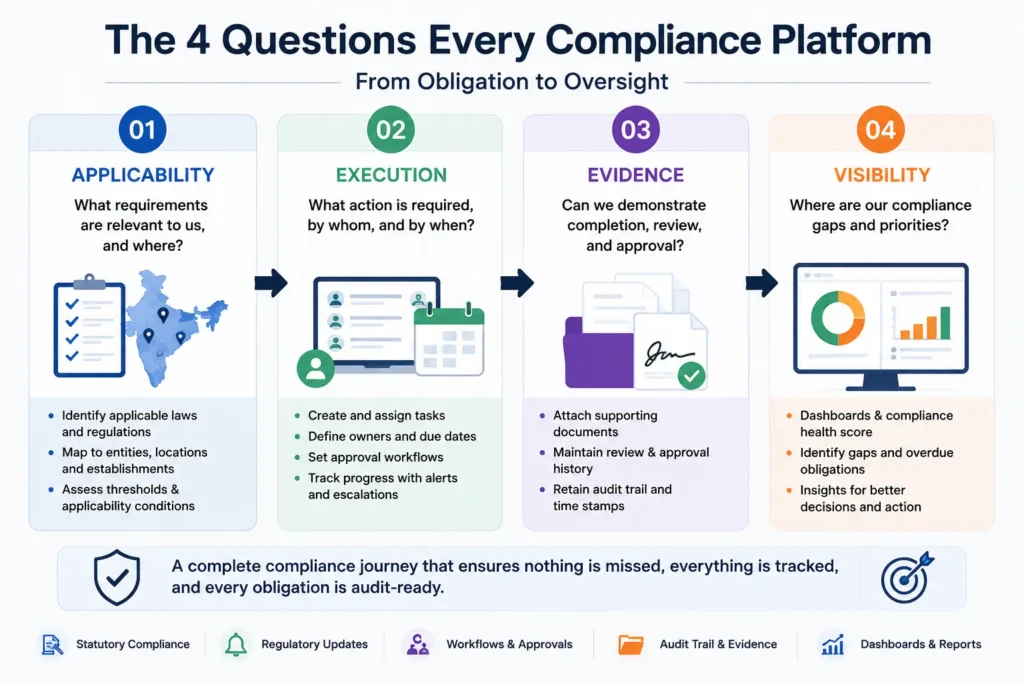
| Evaluation Area | Question to Ask |
| Applicability | What requirements are relevant to us, and where? |
| Execution | What action is required, who owns it, and when must it be completed? |
| Evidence | Can we demonstrate completion, review, and approval? |
| Visibility | Which unresolved issues require management attention? |
This Applicability → Execution → Evidence → Visibility model is the evaluation framework used in this guide. It is intended to help buyers compare business outcomes rather than marketing terminology.
1. Applicability: What Actually Applies to Your Organisation?
A large regulatory library has limited operational value if your team must still manually determine which requirements affect which locations.
Depending on the applicable legislation and rules, statutory obligations may vary according to factors such as state or Union Territory, legal entity, establishment, business activity, industry, employee strength, workforce composition, contractor arrangements, and applicable thresholds.
Consider a business operating establishments in several states. A new regulatory requirement may affect only certain establishments. The compliance team needs to move beyond simply knowing that a notification exists. It needs to determine: Is this relevant to our organisation? Which establishments require action? What needs to change?
This is why regulatory coverage and applicability management should be evaluated separately.
Test this during the demo: “A regulatory change affects establishments in only two of the states where we operate. Show us how your platform identifies the potentially affected operations and how the applicability decision is reviewed.”
2. Execution: Can a Requirement Be Driven to Closure?
Knowing what applies does not complete the obligation. A compliance-management process must translate the requirement into accountable action.
For each applicable requirement, the organisation may need to establish the required action, responsible establishment, owner, due date, reviewer, approver, supporting documentation, and closure status.
Depending on organisational controls, the workflow may resemble: Applicable Requirement → Assigned Action → Preparation → Review → Approval → Evidence → Closure.
This becomes particularly important when responsibility is distributed across HR, Payroll, Legal, Finance, Procurement, Compliance, Operations, local establishments, and external vendors.
Test this during the demo: “Show us one compliance obligation from assignment through final closure, including every person who interacted with it.” The objective is to determine whether the software creates genuine process control or simply a digital to-do list.
3. Evidence: What Proves the Activity Was Completed?
A completed status is not the same as supporting evidence. Depending on the requirement, an organisation may need to demonstrate what action was completed, when it was completed, who performed it, who reviewed it, who approved it, which supporting records were used, which document was final, and what subsequent action occurred.
This information can become important during audits, inspections, internal reviews, vendor reviews, and due diligence.
Test this during the demo: Don’t ask only “Do you maintain an audit trail?” Ask: “Open a completed activity and show us the full chain from assignment to evidence and approval.”
4. Visibility: Can Decision-Makers Identify Where Intervention Is Needed?
Operational teams may work with hundreds or thousands of individual activities. Senior management should not need to inspect them individually to understand compliance status.
Depending on role and responsibility, decision-makers may need visibility into overdue obligations, unresolved gaps, establishments requiring attention, approaching licence or registration expiries, vendor issues, regulatory changes awaiting action, and compliance areas showing weaker performance.
Therefore, the value of a dashboard is not the number of charts it contains. Its value is whether it helps management determine: “Where do we need to act?”
Test this during the demo: “Assume our Compliance Head has five minutes. Show us how they would identify the highest-priority unresolved issues.”
Has Your Current Compliance Process Reached Its Limit?
Spreadsheets remain useful tools, particularly for organisations with relatively straightforward requirements. The issue emerges when the operating model becomes more complex than the process supporting it.
Dedicated compliance-management technology may be worth evaluating when:
- Different establishments maintain separate compliance records.
- Several departments share responsibility for statutory activities.
- Regulatory changes require significant manual review and distribution.
- Compliance ownership depends heavily on individual follow-up.
- Management reporting requires repeated consolidation.
- Licences and registrations are maintained through separate processes.
- Vendor evidence is difficult to review centrally.
- Audit preparation requires substantial reconstruction of past activity.
- Responsibility or approval history is difficult to establish.
- Leadership cannot readily identify unresolved compliance exposure.
The real test is whether the current process can consistently: determine what applies → drive it to closure → preserve evidence → surface unresolved exposure.
Key Capabilities to Evaluate
Compliance Applicability Mapping
Determine how requirements are mapped to entities, establishments, jurisdictions, workforce characteristics, business activities, and relevant statutory conditions. Also ask who validates applicability and how it is updated when circumstances change.
Multi-Jurisdiction Management
For organisations operating across India, evaluate whether compliance can be managed according to State/Union Territory, entity, establishment, applicable regulation, and compliance domain. Test coverage against jurisdictions where your organisation actually operates.
Regulatory Change Management
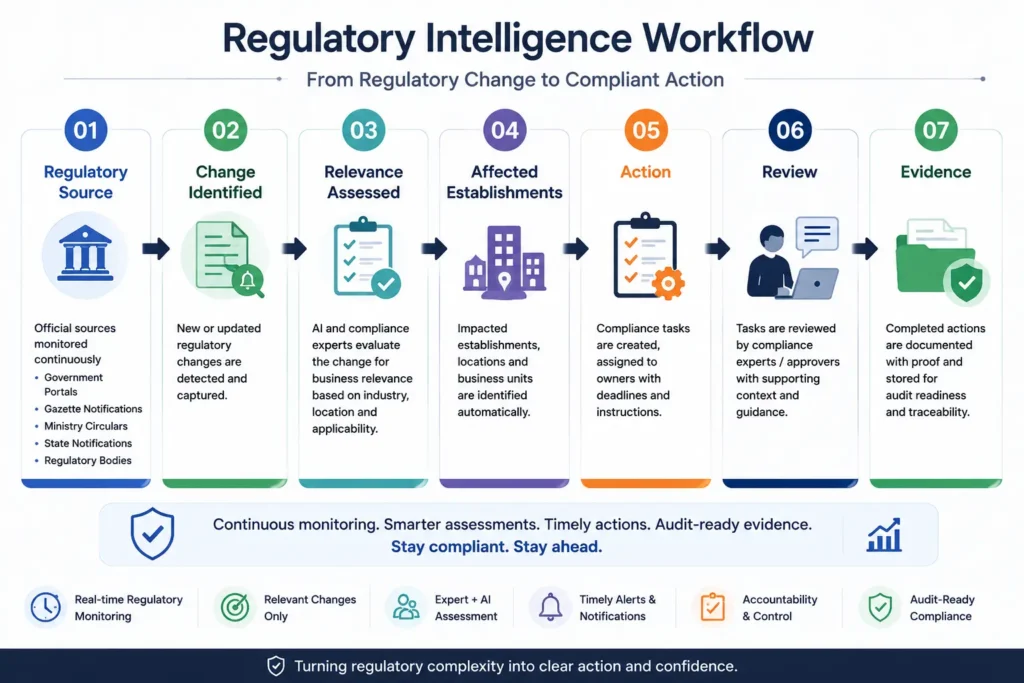
Evaluate whether the platform can support: Regulatory Source → Change Identified → Business Relevance Assessed → Affected Establishments Identified → Action Assigned → Review Completed → Evidence Retained. The degree of automation and human involvement will differ between platforms.
Compliance Calendar and Escalations
Evaluate how the system handles due dates, upcoming requirements, ownership, alerts, escalations, completion, supporting evidence, and historical status.
Approval Controls
Where segregation of duties is required, determine whether the platform supports structured Preparation → Review → Approval → Closure and whether workflows can reflect your governance structure.
Licence and Registration Management
Evaluate registrations, licences, validity periods, renewals, supporting records, ownership, alerts, and escalations.
Statutory Records
Where applicable, determine whether the system supports relevant statutory records and prescribed formats. Verify current coverage for jurisdictions where your organisation operates.
Vendor and Contractor Compliance
Depending on the product, capabilities may include vendor-specific requirements, document collection, evidence review, audit workflows, findings, compliance indicators, escalations, and historical records.
Integrations
Determine how the platform interacts with HRMS, Payroll, ERP, accounting platforms, and document-management systems. Ask whether integrations are native, API-based, custom, or third-party dependent.
What Type of Compliance Management Software Should You Evaluate?
Comparison of compliance software categories to help businesses choose between statutory compliance, RegTech, GRC, HRMS/Payroll and industry-specific platforms.
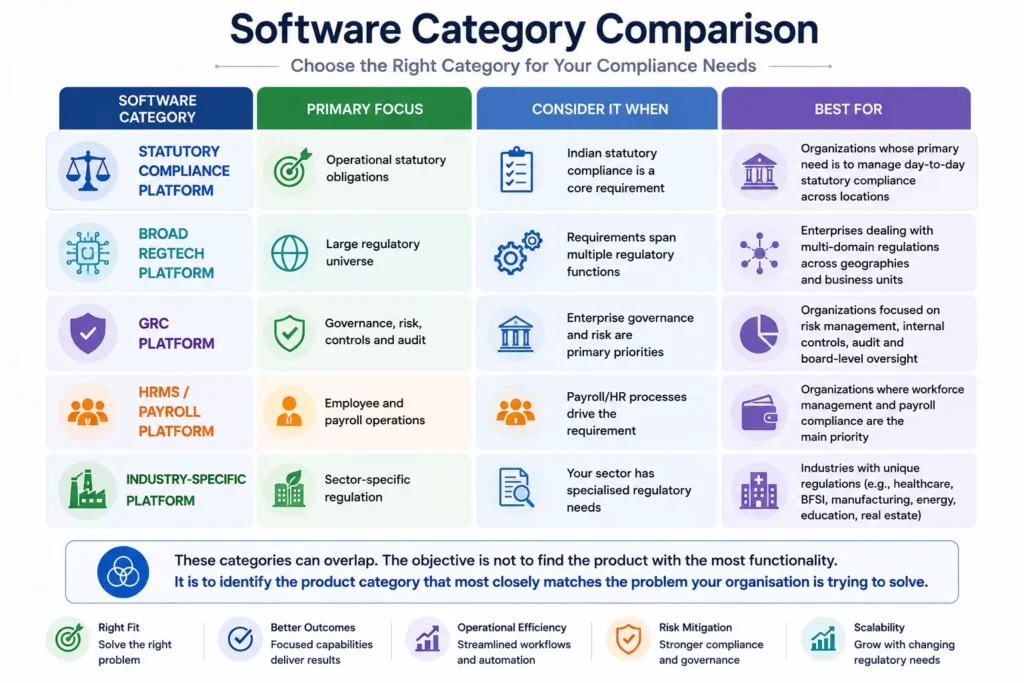
| Software Category | Primary Focus | Consider It When |
| Statutory compliance platform | Operational statutory obligations | Indian statutory compliance is a core requirement |
| Broad RegTech platform | Large regulatory universe | Requirements span multiple regulatory functions |
| GRC platform | Governance, risk, controls and audit | Enterprise governance and risk are primary |
| HRMS/Payroll platform | Employee and payroll operations | Payroll/HR processes drive the requirement |
| Industry-specific platform | Sector-specific regulation | Your sector has specialised regulatory needs |
These categories can overlap. The objective is not to find the product with the most functionality. It is to identify the product category that most closely matches the problem your organisation is trying to solve.
Compliance Management Software Options in India
TeamLease RegTech — RegTrack
TeamLease RegTech describes RegTrack as supporting statutory compliance, internal compliance, licence management, task management, workflows, document management, alerts, dashboards, and regulatory updates. TeamLease currently publishes figures of 1,536 Acts, 69,233 compliances and 6,618 filings across 28 states, 8 Union Territories and local bodies. These are vendor-published figures and should be independently confirmed during procurement if material to the buying decision.
Simpliance
Simpliance describes its Regulatory Compliance Management offering as providing regulatory intelligence, configurable compliance requirements, automated alerts, issue management, regulatory reporting, dashboards, and compliance risk scores. Its published positioning has a significant focus on Indian labour-law and statutory compliance.
Ricago
Ricago’s published offering includes compliance-management technology, labour-compliance services, and audit/vendor-management functionality. Its published product information describes compliance libraries, workflows, dashboards, document management, regulatory information, vendor audits, and integration capabilities.
HRMS and Payroll Platforms
Some HRMS and payroll products provide functionality for payroll-related statutory processes. These may be suitable where payroll and employee administration are the primary requirements. Organisations seeking broader statutory governance should separately evaluate applicability, regulatory changes, licences, contractor/vendor compliance, statutory records, audit trails, and management visibility.
IZTTY
IZTTY’s current product documentation positions the platform around six operational areas: Labour, Factory, Shops & Establishment, Payroll, Vendor, and Contract Labour / CLRA. These are product categories rather than statements that the legacy legal framework remains unchanged. Actual obligations should be evaluated against current applicable legislation, including the Labour Codes and relevant Central and State rules where applicable.
Don’t Compare Compliance Software by Feature Count Alone
| Common Question | Better Evaluation Request |
| Do you provide regulatory updates? | Show how an update reaches the establishments that may need action |
| Do you have dashboards? | Show how management identifies unresolved exposure |
| Do you cover multiple states? | Demonstrate requirements for jurisdictions where we actually operate |
| Do you manage vendors? | Show one vendor from requirement through evidence review |
| Do you have AI? | Show what the AI produces, what context it uses, and who validates the output |
| Do you provide audit trails? | Show the history of one completed obligation |
| Do you manage licences? | Show an upcoming renewal through escalation and closure |
Compliance Management Software vs Spreadsheet-Based Management
Spreadsheet-based compliance vs a dedicated compliance platform: comparing how each approach manages workflows, deadlines, evidence, oversight and reporting.
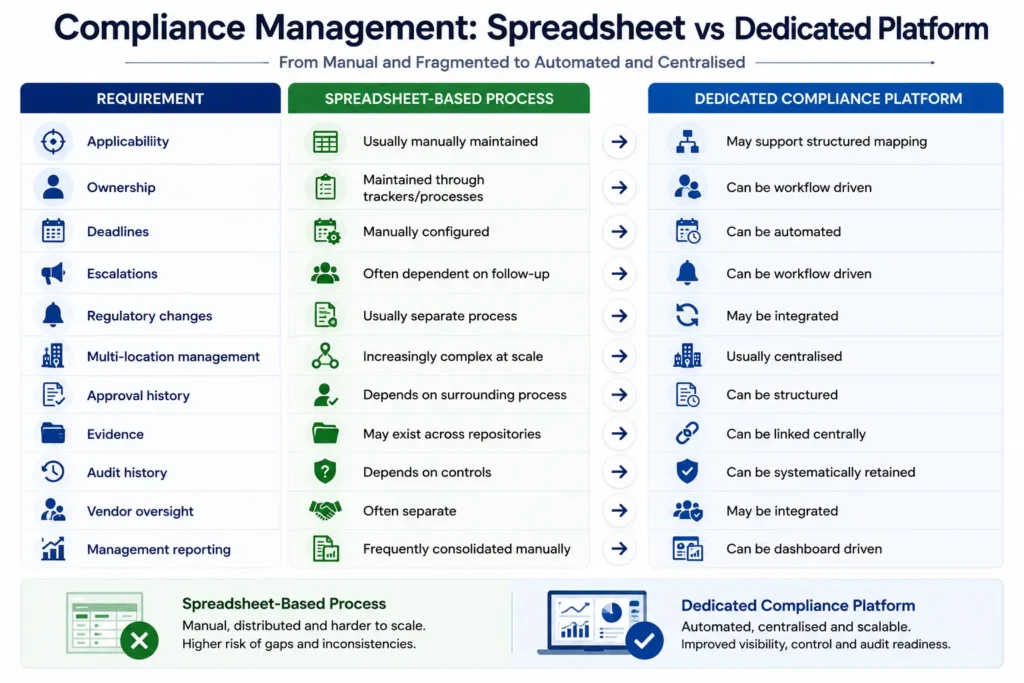
| Requirement | Spreadsheet-Based Process | Dedicated Compliance Platform |
| Applicability | Usually manually maintained | May support structured mapping |
| Ownership | Maintained through trackers/processes | Can be workflow driven |
| Deadlines | Manually configured | Can be automated |
| Escalations | Often dependent on follow-up | Can be workflow driven |
| Regulatory changes | Usually separate process | May be integrated |
| Multi-location management | Increasingly complex at scale | Usually centralised |
| Approval history | Depends on surrounding process | Can be structured |
| Evidence | May exist across repositories | Can be linked centrally |
| Audit history | Depends on controls | Can be systematically retained |
| Vendor oversight | Often separate | May be integrated |
| Management reporting | Frequently consolidated manually | Can be dashboard driven |
These are typical characteristics, not universal capabilities. Actual functionality depends on the platform and implementation.
Compliance Management Software vs Payroll/HRMS
The distinction becomes clearer when you start with the business problem. If the primary questions are: How do we process payroll? How do we calculate salaries? How do we manage employee records? A payroll/HRMS platform is likely the appropriate category to evaluate first.
If the questions are: What statutory requirements apply? What is outstanding? Which establishment is exposed? What changed? Who approved the activity? Where is the evidence? A dedicated compliance-management platform may be more relevant.
The systems can complement each other rather than necessarily replace one another.
How Much Does Compliance Management Software Cost?
There is no universal pricing model. Depending on the vendor, commercial terms may be influenced by:
- Number of legal entities
- Locations
- Users
- Modules
- Regulatory scope
- Integrations
- Implementation
- Data migration
- Customisation
- Training
- Support
Some products publish subscription plans, while enterprise platforms may provide customised quotations. For meaningful comparison, request a breakdown covering: Software + Implementation + Integration + Migration + Customisation + Support.
Also ask about renewal terms, additional users, additional locations, new modules, integration charges, custom development, and support levels.
How to Choose the Right Compliance Management Software
Step 1: Define Your Operating Environment
- Legal entities
- States and Union Territories
- Establishments
- Factories, where relevant
- Employees
- Vendors
- Contractors
- Compliance domains
- Licences
- Registrations
Step 2: Identify Where Control Breaks Down
- Where do obligations get delayed?
- Which activities require repeated intervention?
- Where is applicability difficult to determine?
- Which evidence is hardest to retrieve?
- Which reports take the longest to prepare?
- Where is responsibility unclear?
- What information does management currently lack?
Step 3: Build an Evaluation Scorecard
| Requirement | Example Priority |
| Multi-jurisdiction management | Must Have |
| Regulatory change management | Must Have |
| Audit history | Must Have |
| Approval controls | Must Have |
| Vendor compliance | Depends on operating model |
| HRMS/payroll integration | Should Have |
| Compliance health indicators | Should Have |
| AI-assisted notice analysis | Should Have / Nice to Have |
The priorities should reflect your organisation rather than this example.
Step 4: Use the Same Scenario for Every Vendor
Instead of allowing each vendor to choose its strongest demonstration, give all shortlisted providers the same operational scenario.
Example: “Our organisation operates 50 establishments across multiple Indian states. A regulatory change potentially affects only some locations. Show us how your platform takes this from regulatory identification through applicability review, assignment, approval, evidence, and management reporting.”
You are testing the complete chain: Applicability → Execution → Evidence → Visibility.
Step 5: Examine Implementation, Not Just Product Functionality
- Who configures applicability?
- Who validates it?
- How are existing records migrated?
- How are workflows configured?
- How are integrations implemented?
- How are users trained?
- What support exists after go-live?
- How are regulatory updates maintained?
A platform’s practical value depends on both technology and implementation.
Where AI Can Add Value—and Where Human Review Still Matters
AI-enabled compliance systems may assist with tasks such as:
- Regulatory-document analysis
- Information extraction
- Change categorisation
- Potential relevance assessment
- Regulatory-notice analysis
- Draft preparation
- Compliance-gap prioritisation
Capabilities differ considerably between products. For this reason, “AI-powered” should not itself be a buying criterion.
- What task is AI performing?
- Which information is being used?
- Can the output be traced and reviewed?
- What happens when the system is uncertain?
- Who approves the resulting action?
AI-generated output should not automatically be treated as a definitive legal conclusion. Appropriate human and professional review remains important for material statutory-compliance decisions.
Where IZTTY Fits Into This Evaluation Framework
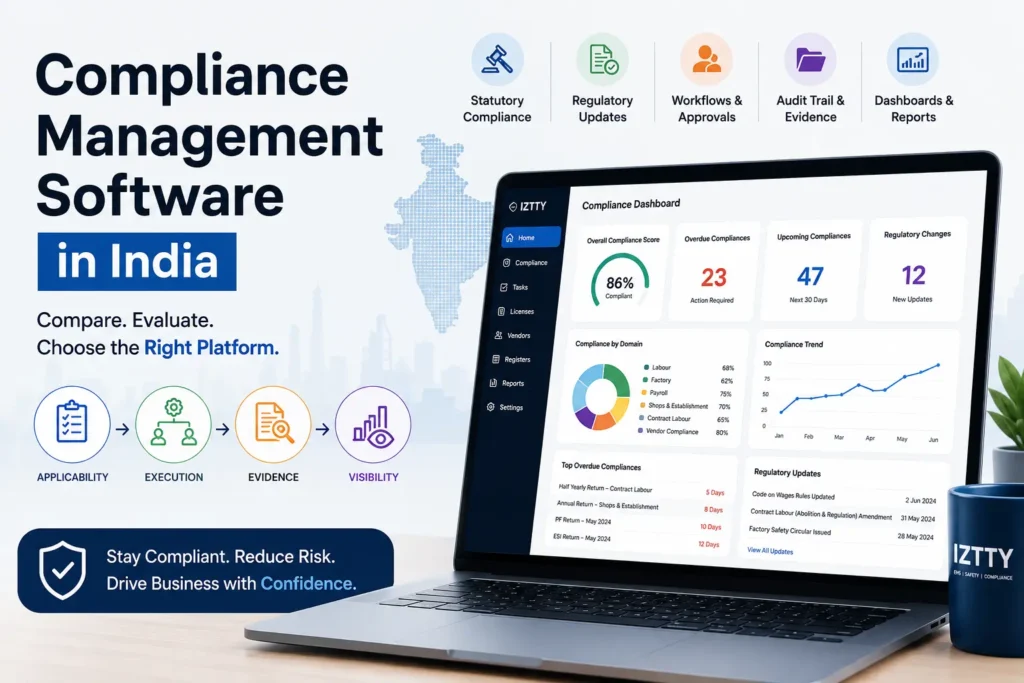
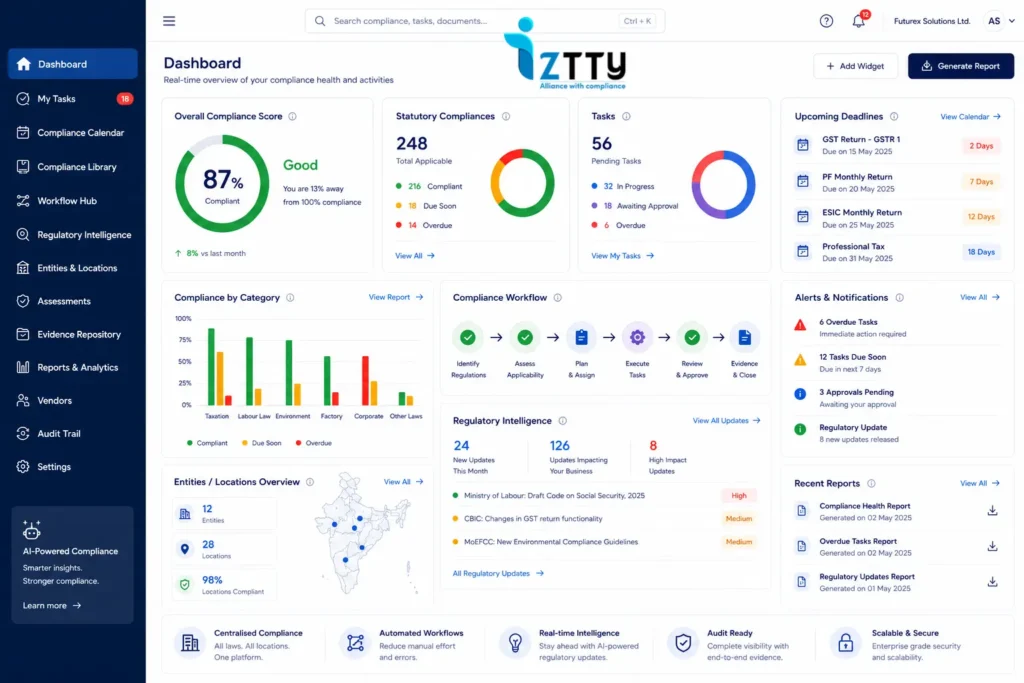
Compliance management dashboard providing centralised visibility into compliance scores, tasks, deadlines, workflows, regulatory updates and reporting.
The following section describes capabilities based on IZTTY’s current published product documentation. Buyers should validate them against their own requirements during product evaluation.
Applicability
IZTTY states that its Regulatory Change Intelligence monitors regulatory sources and analyses changes using organisational context to identify potentially relevant requirements. Its published process also includes human review of identified changes and generated actions.
Execution
IZTTY positions its platform across Labour, Factory, Shops & Establishment, Payroll, Vendor, and Contract Labour / CLRA. Its published Maker-Checker-DSC workflow is designed around preparation, review, approval/rejection, and digital signing. Buyers should ask IZTTY to demonstrate these workflows using requirements relevant to their own establishments.
Evidence
IZTTY’s product documentation describes supporting documentation and audit-trail functionality within structured workflows. The most useful way to evaluate this capability is to inspect a completed workflow from original assignment through final approval and retained evidence.
Visibility
IZTTY describes its Compliance Score Meter as a live compliance-health view across dimensions including company, branch, act, and state. According to IZTTY’s published information, the scoring model considers timely filings, active licences and registrations, statutory registers, vendor audit compliance, and open regulatory gaps. Buyers should review the methodology and determine whether the score reflects their risk and governance priorities.
See How IZTTY Manages End-to-End Statutory Compliance
How IZTTY Describes Its AI Capabilities
IZTTY’s AI-powered compliance architecture combines AI Notice Response, Regulatory Intelligence and Compliance Score Meter with human review and oversight.
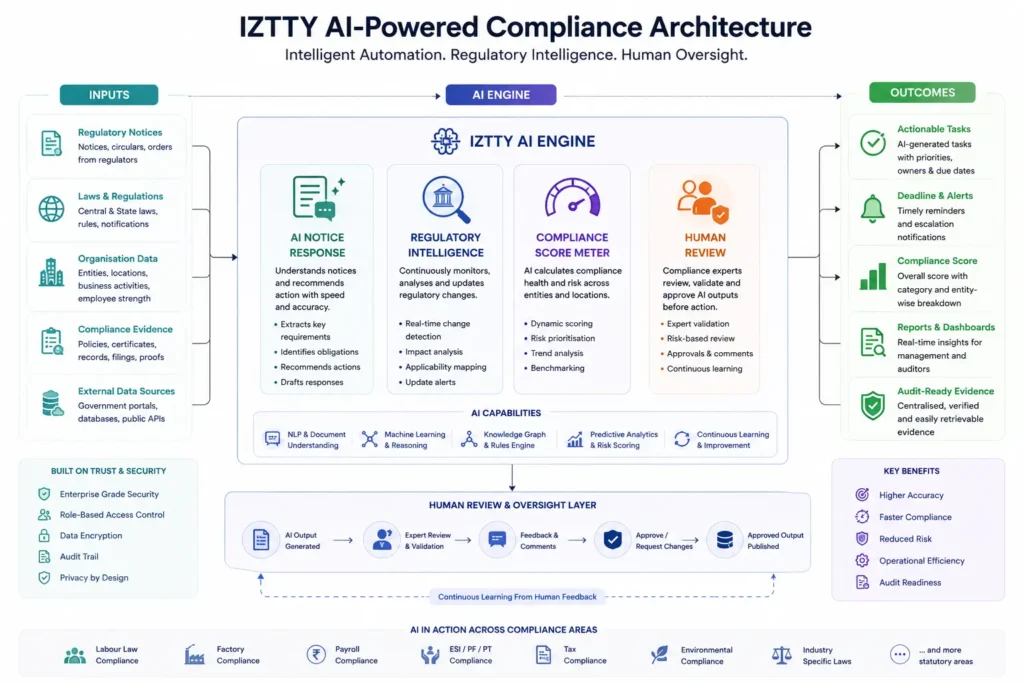
AI Notice Response Assistant
The capability is designed to assist with regulatory-notice analysis, evidence mapping, and preparation of draft responses.
Regulatory Change Intelligence
The platform is designed to monitor regulatory sources, analyse changes, assess potential organisational relevance, and generate structured actions.
Human Review
IZTTY states that AI-generated notice responses and regulatory-change actions remain subject to human review. These capabilities should be validated during a product demonstration rather than treated as independent performance findings.
When Might IZTTY Belong on Your Shortlist?
Based on its published positioning, IZTTY may be relevant for organisations that need to manage significant Indian statutory compliance across:
- Multiple establishments
- Multiple jurisdictions
- Labour-related requirements
- Factory operations
- Shops & Establishment requirements
- Payroll-related statutory processes
- Vendors and contractors
- Contract-labour requirements
It may also be relevant where the organisation is specifically looking for:
- Structured approval controls
- Regulatory-change monitoring
- Centralised compliance evidence
- Compliance-health visibility
- AI-assisted workflows with human review
This does not make IZTTY the appropriate platform for every compliance requirement. An organisation primarily seeking global GRC, cybersecurity compliance, financial-services regulatory management, ESG reporting, or another specialised framework should also evaluate products designed specifically for those areas.
Frequently Asked Questions
What is compliance management software?
Compliance management software provides a structured way to manage regulatory and statutory requirements, including ownership, deadlines, workflows, supporting evidence, monitoring, and reporting.
Who should use compliance management software?
It may be particularly useful where compliance needs to be coordinated across multiple entities, establishments, jurisdictions, teams, vendors, or regulatory requirements.
What should I look for in compliance management software?
Start by evaluating whether the platform can support four requirements: Applicability → Execution → Evidence → Visibility. Then examine regulatory coverage, workflows, audit history, licence management, vendor compliance, integrations, reporting, security, implementation, and support.
What is statutory compliance management software?
It is software focused on operational obligations arising from applicable laws and regulations, which may include filings, returns, licences, registrations, statutory records, deadlines, approvals, and audits.
Is compliance management software the same as GRC software?
Not necessarily. GRC platforms commonly address broader governance, risk, controls, policies, and audit requirements. Statutory compliance platforms may focus more deeply on recurring operational regulatory obligations. There can be overlap between the categories.
Can compliance management software replace Excel?
It can reduce or replace many spreadsheet-driven processes when an organisation requires more structured ownership, workflows, evidence, regulatory monitoring, and reporting. Whether replacement is necessary depends on the complexity of the organisation and its existing controls.
Can compliance software manage multiple Indian states?
Some platforms are designed specifically for multi-jurisdiction compliance. Buyers should verify the actual state/Union Territory coverage, regulatory depth, applicability process, and update methodology relevant to their own locations.
How can AI be used in compliance management?
Depending on the product, AI may assist with document analysis, information extraction, regulatory-change categorisation, potential relevance assessment, notice analysis, draft preparation, and prioritisation. AI output should be reviewed appropriately before material compliance action is taken.
Can AI replace compliance professionals?
AI and automation can support compliance teams, but they should not be assumed to replace professional judgement for legal interpretation, applicability, exceptions, notices, or complex regulatory matters.
How much does compliance management software cost?
Pricing varies and may be influenced by users, entities, locations, modules, regulatory scope, implementation, integrations, customisation, and support. Businesses should compare total cost of ownership rather than subscription price alone.
Final Evaluation Checklist
Applicability: Can the system connect relevant requirements to the entities and establishments where action may be required?
Execution: Can those requirements be converted into accountable workflows and driven through review and closure?
Evidence: Can the organisation retrieve a reliable record of what happened, when, by whom, and with what supporting documentation?
Visibility: Can decision-makers quickly identify unresolved issues requiring attention?
Then verify:
- Regulatory coverage relevant to your operations
- State and Union Territory coverage
- Applicability methodology
- Regulatory update process
- Compliance calendars
- Approval controls
- Licence and registration management
- Statutory records
- Vendor/contractor workflows
- Audit history
- Integrations
- Data security
- AI governance
- Implementation model
- Scalability
- Support
- Total cost of ownership
Require vendors to demonstrate these capabilities using your actual compliance environment, not only a prepared sales scenario.
From Requirement to Evidence: What Compliance Software Should Actually Deliver
A compliance platform should not simply reproduce an existing tracker in a new interface. Its practical value lies in connecting the complete operational chain:
Relevant Requirement → Accountable Action → Controlled Review → Supporting Evidence → Management Visibility
For organisations evaluating technology specifically for Indian statutory compliance, IZTTY’s published positioning combines multi-domain statutory workflows, regulatory-change intelligence, Maker-Checker-DSC controls, vendor-compliance functionality, compliance-health visibility, and AI-assisted processes.
The final question is not whether those features exist on a product page. It is whether they work for your compliance environment.
Put IZTTY Through a Real Compliance Scenario
Bring a real operating scenario to the demonstration: Your entities. Your establishments. Your jurisdictions. Your vendors. Your approval structure. Your statutory requirements.
Then ask IZTTY to demonstrate the complete process from applicability through execution, evidence, and management visibility.
Book a personalised IZTTY demo.
Author Bio:
Satyam writes about Indian statutory compliance, compliance management technology, regulatory change management, and AI-enabled compliance workflows. His content focuses on helping businesses understand how technology can support the management of complex compliance requirements across multiple establishments and jurisdictions.
Through his work on IZTTY-related content, Satyam covers topics including compliance management software, statutory compliance automation, regulatory intelligence, compliance workflows, audit readiness, and the practical application of AI in compliance operations.