A finance manager in Ludhiana opens an email from the regional EPFO office. The subject line says “Notice under Section 14B”. Three years ago, a bonus-linked contribution for one quarter was paid late because a bank holiday and a signatory’s leave landed together. Nobody thought about it again. Now the notice asks why damages should not be levied, and the amount at stake is larger than the original delay.
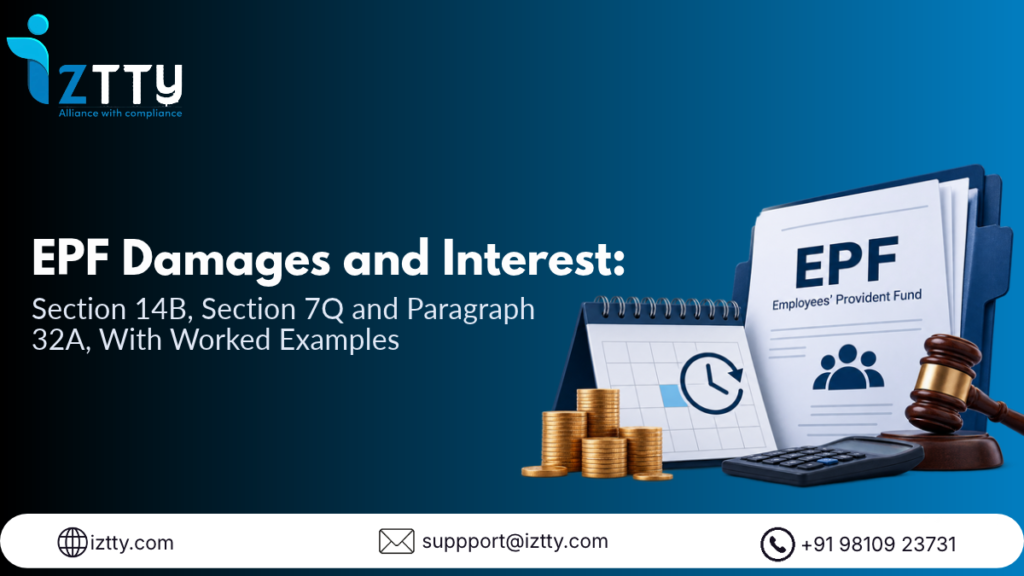
That is the usual way EPF damages arrive: quietly, years later, and as a multiple of the original default. This guide explains what EPF damages are, how they differ from interest, what Section 14B, Section 7Q and Paragraph 32A each do, how the rate changed in June 2024, what the new Code and the 2026 EPF Scheme mean for you, and how to calculate the numbers with worked examples.
Got an EPFO notice or an old contribution delay you are unsure about? Our compliance practice can review the dates and the exposure with you. GET A FREE COMPLIANCE AUDIT
Contribution, Interest and Damages: Three Different Things
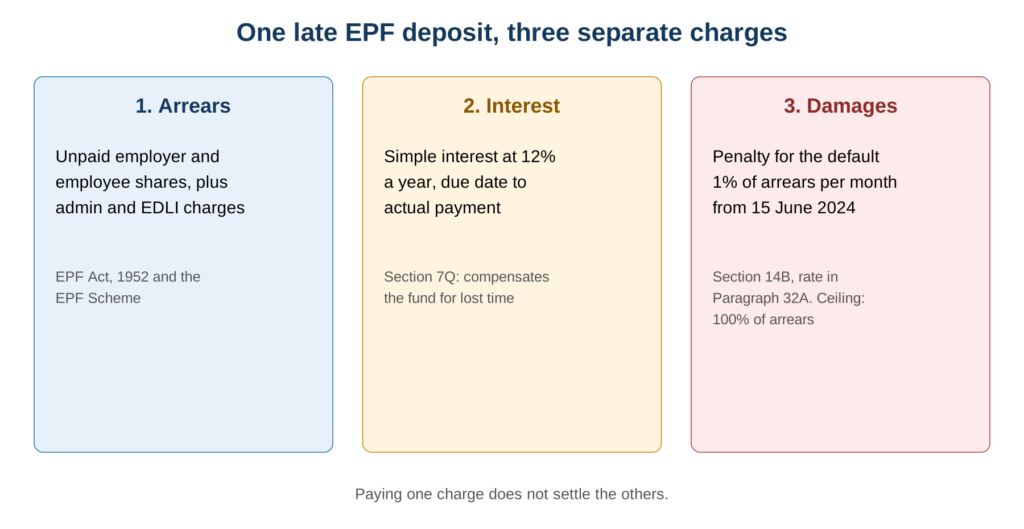
Most confusion about EPF default comes from treating three separate charges as one. Keep them apart.
| Charge | What it is | Where it comes from |
|---|---|---|
| Contribution arrears | The unpaid employer and employee share, plus administrative and EDLI charges | The EPF and Miscellaneous Provisions Act, 1952 and the EPF Scheme |
| Interest | A compensation charge for the time the money was not in the fund. Simple interest at 12 per cent a year | Section 7Q of the 1952 Act |
| Damages | A penal charge for the default itself. Rate set by the Scheme | Section 14B of the 1952 Act, quantified under Paragraph 32A of the EPF Scheme |
You owe all three when a deposit is late. Paying interest does not close the damages question, and paying damages does not replace the interest. EPFO treats them as separate demands, usually raised in separate orders.
For the monthly cycle that keeps you out of this table, see our EPF and ESIC compliance guide. This article is about what happens after the 15th has passed.
Section 7Q: Interest at 12 Per Cent
Section 7Q provides for simple interest at 12 per cent per annum on any amount due under the Act, from the date it became due until it is actually paid. Three practical points follow.
- The clock starts on the due date. For the ECR, that is the 15th of the following month.
- The clock stops on actual payment. A challan generated but not paid does not count.
- It is not discretionary. Secondary commentary on the June 2024 changes notes that the 12 per cent rate was not changed, and that no authority has power to waive it. We could not confirm that against the Act text, so check the text on India Code.
Interest is arithmetic. It is the damages piece that carries judgment, history and dispute.
Section 14B and Paragraph 32A: Damages and How the Rate Changed
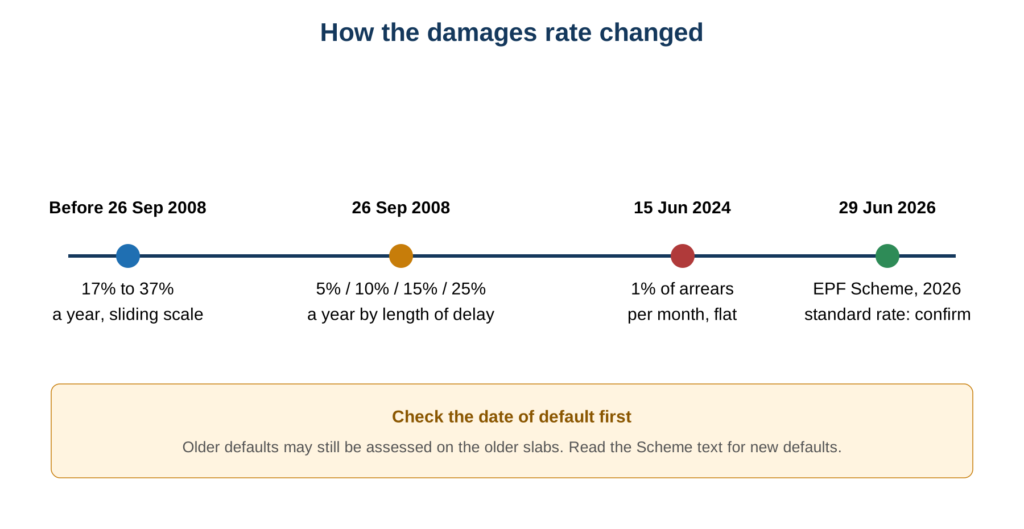
Section 14B allows the authorised officer to recover damages from an employer who defaults in paying contributions or other sums, after giving a reasonable opportunity of being heard. The ceiling is 100 per cent of the arrears. The actual rate is not in the section. It sits in Paragraph 32A of the EPF Scheme, and it has changed twice.
| Period | Damages rate under the Scheme |
|---|---|
| Before 26 September 2008 | 17 per cent to 37 per cent a year on a sliding scale. Commentary notes doubt over whether interest was folded in. |
| 26 September 2008 to 14 June 2024 | 5 per cent a year for delays up to 2 months, 10 per cent for 2 to 4 months, 15 per cent for 4 to 6 months, and 25 per cent beyond 6 months |
| From 15 June 2024 | 1 per cent of arrears for each month of default, replacing the slabs. The EPS and EDLI schemes moved to the same flat rate. |
The change was made through notifications of the Ministry of Labour and Employment published on 14 and 15 June 2024. Two consequences matter.
- The 2024 rate is not capped at 25 per cent. A default running beyond about 25 months can cross the old 25 per cent ceiling, though it can never cross the 100 per cent limit in Section 14B.
- The old slabs still apply to old defaults. Commentary on a February 2026 Karnataka High Court decision, reported as EPFO v. Enchanting Travels Pvt. Ltd., says defaults before 15 June 2024 were assessed under the old slabs because the amendment operates prospectively. We have not read the judgment itself, so confirm it before relying on it in a reply.
The practical lesson is to check the date of default before anything else. Two defaults in one notice can sit under two different rates.
What the Code on Social Security and the 2026 Scheme Change
This is the part that is not yet fully settled, so read it carefully.
- The Code is in force. The Code on Social Security, 2020 took effect on 21 November 2025 and subsumes the 1952 Act. The Social Security (Central) Rules, 2026 were notified on 8 May 2026 as G.S.R. 344(E), as the PRS Legislative Research summary records.
- Interest continues. Commentary on the notifications says employers must pay simple interest at 12 per cent a year on amounts due under the Code, from the due date until payment, and that the provision is deemed to have taken effect from 21 November 2025.
- Damages continue under the Code. Coverage of the VISHWAS 2026 circular refers to damages under Section 14B of the 1952 Act and Section 128 of the Code on Social Security, 2020, and to interest under Section 7Q and Section 127 of the Code. Check the section numbers against the Code text before you cite them in a reply.
- A new Scheme exists. The EPF Scheme, 2026 was notified on 29 June 2026 and replaces the 1952 Scheme. The sources we reviewed do not agree on whether its standard damages rate for new defaults is the flat 1 per cent a month, or a slab of 0.25, 0.50 and 1 per cent a month by length of delay. Most coverage ties the slab to the VISHWAS relief scheme for older defaults. One law-firm note reads it as the standard rate. Do not publish or act on either reading without the Scheme’s own paragraph text.
Until that is confirmed, a prudent employer plans on the flat 1 per cent a month, because it is equal to or higher than the slab at every length of delay. Treat that as a budgeting assumption, not a legal position.
Not sure which rate applies to your default dates? Our team can map each delayed month to the right period and rate. CHECK MY COMPLIANCE
Worked Examples
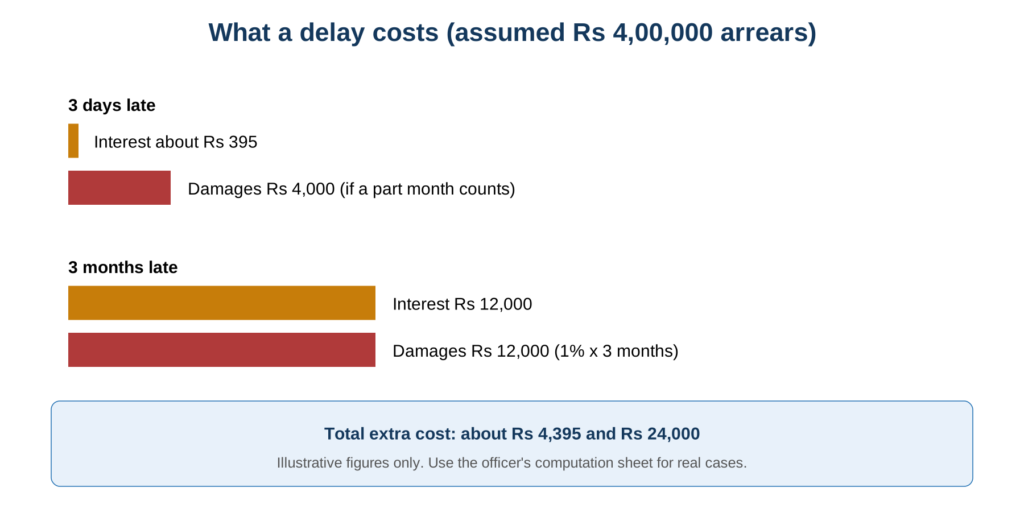
All figures below are assumed for illustration. They show the method, not a demand. EPFO’s own calculation may count months and part-months differently, so use the officer’s computation sheet for any real case.
Example 1: A three-month delay after 15 June 2024
Total arrears: Rs 4,00,000 (employer and employee shares, administrative and EDLI charges). Due on 15 January. Paid on 15 April.
| Item | Working | Amount (Rs) |
|---|---|---|
| Arrears paid late | As above | 4,00,000 |
| Section 7Q interest | 4,00,000 x 12% x 3/12 | 12,000 |
| Damages at 1% a month | 4,00,000 x 1% x 3 | 12,000 |
| Extra cost of the delay | Interest plus damages | 24,000 |
The delay costs 6 per cent of the arrears for three months, which is double the interest alone.
Example 2: A delay of only a few days
Same arrears of Rs 4,00,000, paid three days after the 15th.
| Item | Working | Amount (Rs) |
|---|---|---|
| Interest | 4,00,000 x 12% x 3/365 | about 395 |
| Damages, if a part month counts as a month | 4,00,000 x 1% x 1 | 4,000 |
Here the damages are about ten times the interest, for a three-day slip. If part months are counted as full months, as is commonly applied, that is why a payment that misses the 15th by a day costs more than most teams expect. Confirm how your regional office counts.
Example 3: An old default, before 15 June 2024, and the VISHWAS comparison
Arrears of Rs 1,00,000, left unpaid for 8 months, before 14 June 2024. Interest is simplified to the default period only, though in real life it keeps running until payment.
| Item | Working | Amount (Rs) |
|---|---|---|
| Interest (simplified) | 1,00,000 x 12% x 8/12 | 8,000 |
| Damages under the old slab (25% a year for a delay beyond 6 months) | 1,00,000 x 25% x 8/12 | about 16,667 |
| Damages under VISHWAS 2026 (1% a month for delays beyond 4 months) | 1,00,000 x 1% x 8 | 8,000 |
| Difference | Old slab minus VISHWAS | about 8,667 |
The interest is payable either way. VISHWAS reduces only the damages. Note also that commentary on the pre-2024 slabs is not consistent on whether the 25 per cent is applied pro rata or to the whole arrears, so treat the old-slab figure as a method illustration.
How a Damages Case Runs
Knowing the sequence helps you answer on time, because most of the cost of a damages case comes from missing a stage.
- Detection. A late deposit shows in the ECR data, an inspection, or an enquiry into an exit or a claim.
- Determination of dues. Where the amount is disputed, an inquiry follows under Section 7A. Our guide to the AI-assisted notice response process covers how to read the allegations and deadlines in these notices.
- Show-cause notice under Section 14B. It states the period of default and asks why damages should not be levied.
- Hearing. You can put in written submissions and documents. This is the stage where a reasoned reply helps most.
- Order. The officer passes a speaking order with the amount and the working.
- Recovery or appeal. An appeal lies to the tribunal, subject to a pre-deposit. Check the pre-deposit under the 1952 Act (Section 7O) or its counterpart in the Code before you plan an appeal.
Keep the notice, the date you received it and the reply deadline in one place. Most missed hearings are mail that sat on an unattended desk.
What Helps Your Case and What Does Not
This is the practitioner’s view, not legal advice. Take written advice for any live matter.
- Intent is usually not the test. Commentary on a 2022 Supreme Court decision, reported as Horticulture Experiment Station ((2022) 4 SCC 516), says intent is not required for Section 14B damages. That makes “we did not mean to” a weak defence by itself. Check the judgment before citing it.
- Documents help. Bank statements, approval timestamps, ECR submission logs and the reason for the delay, kept in a form an officer can read in five minutes.
- A clean history helps at the margin. A first and isolated default reads differently from a pattern across twelve months.
- Quantum can be challenged. Whether the officer applied the right rate for the right period is checkable. Compare each month to the table in Section 3.
- Sick-company relief exists in narrow cases. Commentary notes that sick companies under a sanctioned rehabilitation scheme can seek a reduction. It does not fit a normal cash-flow delay.
VISHWAS 2026: Relief for Older Defaults
If you carry an unresolved damages matter from before 14 June 2024, check this first. Reports say EPFO operationalised VISHWAS, 2026, a one-time scheme for settling damages disputes, through a circular dated 9 July 2026. The scheme is described as effective from 29 June 2026 and open for six months. Some coverage gives 28 December 2026 as the closing date. We could not confirm the exact date from the circular itself.
| Feature | As reported |
|---|---|
| Covers | Defaults before 14 June 2024, including cases under challenge, orders not yet recovered, notices without a final order, and cases where no notice has yet been issued |
| Rates | 0.25% a month for delays up to 2 months, 0.50% for 2 to 4 months, 1% for longer delays |
| Conditions | Full payment of the Section 7Q interest, an undertaking not to pursue further appeals, and compliance with EPFO’s procedure |
| Excluded | Cases already fully recovered, fraud or falsified records, and cases where interest remains unpaid |
| Pre-deposits | Counted in working out what is owed. No refund if you have already paid more than the revised damages |
Do three things this week if you think you qualify. List every pre-June 2024 default and its months of delay. Compute interest in full. Then compare damages under the old slab and under VISHWAS, as in Example 3. Read the circular itself on the EPFO website before you file anything. The scheme’s undertaking not to appeal is a one-way door.
Keeping Contributions Out of Damages Territory
Most defaults are process failures, not cash failures. A short control set removes most of the risk.
- Work back from the 15th. Set the payroll freeze, the ECR upload and the bank approval as three dated steps, not one.
- Assign a backup signatory. Leave and holidays are the single most common cause of a one-day slip.
- Reconcile before upload. Compare payroll wage totals to the ECR so a rejected file does not eat the last two days.
- Watch contractors. A contractor’s default can become yours as principal employer. Our guide to vendor compliance covers the documents to collect.
- Keep a delay register. If a payment is late, log the cause, the amount and the date paid, and pay interest immediately.
- Test your calendar. Every state and Act has its own dates. Use a single compliance calendar instead of five spreadsheets.
Where Iztty Fits
Iztty is an AI statutory compliance platform for Indian employers, built by Futurex Management Solutions Limited. For EPF default risk, the relevant published features are:
- Payroll compliance: EPF through the ECR on the 15th-of-month cycle, with ESIC, Professional Tax and LWF, and integrations with Tally, Zoho Payroll and Keka HR.
- Maker-Checker-DSC workflow: a four-stage chain of upload and validate, review or reject with remarks, digital signing and archive, so a filing is reviewed before the 15th, not after.
- AI Notice Response: reads EPF and other departmental notices, extracts the allegations and deadlines, and drafts a reply with an evidence checklist, in about 4 hours against the 3 to 5 days many teams take manually.
- Compliance Score Meter: a live 0 to 100 per cent score by Act and by state, with Low, Medium and High bands.
- Regulatory Change Intelligence: watches gazette notifications and EPFO circulars, with human review before enforcement, which matters while the 2026 Scheme settles.
As a representative example, a 40-client consultancy cut EPF and ESIC notice-response time from 5 days to 4 hours, and a 14-factory manufacturer moved its compliance score from 61 per cent to 88 per cent in 90 days. Both are anonymised and illustrative, not named case studies. Iztty does not decide your legal position or waive any charge. It helps you file on time and respond with the right documents. See the Iztty platform or the provident fund compliance page.
See how a notice and its deadlines would run through Iztty. We will walk you through a real notice flow using your own states. BOOK A DEMO
Conclusion
EPF damages come down to three questions. When did the default happen, which rate applied on that date, and what does the officer’s working sheet say for each month? Interest at 12 per cent is routine. Damages are where the money, and the argument, usually sit.
Two live points deserve your attention before the year ends. First, confirm the standard damages rate under the EPF Scheme 2026 from the Scheme’s own text, because the sources disagree. Second, if you carry a pre-June 2024 dispute, test VISHWAS 2026 before its window closes.
If you would like a second pair of eyes on a notice or a default history, CALL AN EXPERT at Futurex or ask for an audit.
FAQs
Q1: What are EPF damages?
EPF damages are a penal charge levied on an employer who is late in paying provident fund contributions or related sums. They are levied under Section 14B of the EPF and Miscellaneous Provisions Act, 1952, with the rate set in Paragraph 32A of the EPF Scheme. They are separate from interest.
Q2: What is the difference between EPF interest and EPF damages?
Interest under Section 7Q is simple interest at 12 per cent a year on the delayed amount, from the due date until actual payment. Damages under Section 14B are a penalty for the default itself. You owe both on a late deposit.
Q3: What is the current rate of EPF damages?
For defaults on or after 15 June 2024, the rate under the 1952 Scheme as amended is 1 per cent of arrears for each month of default. The EPF Scheme, 2026 was notified on 29 June 2026, and the sources we reviewed disagree on whether it keeps a flat 1 per cent or uses a slab. Check the Scheme text.
Q4: What was Paragraph 32A before June 2024?
Damages ran at 5 per cent a year for delays up to 2 months, 10 per cent for 2 to 4 months, 15 per cent for 4 to 6 months, and 25 per cent beyond 6 months. Commentary says these slabs still apply to defaults before 15 June 2024.
Q5: Is there a maximum on EPF damages?
Section 14B sets a ceiling of 100 per cent of the arrears. Under the flat monthly rate there is no separate 25 per cent cap, so a long default can exceed the old ceiling.
Q6: How do you calculate EPF damages?
Multiply the arrears by the monthly rate and by the number of months of default, counting a part month as a month where your office does so. Add interest separately at 12 per cent a year from the due date. See the worked examples in Section 5 and use the officer’s computation sheet for any real case.
Q7: Can EPF damages be waived?
Not as a matter of course. Intent is generally not required for damages, according to commentary on a 2022 Supreme Court ruling. Reductions depend on the quantum being wrongly computed or on narrow relief such as the one-time VISHWAS 2026 scheme. Take written advice on a live matter.
Q8: What is VISHWAS 2026 for EPF?
It is a one-time EPFO scheme to settle damages disputes for defaults before 14 June 2024, at 0.25 per cent a month for delays up to 2 months, 0.50 per cent for 2 to 4 months and 1 per cent beyond that. Employers must pay the Section 7Q interest in full and undertake not to appeal further. Reports describe a six-month window from 29 June 2026, with some giving 28 December 2026 as the end date. Confirm on the EPFO circular.
Q9: Does the Code on Social Security change EPF damages?
The Code took effect on 21 November 2025 and subsumes the 1952 Act. Coverage of the VISHWAS circular refers to damages under Section 128 of the Code and interest under Section 127. The rate for new defaults depends on the Scheme, so check the 2026 Scheme text.
Q10: What should an employer do on receiving a Section 14B notice?
Note the reply date, collect the deposit and bank records, check the period of default and the rate applied to each month, prepare a written reply and attend the hearing. Do not ignore it. Missing the hearing is the most avoidable way to increase the cost.
This article gives general information and is not legal advice. Confirm interpretation, rates and procedure against the Act, the Scheme, the Code and the EPFO circulars that apply to you.