What the Shop & Establishment Act Compliance Actually Regulates
The Shops and Establishments Act is a state subject, meaning every Indian state and union territory has its own version of the law, its own registration form, and its own renewal cycle. There is no single central “Shops Act.” What’s common across states is the subject matter: working hours, rest intervals, weekly holidays, opening and closing hours, employment of young persons and women, maintenance of registers for wages and leave, and the registration of the establishment itself with the local labour or municipal authority.
This is the compliance obligation that applies to almost every commercial establishment in India, retail stores, offices, IT companies, restaurants, and warehouses, regardless of whether they are also covered under the Factories Act 1948. If you run a shop, office, or commercial establishment (as opposed to a manufacturing unit that falls under the Factories Act), S&E registration is typically your first statutory obligation, not an optional one.
Not sure if your business falls under S&E or Factories Act, or both?Book a Free Compliance Audit and get a clear answer mapped to your specific operations.
Who Needs to Register: Applicability Thresholds by State
Applicability thresholds (the employee count above which registration becomes mandatory, or the point at which additional obligations like a welfare officer kick in) are not uniform. Some states require registration regardless of employee count once a commercial establishment is operational; others set a minimum headcount. Because these thresholds are amended by individual state governments from time to time, the safest approach is to confirm the current threshold with your state’s labour department or the relevant state Shops and Establishments Act notification before assuming a number from an old reference.
What is consistent across states: registration is triggered by opening the establishment for business, not by reaching a specific employee count in most states, which means many businesses register far earlier than they expect, often within 30 to 90 days of commencing operations depending on the state’s specified window.
State-wise Registration Process: Documents, Timelines, and Fees
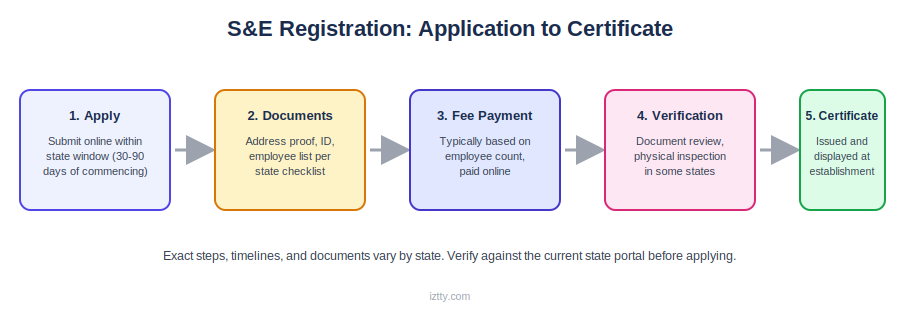
While the exact portal and form numbers vary, the registration process follows a broadly similar structure across most states:
Application submission, typically online through the state labour department’s portal, within the state-specified window from commencement of business (commonly 30 to 90 days).
Supporting documents, generally including proof of establishment address (rent agreement or property documents), identity proof of the employer, a list of employees with basic details, and in some states, a photograph of the establishment’s signboard.
Fee payment, calculated in most states based on the number of employees, payable online at the time of application.
Verification and approval, which can involve a physical inspection in some states and a purely document-based review in others.
Certificate issuance, after which the certificate must typically be displayed prominently at the establishment.
Because document requirements and portals change with state government IT modernisation drives, verify the exact current list from the relevant state labour department website before submitting, rather than relying on a document checklist from a previous filing cycle.
1, 3, 5, or 10 years (business’s choice at registration)
Karnataka
Karnataka Shops and Commercial Establishments Act, 1961
Commencement of business
Multi-year validity, state-notified
Delhi (NCT)
Delhi Shops and Establishments Act, 1954
Commencement of business
registration certificate is valid for 5 years and must be renewed before expiry
Tamil Nadu
Tamil Nadu Shops and Establishments Act, 1947
Commencement of business
Annual or multi-year, state-notified
Telangana
Telangana Shops and Establishments Act, 1988
Commencement of business
State-notified renewal cycle
Gujarat
Gujarat Shops and Establishments (Regulation of Employment and Conditions of Service) Act, 2019
Commencement of business
State-notified renewal cycle
Uttar Pradesh
Uttar Pradesh Shops and Commercial Establishments Act, 1962
Commencement of business
State-notified renewal cycle
West Bengal
West Bengal Shops and Establishments Act, 1963
Commencement of business
State-notified renewal cycle
Note: Several states have moved toward longer validity periods or one-time registration as part of ease-of-doing-business reforms in recent years. Renewal periodicity and fee slabs should always be verified against the current state notification, since these are exactly the kind of details that change without much national press coverage.
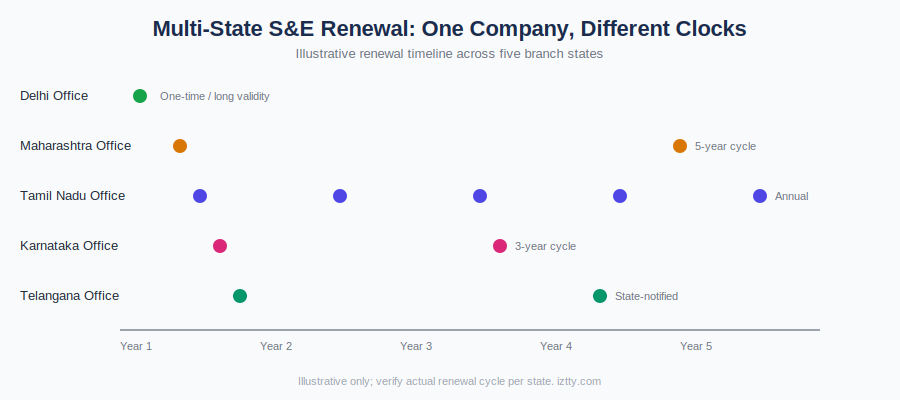
Unlike EPF or ESIC, where the compliance cycle is monthly and identical nationwide, S&E renewal cycles are set independently by each state, ranging from annual renewal to multi-year validity periods of 5 or 10 years in states that have modernised their registration frameworks. This is precisely why a multi-branch retailer or IT company operating in six states cannot manage S&E renewals on a single calendar reminder; each state licence has its own expiry date, and missing one doesn’t just risk a fine, it can affect the legal standing of the establishment to operate at that specific location.
A Plant HR Head or Admin & Legal Manager tracking this manually across multiple branches typically resorts to a shared spreadsheet with expiry dates, which works until a renewal date is entered incorrectly or a state amendment shifts a validity period retroactively, both of which happen more often than compliance teams expect.
Common Registration Mistakes That Delay Approval
Address mismatch. The registered address on the application doesn’t match the rent agreement or utility bill exactly, causing a rejection or a request for resubmission.
Wrong establishment category. Classifying an IT services office incorrectly as a “shop” versus “commercial establishment” (the categories carry different obligations in some states) leads to processing delays.
Missing employee declaration updates. Many states require the registered employee count to be kept current; failing to update it after headcount changes can flag the registration during a later inspection.
Applying under the wrong state Act for a remote or hybrid workforce. Companies with employees working from a registered office in one state but operating client-facing work in another sometimes register incorrectly, which surfaces later during a labour department query.
What Happens If You Operate Without S&E Registration
Operating a commercial establishment without valid S&E registration exposes the business to penalties under the relevant state Act, which can include fines and, in some states, the ability of the labour department to direct closure of operations until registration is completed. Beyond the direct penalty, an unregistered establishment typically cannot produce the S&E certificate that banks, landlords, government tenders, and increasingly, enterprise customers during vendor onboarding, ask for as a basic proof of legal operation.
This is also one of the first documents requested during funding due diligence for startups, since an investor’s legal team will check whether the company is operating from a properly registered establishment in every state it claims to have a presence in.
S&E Compliance for Multi-State and Multi-Branch Businesses
For a retail chain, IT services company, or logistics provider with branches across states, S&E compliance is not one registration but as many registrations as there are physical locations, each with its own renewal date, its own register format for leave and wages, and its own local labour department point of contact. A CHRO or COO overseeing this across, say, eight states needs visibility into all eight without relying on eight separate branch teams to self-report status accurately.
This is where a consolidated dashboard view, the same principle covered in our pillar guide’s section on multi-state compliance management, becomes operationally necessary rather than a nice-to-have.
How S&E Registration Connects to Your Other Statutory Obligations
S&E registration is often the first domino. Many states link Professional Tax registration and Labour Welfare Fund applicability to the existence of a valid S&E certificate, since it establishes the legal existence of the establishment at that address. If your S&E registration lapses or was never obtained for a specific branch, it can create downstream complications for Professional Tax filings and LWF contributions tied to that location.
This is why S&E compliance shouldn’t be tracked in isolation from your broader statutory calendar covering Professional Tax and Labour Welfare Fund obligations.
Manual Filing vs. a Compliance Platform: What Actually Saves Time
For a single-location business, manual S&E registration and renewal is entirely manageable with a calendar reminder and a folder of documents. The calculation changes once a business crosses three or four states, because at that point, tracking renewal dates, document formats, and category classifications correctly for each state becomes a dedicated task, not a five-minute admin job.
A dedicated platform’s value here isn’t “digitising a PDF,” it’s maintaining the correct, current register and renewal format per state (since these change with state amendments), sending tiered alerts before each state’s specific renewal date, and giving a CHRO or COO one dashboard instead of eight branch-level spreadsheets.
1. Is Shops and Establishment registration mandatory for all businesses in India? Yes, in most states, any commercial establishment, including shops, offices, and IT companies, is required to register under the applicable state Shops and Establishments Act, generally within a specified window after commencing business.
2. Is there a central Shops and Establishment Act for all of India? No, it is a state subject, so each state and union territory has its own Act, registration process, and renewal cycle, which is why requirements differ significantly between, for example, Maharashtra and Tamil Nadu.
3. How long does S&E registration take to process? This varies by state and depends on whether physical inspection is required; some states process purely online applications within a few working days, while others take longer if verification is needed.
4. Does S&E registration need to be renewed every year? Not always. Some states have moved to multi-year validity periods (3, 5, or even 10 years) as part of ease-of-doing-business reforms, while others retain annual renewal. Confirm the current cycle for your specific state.
5. What documents are needed for Shops and Establishment registration? Commonly required documents include proof of establishment address, employer identity proof, and employee details, though the exact list varies by state and should be confirmed against the current state labour department checklist.
6. What is the penalty for not registering under the Shops and Establishment Act? Penalties vary by state and can include fines and, in some cases, the labour department’s ability to restrict operations until registration is completed.
7. Does a company need separate S&E registration for each branch office? Yes, registration is typically required for each physical establishment location, since the Act applies at the establishment level, not at the company level.
8. Is S&E registration different from Factories Act registration? Yes, the Factories Act 1948 applies to manufacturing units meeting specific worker and power-usage thresholds, while the Shops and Establishments Act applies to commercial establishments like offices, shops, and retail outlets. A business could need one, the other, or neither, depending on its operations.
9. Can Shops and Establishment compliance be managed through an HRMS? Most HRMS platforms don’t natively generate state-specific S&E registers or track multi-state renewal dates; this is typically handled better by a dedicated statutory compliance platform, as covered in our complete statutory compliance guide.
10. How much does Shops and Establishment registration cost? Fees are typically calculated based on employee count and vary by state; confirm the current fee slab with your state’s labour department portal at the time of application.
Compliance Management Software in India: How to Compare and Choose the Right Platform
For organisations operating across multiple establishments, states, business units, or workforce models, statutory compliance is not simply a matter of remembering filing dates.
The harder questions are operational:
Which requirements are relevant to each establishment?
What action needs to be taken?
Who is accountable for completing and reviewing it?
What evidence demonstrates completion?
Which unresolved issues need management attention?
How should a regulatory change be translated into action across affected locations?
This is where compliance management software can help. But choosing the right platform requires more than comparing the number of laws in a database, the number of alerts generated, or the number of features on a product page.
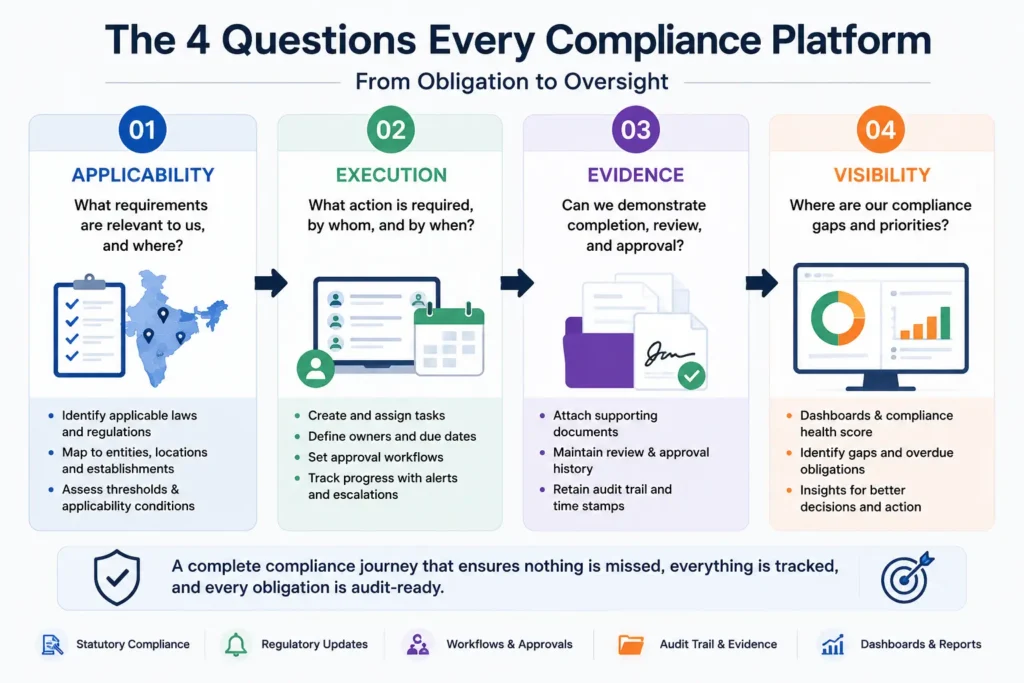
A practical compliance system should help connect four critical elements: Applicability → Execution → Evidence → Visibility
In other words, the platform should help determine what is relevant to the organisation, move required actions through controlled workflows, retain proof of completion, and give decision-makers a clear view of unresolved compliance exposure.
This guide uses that framework to help businesses evaluate compliance management software in India, understand the different types of platforms available, compare capabilities, prepare for vendor demonstrations, and determine whether a statutory compliance platform such as IZTTY belongs on their shortlist.
Table of Contents
What Is Compliance Management Software?
Compliance management software provides a structured system for determining which compliance requirements are relevant to an organisation, assigning the resulting activities, tracking them through review and closure, retaining supporting records, and giving management a consolidated view of compliance status.
Depending on the platform and regulatory scope, functionality may include:
Compliance calendars
Applicability mapping
Task ownership
Alerts and escalations
Regulatory change monitoring
Licence and registration management
Statutory documentation
Approval workflows
Vendor and contractor compliance
Evidence management
Audit trails
Dashboards and reporting
Risk indicators
AI-assisted regulatory analysis
For Indian organisations, the relevant requirements may vary according to the applicable legal framework, state or Union Territory, establishment, workforce structure, business activity, statutory thresholds, and other applicability conditions.
Key buying question: Can the platform connect relevant regulatory requirements to the actual establishments and operations where action is required?
India’s Labour Compliance Environment Has Changed
Businesses evaluating statutory compliance technology in 2026 should take account of India’s changed labour-law framework. The four Labour Codes were brought into effect from 21 November 2025, rationalising 29 existing central labour laws:
Code on Wages, 2019
Industrial Relations Code, 2020
Code on Social Security, 2020
Occupational Safety, Health and Working Conditions Code, 2020
Businesses should therefore evaluate whether their compliance processes and technology reflect the current Labour Code framework and applicable Central and State rules, rather than relying solely on legacy compliance structures.
Terms such as factory compliance, contract labour compliance, payroll compliance, and Shops & Establishments compliance may continue to be used as operational or software categories. However, actual legal obligations and applicability should always be assessed against the law and rules currently in force.
The Four Questions Every Compliance Platform Should Answer
Four key areas to evaluate in compliance management software: Applicability, Execution, Evidence and Visibility.
Evaluation Area
Question to Ask
Applicability
What requirements are relevant to us, and where?
Execution
What action is required, who owns it, and when must it be completed?
Evidence
Can we demonstrate completion, review, and approval?
Visibility
Which unresolved issues require management attention?
This Applicability → Execution → Evidence → Visibility model is the evaluation framework used in this guide. It is intended to help buyers compare business outcomes rather than marketing terminology.
1. Applicability: What Actually Applies to Your Organisation?
A large regulatory library has limited operational value if your team must still manually determine which requirements affect which locations.
Depending on the applicable legislation and rules, statutory obligations may vary according to factors such as state or Union Territory, legal entity, establishment, business activity, industry, employee strength, workforce composition, contractor arrangements, and applicable thresholds.
Consider a business operating establishments in several states. A new regulatory requirement may affect only certain establishments. The compliance team needs to move beyond simply knowing that a notification exists. It needs to determine: Is this relevant to our organisation? Which establishments require action? What needs to change?
This is why regulatory coverage and applicability management should be evaluated separately.
Test this during the demo: “A regulatory change affects establishments in only two of the states where we operate. Show us how your platform identifies the potentially affected operations and how the applicability decision is reviewed.”
2. Execution: Can a Requirement Be Driven to Closure?
Knowing what applies does not complete the obligation. A compliance-management process must translate the requirement into accountable action.
For each applicable requirement, the organisation may need to establish the required action, responsible establishment, owner, due date, reviewer, approver, supporting documentation, and closure status.
Depending on organisational controls, the workflow may resemble: Applicable Requirement → Assigned Action → Preparation → Review → Approval → Evidence → Closure.
This becomes particularly important when responsibility is distributed across HR, Payroll, Legal, Finance, Procurement, Compliance, Operations, local establishments, and external vendors.
Test this during the demo: “Show us one compliance obligation from assignment through final closure, including every person who interacted with it.” The objective is to determine whether the software creates genuine process control or simply a digital to-do list.
3. Evidence: What Proves the Activity Was Completed?
A completed status is not the same as supporting evidence. Depending on the requirement, an organisation may need to demonstrate what action was completed, when it was completed, who performed it, who reviewed it, who approved it, which supporting records were used, which document was final, and what subsequent action occurred.
This information can become important during audits, inspections, internal reviews, vendor reviews, and due diligence.
Test this during the demo: Don’t ask only “Do you maintain an audit trail?” Ask: “Open a completed activity and show us the full chain from assignment to evidence and approval.”
4. Visibility: Can Decision-Makers Identify Where Intervention Is Needed?
Operational teams may work with hundreds or thousands of individual activities. Senior management should not need to inspect them individually to understand compliance status.
Depending on role and responsibility, decision-makers may need visibility into overdue obligations, unresolved gaps, establishments requiring attention, approaching licence or registration expiries, vendor issues, regulatory changes awaiting action, and compliance areas showing weaker performance.
Therefore, the value of a dashboard is not the number of charts it contains. Its value is whether it helps management determine: “Where do we need to act?”
Test this during the demo: “Assume our Compliance Head has five minutes. Show us how they would identify the highest-priority unresolved issues.”
Has Your Current Compliance Process Reached Its Limit?
Spreadsheets remain useful tools, particularly for organisations with relatively straightforward requirements. The issue emerges when the operating model becomes more complex than the process supporting it.
Dedicated compliance-management technology may be worth evaluating when:
Different establishments maintain separate compliance records.
Several departments share responsibility for statutory activities.
Regulatory changes require significant manual review and distribution.
Compliance ownership depends heavily on individual follow-up.
The real test is whether the current process can consistently: determine what applies → drive it to closure → preserve evidence → surface unresolved exposure.
Key Capabilities to Evaluate
Compliance Applicability Mapping
Determine how requirements are mapped to entities, establishments, jurisdictions, workforce characteristics, business activities, and relevant statutory conditions. Also ask who validates applicability and how it is updated when circumstances change.
Multi-Jurisdiction Management
For organisations operating across India, evaluate whether compliance can be managed according to State/Union Territory, entity, establishment, applicable regulation, and compliance domain. Test coverage against jurisdictions where your organisation actually operates.
Regulatory Change Management
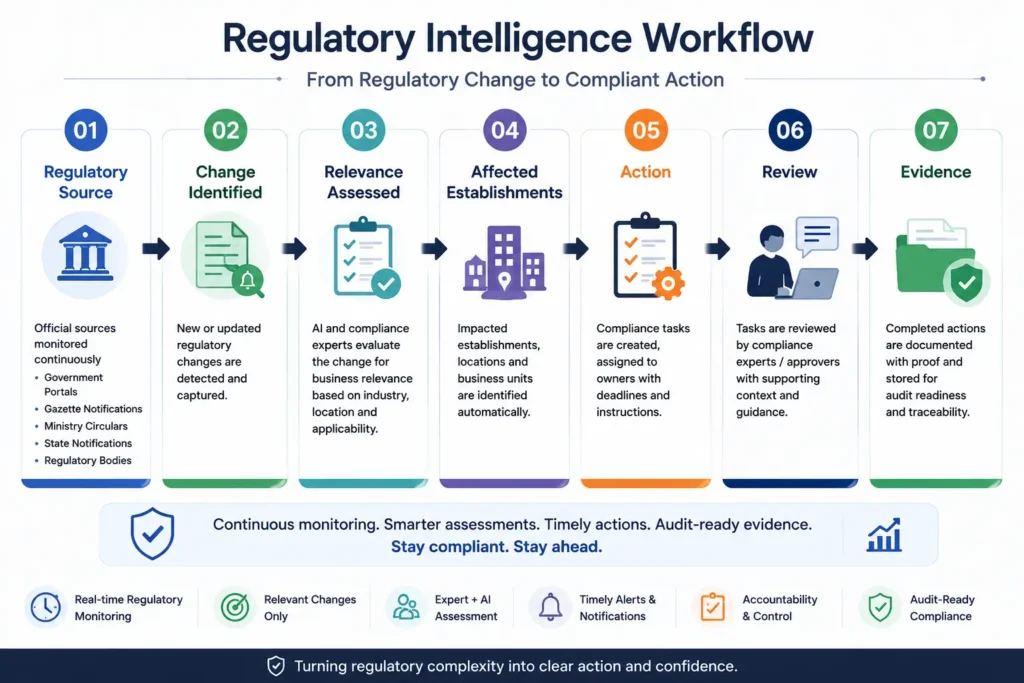
Regulatory Intelligence Workflow: From regulatory change identification and relevance assessment to accountable action, human review and audit-ready evidence.
Evaluate whether the platform can support: Regulatory Source → Change Identified → Business Relevance Assessed → Affected Establishments Identified → Action Assigned → Review Completed → Evidence Retained. The degree of automation and human involvement will differ between platforms.
Compliance Calendar and Escalations
Evaluate how the system handles due dates, upcoming requirements, ownership, alerts, escalations, completion, supporting evidence, and historical status.
Approval Controls
Where segregation of duties is required, determine whether the platform supports structured Preparation → Review → Approval → Closure and whether workflows can reflect your governance structure.
Where applicable, determine whether the system supports relevant statutory records and prescribed formats. Verify current coverage for jurisdictions where your organisation operates.
Vendor and Contractor Compliance
Depending on the product, capabilities may include vendor-specific requirements, document collection, evidence review, audit workflows, findings, compliance indicators, escalations, and historical records.
Integrations
Determine how the platform interacts with HRMS, Payroll, ERP, accounting platforms, and document-management systems. Ask whether integrations are native, API-based, custom, or third-party dependent.
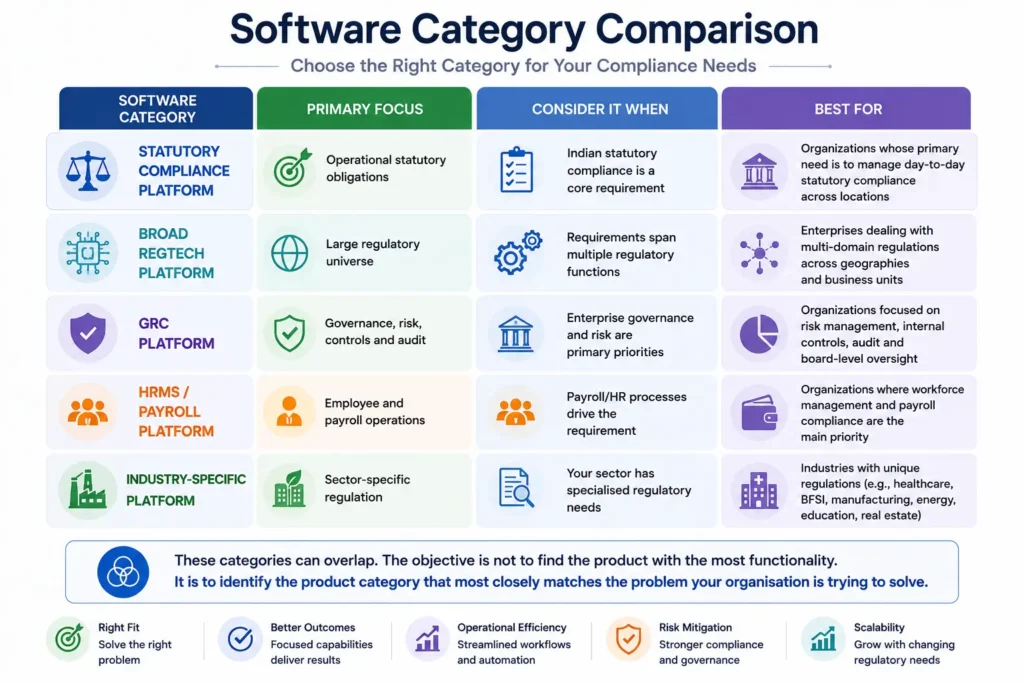
What Type of Compliance Management Software Should You Evaluate?
Comparison of compliance software categories to help businesses choose between statutory compliance, RegTech, GRC, HRMS/Payroll and industry-specific platforms.
Software Category
Primary Focus
Consider It When
Statutory compliance platform
Operational statutory obligations
Indian statutory compliance is a core requirement
Broad RegTech platform
Large regulatory universe
Requirements span multiple regulatory functions
GRC platform
Governance, risk, controls and audit
Enterprise governance and risk are primary
HRMS/Payroll platform
Employee and payroll operations
Payroll/HR processes drive the requirement
Industry-specific platform
Sector-specific regulation
Your sector has specialised regulatory needs
These categories can overlap. The objective is not to find the product with the most functionality. It is to identify the product category that most closely matches the problem your organisation is trying to solve.
Compliance Management Software Options in India
TeamLease RegTech — RegTrack
TeamLease RegTech describes RegTrack as supporting statutory compliance, internal compliance, licence management, task management, workflows, document management, alerts, dashboards, and regulatory updates. TeamLease currently publishes figures of 1,536 Acts, 69,233 compliances and 6,618 filings across 28 states, 8 Union Territories and local bodies. These are vendor-published figures and should be independently confirmed during procurement if material to the buying decision.
Simpliance
Simpliance describes its Regulatory Compliance Management offering as providing regulatory intelligence, configurable compliance requirements, automated alerts, issue management, regulatory reporting, dashboards, and compliance risk scores. Its published positioning has a significant focus on Indian labour-law and statutory compliance.
Ricago
Ricago’s published offering includes compliance-management technology, labour-compliance services, and audit/vendor-management functionality. Its published product information describes compliance libraries, workflows, dashboards, document management, regulatory information, vendor audits, and integration capabilities.
HRMS and Payroll Platforms
Some HRMS and payroll products provide functionality for payroll-related statutory processes. These may be suitable where payroll and employee administration are the primary requirements. Organisations seeking broader statutory governance should separately evaluate applicability, regulatory changes, licences, contractor/vendor compliance, statutory records, audit trails, and management visibility.
IZTTY
IZTTY’s current product documentation positions the platform around six operational areas: Labour, Factory, Shops & Establishment, Payroll, Vendor, and Contract Labour / CLRA. These are product categories rather than statements that the legacy legal framework remains unchanged. Actual obligations should be evaluated against current applicable legislation, including the Labour Codes and relevant Central and State rules where applicable.
Don’t Compare Compliance Software by Feature Count Alone
Common Question
Better Evaluation Request
Do you provide regulatory updates?
Show how an update reaches the establishments that may need action
Do you have dashboards?
Show how management identifies unresolved exposure
Do you cover multiple states?
Demonstrate requirements for jurisdictions where we actually operate
Do you manage vendors?
Show one vendor from requirement through evidence review
Do you have AI?
Show what the AI produces, what context it uses, and who validates the output
Do you provide audit trails?
Show the history of one completed obligation
Do you manage licences?
Show an upcoming renewal through escalation and closure
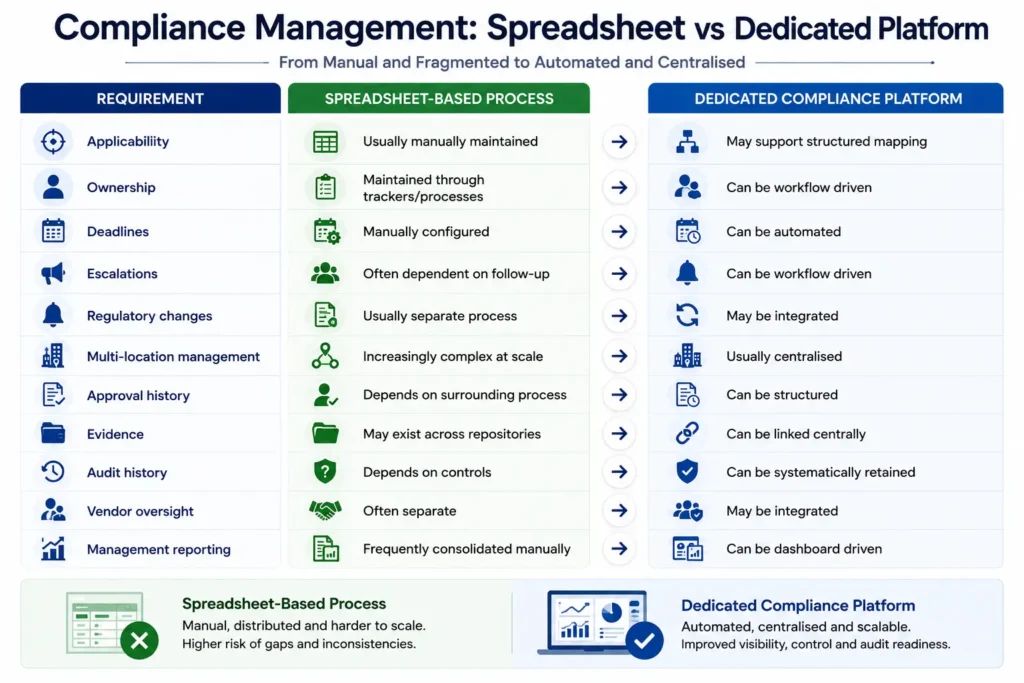
Compliance Management Software vs Spreadsheet-Based Management
Spreadsheet-based compliance vs a dedicated compliance platform: comparing how each approach manages workflows, deadlines, evidence, oversight and reporting.
Requirement
Spreadsheet-Based Process
Dedicated Compliance Platform
Applicability
Usually manually maintained
May support structured mapping
Ownership
Maintained through trackers/processes
Can be workflow driven
Deadlines
Manually configured
Can be automated
Escalations
Often dependent on follow-up
Can be workflow driven
Regulatory changes
Usually separate process
May be integrated
Multi-location management
Increasingly complex at scale
Usually centralised
Approval history
Depends on surrounding process
Can be structured
Evidence
May exist across repositories
Can be linked centrally
Audit history
Depends on controls
Can be systematically retained
Vendor oversight
Often separate
May be integrated
Management reporting
Frequently consolidated manually
Can be dashboard driven
These are typical characteristics, not universal capabilities. Actual functionality depends on the platform and implementation.
Compliance Management Software vs Payroll/HRMS
The distinction becomes clearer when you start with the business problem. If the primary questions are: How do we process payroll? How do we calculate salaries? How do we manage employee records? A payroll/HRMS platform is likely the appropriate category to evaluate first.
If the questions are: What statutory requirements apply? What is outstanding? Which establishment is exposed? What changed? Who approved the activity? Where is the evidence? A dedicated compliance-management platform may be more relevant.
The systems can complement each other rather than necessarily replace one another.
How Much Does Compliance Management Software Cost?
There is no universal pricing model. Depending on the vendor, commercial terms may be influenced by:
Number of legal entities
Locations
Users
Modules
Regulatory scope
Integrations
Implementation
Data migration
Customisation
Training
Support
Some products publish subscription plans, while enterprise platforms may provide customised quotations. For meaningful comparison, request a breakdown covering: Software + Implementation + Integration + Migration + Customisation + Support.
Also ask about renewal terms, additional users, additional locations, new modules, integration charges, custom development, and support levels.
How to Choose the Right Compliance Management Software
Step 1: Define Your Operating Environment
Legal entities
States and Union Territories
Establishments
Factories, where relevant
Employees
Vendors
Contractors
Compliance domains
Licences
Registrations
Step 2: Identify Where Control Breaks Down
Where do obligations get delayed?
Which activities require repeated intervention?
Where is applicability difficult to determine?
Which evidence is hardest to retrieve?
Which reports take the longest to prepare?
Where is responsibility unclear?
What information does management currently lack?
Step 3: Build an Evaluation Scorecard
Requirement
Example Priority
Multi-jurisdiction management
Must Have
Regulatory change management
Must Have
Audit history
Must Have
Approval controls
Must Have
Vendor compliance
Depends on operating model
HRMS/payroll integration
Should Have
Compliance health indicators
Should Have
AI-assisted notice analysis
Should Have / Nice to Have
The priorities should reflect your organisation rather than this example.
Step 4: Use the Same Scenario for Every Vendor
Instead of allowing each vendor to choose its strongest demonstration, give all shortlisted providers the same operational scenario.
Example: “Our organisation operates 50 establishments across multiple Indian states. A regulatory change potentially affects only some locations. Show us how your platform takes this from regulatory identification through applicability review, assignment, approval, evidence, and management reporting.”
You are testing the complete chain: Applicability → Execution → Evidence → Visibility.
Step 5: Examine Implementation, Not Just Product Functionality
Who configures applicability?
Who validates it?
How are existing records migrated?
How are workflows configured?
How are integrations implemented?
How are users trained?
What support exists after go-live?
How are regulatory updates maintained?
A platform’s practical value depends on both technology and implementation.
Where AI Can Add Value—and Where Human Review Still Matters
AI-enabled compliance systems may assist with tasks such as:
Regulatory-document analysis
Information extraction
Change categorisation
Potential relevance assessment
Regulatory-notice analysis
Draft preparation
Compliance-gap prioritisation
Capabilities differ considerably between products. For this reason, “AI-powered” should not itself be a buying criterion.
What task is AI performing?
Which information is being used?
Can the output be traced and reviewed?
What happens when the system is uncertain?
Who approves the resulting action?
AI-generated output should not automatically be treated as a definitive legal conclusion. Appropriate human and professional review remains important for material statutory-compliance decisions.
Where IZTTY Fits Into This Evaluation Framework
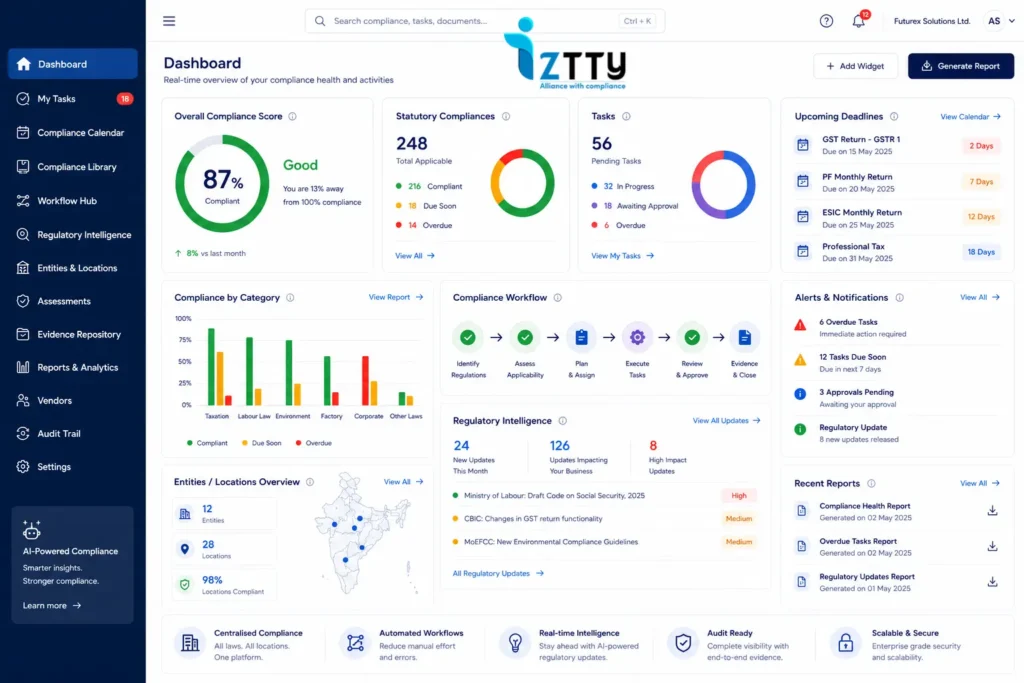
Compliance management dashboard providing centralised visibility into compliance scores, tasks, deadlines, workflows, regulatory updates and reporting.
The following section describes capabilities based on IZTTY’s current published product documentation. Buyers should validate them against their own requirements during product evaluation.
Applicability
IZTTY states that its Regulatory Change Intelligence monitors regulatory sources and analyses changes using organisational context to identify potentially relevant requirements. Its published process also includes human review of identified changes and generated actions.
Execution
IZTTY positions its platform across Labour, Factory, Shops & Establishment, Payroll, Vendor, and Contract Labour / CLRA. Its published Maker-Checker-DSC workflow is designed around preparation, review, approval/rejection, and digital signing. Buyers should ask IZTTY to demonstrate these workflows using requirements relevant to their own establishments.
Evidence
IZTTY’s product documentation describes supporting documentation and audit-trail functionality within structured workflows. The most useful way to evaluate this capability is to inspect a completed workflow from original assignment through final approval and retained evidence.
Visibility
IZTTY describes its Compliance Score Meter as a live compliance-health view across dimensions including company, branch, act, and state. According to IZTTY’s published information, the scoring model considers timely filings, active licences and registrations, statutory registers, vendor audit compliance, and open regulatory gaps. Buyers should review the methodology and determine whether the score reflects their risk and governance priorities.
See How IZTTY Manages End-to-End Statutory Compliance
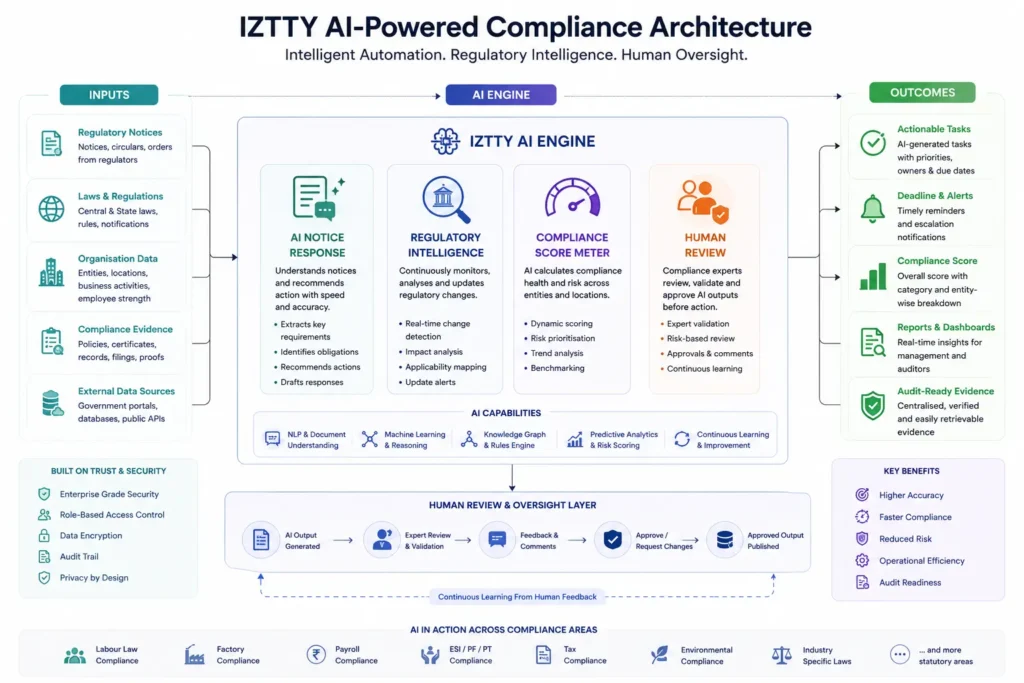
How IZTTY Describes Its AI Capabilities
IZTTY’s AI-powered compliance architecture combines AI Notice Response, Regulatory Intelligence and Compliance Score Meter with human review and oversight.
AI Notice Response Assistant
The capability is designed to assist with regulatory-notice analysis, evidence mapping, and preparation of draft responses.
Regulatory Change Intelligence
The platform is designed to monitor regulatory sources, analyse changes, assess potential organisational relevance, and generate structured actions.
Human Review
IZTTY states that AI-generated notice responses and regulatory-change actions remain subject to human review. These capabilities should be validated during a product demonstration rather than treated as independent performance findings.
When Might IZTTY Belong on Your Shortlist?
Based on its published positioning, IZTTY may be relevant for organisations that need to manage significant Indian statutory compliance across:
Multiple establishments
Multiple jurisdictions
Labour-related requirements
Factory operations
Shops & Establishment requirements
Payroll-related statutory processes
Vendors and contractors
Contract-labour requirements
It may also be relevant where the organisation is specifically looking for:
Structured approval controls
Regulatory-change monitoring
Centralised compliance evidence
Compliance-health visibility
AI-assisted workflows with human review
This does not make IZTTY the appropriate platform for every compliance requirement. An organisation primarily seeking global GRC, cybersecurity compliance, financial-services regulatory management, ESG reporting, or another specialised framework should also evaluate products designed specifically for those areas.
Frequently Asked Questions
What is compliance management software?
Compliance management software provides a structured way to manage regulatory and statutory requirements, including ownership, deadlines, workflows, supporting evidence, monitoring, and reporting.
Who should use compliance management software?
It may be particularly useful where compliance needs to be coordinated across multiple entities, establishments, jurisdictions, teams, vendors, or regulatory requirements.
What should I look for in compliance management software?
Start by evaluating whether the platform can support four requirements: Applicability → Execution → Evidence → Visibility. Then examine regulatory coverage, workflows, audit history, licence management, vendor compliance, integrations, reporting, security, implementation, and support.
What is statutory compliance management software?
It is software focused on operational obligations arising from applicable laws and regulations, which may include filings, returns, licences, registrations, statutory records, deadlines, approvals, and audits.
Is compliance management software the same as GRC software?
Not necessarily. GRC platforms commonly address broader governance, risk, controls, policies, and audit requirements. Statutory compliance platforms may focus more deeply on recurring operational regulatory obligations. There can be overlap between the categories.
Can compliance management software replace Excel?
It can reduce or replace many spreadsheet-driven processes when an organisation requires more structured ownership, workflows, evidence, regulatory monitoring, and reporting. Whether replacement is necessary depends on the complexity of the organisation and its existing controls.
Can compliance software manage multiple Indian states?
Some platforms are designed specifically for multi-jurisdiction compliance. Buyers should verify the actual state/Union Territory coverage, regulatory depth, applicability process, and update methodology relevant to their own locations.
How can AI be used in compliance management?
Depending on the product, AI may assist with document analysis, information extraction, regulatory-change categorisation, potential relevance assessment, notice analysis, draft preparation, and prioritisation. AI output should be reviewed appropriately before material compliance action is taken.
Can AI replace compliance professionals?
AI and automation can support compliance teams, but they should not be assumed to replace professional judgement for legal interpretation, applicability, exceptions, notices, or complex regulatory matters.
How much does compliance management software cost?
Pricing varies and may be influenced by users, entities, locations, modules, regulatory scope, implementation, integrations, customisation, and support. Businesses should compare total cost of ownership rather than subscription price alone.
Final Evaluation Checklist
Applicability: Can the system connect relevant requirements to the entities and establishments where action may be required?
Execution: Can those requirements be converted into accountable workflows and driven through review and closure?
Evidence: Can the organisation retrieve a reliable record of what happened, when, by whom, and with what supporting documentation?
Visibility: Can decision-makers quickly identify unresolved issues requiring attention?
Then verify:
Regulatory coverage relevant to your operations
State and Union Territory coverage
Applicability methodology
Regulatory update process
Compliance calendars
Approval controls
Licence and registration management
Statutory records
Vendor/contractor workflows
Audit history
Integrations
Data security
AI governance
Implementation model
Scalability
Support
Total cost of ownership
Require vendors to demonstrate these capabilities using your actual compliance environment, not only a prepared sales scenario.
From Requirement to Evidence: What Compliance Software Should Actually Deliver
A compliance platform should not simply reproduce an existing tracker in a new interface. Its practical value lies in connecting the complete operational chain:
For organisations evaluating technology specifically for Indian statutory compliance, IZTTY’s published positioning combines multi-domain statutory workflows, regulatory-change intelligence, Maker-Checker-DSC controls, vendor-compliance functionality, compliance-health visibility, and AI-assisted processes.
The final question is not whether those features exist on a product page. It is whether they work for your compliance environment.
Put IZTTY Through a Real Compliance Scenario
Bring a real operating scenario to the demonstration: Your entities. Your establishments. Your jurisdictions. Your vendors. Your approval structure. Your statutory requirements.
Then ask IZTTY to demonstrate the complete process from applicability through execution, evidence, and management visibility.
Satyam writes about Indian statutory compliance, compliance management technology, regulatory change management, and AI-enabled compliance workflows. His content focuses on helping businesses understand how technology can support the management of complex compliance requirements across multiple establishments and jurisdictions.
Through his work on IZTTY-related content, Satyam covers topics including compliance management software, statutory compliance automation, regulatory intelligence, compliance workflows, audit readiness, and the practical application of AI in compliance operations.